
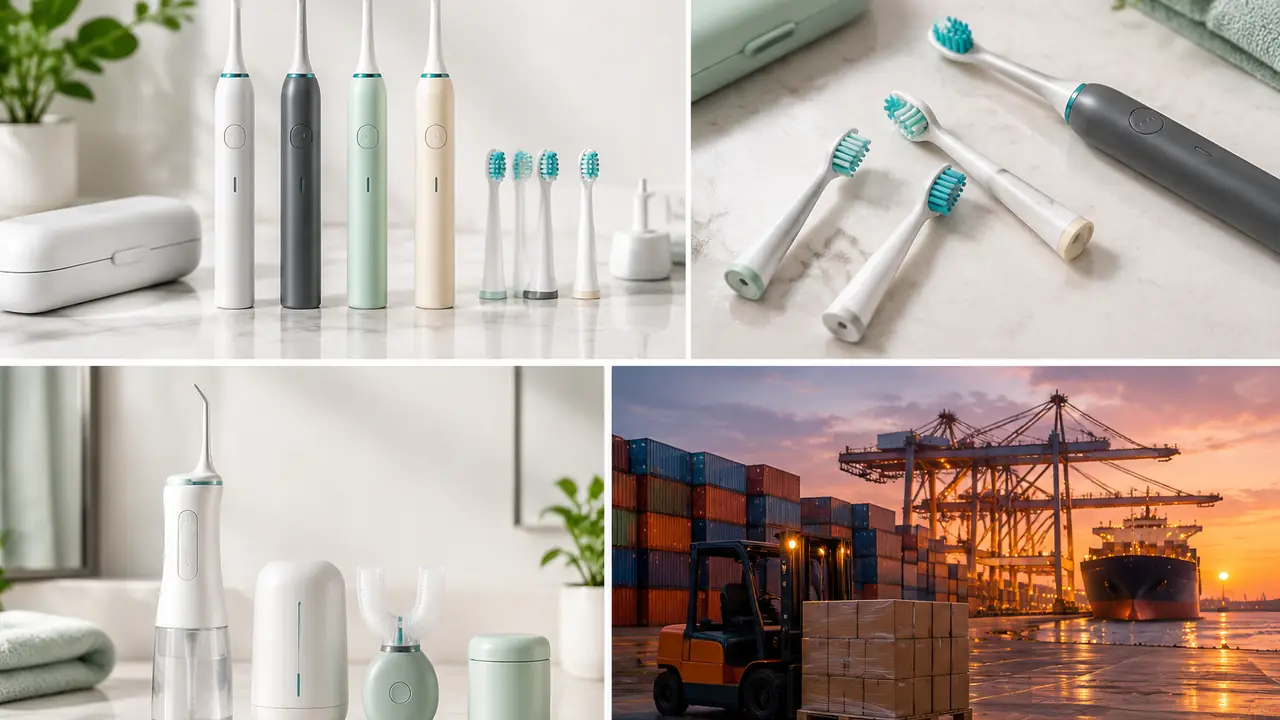
Why the category concentrates in China
China is the world's largest producer of electric toothbrushes and its second-largest consumer market, according to industry research - Zhiyan Consulting's 2026 industry report puts 2025 domestic output at roughly 192 million sets against domestic demand of about 86 million. More than half of production therefore ships abroad, led by the United States, Australia, Japan and the Netherlands. On the demand side, consumer research firms put the 2025 global market between roughly USD 3.5 and 5.4 billion, with North America the largest consumer share; estimates vary widely by scope, so treat any market figure with its source attached.
For a buyer, those numbers describe a supply base that has already solved the hard parts of the category: sonic drives, sealed shells, lithium integration, head tooling and the certification paperwork that follows them. Production concentrates in three coastal clusters, and the plants inside them run the full chain from motor supply and injection molding to SMT, assembly and packing. That depth - not any single quotation - is why sourcing conversations start here: a whole program, replacement heads included, can be built within one region. The geography is mapped on the industry clusters page.
Start with the brief, not the search
Every efficient program begins with a written brief, because plants quote what is written and guess at what is not. The brief should fix six things: the drive family (sonic, rotary, U-shaped or a battery handle), the target market (which sets the standards route), the specification band (frequency, modes, runtime, waterproofing), the customisation level (catalog shell, private label or private mold), the quantity per model and color, and the in-warehouse date. The product lines on this site publish the reference ranges a buyer can quote directly, and the spec-reading note explains which numbers to demand measurement methods for.
A clear brief also protects the buyer. Quotations gathered without one are not comparable - one plant may assume a catalog mold and a stock cell while another assumes private tooling and a custom pack - and weeks are lost reconciling assumptions that a one-page brief would have settled. Writing the brief first is the simplest schedule protection available in this category.
Shortlist by cluster, not by listing
Search results flatten the supply base; the clusters differentiate it. Matching the brief to the right region removes most of the risk before a single quotation is read.
| Cluster | What it concentrates in | Fits best |
|---|---|---|
| Guangdong - Shenzhen and Dongguan | Full electronics chain: motors, injection molding, overmolding, SMT, assembly | Smart and premium handles, deep component integration |
| Zhejiang - Ningbo and Hangzhou | Sonic toothbrush handle plants at scale | Sonic flagships and mid-tier catalog programs |
| Jiangsu - Yangzhou, Hangji town | The world's largest toothbrush base, mainly manual, extending to electric | Manual lines, value electric programs, head supply |
The attributions matter as much as the geography. Local media have reported contract plants for international-brand electric toothbrushes in the Shenzhen area; media reports cite a Zhejiang manufacturer selling more than 30 million units a year into more than 40 countries; and Chinese media reports put Hangji at about 7.5 billion toothbrushes a year and the great majority of China's toothbrush exports. None of that appears in a supplier listing, which is one more reason the desk maintains the cluster map and shortlists from it.
Samples: the first reality check
Sampling converts paper claims into objects a buyer can judge. Typical reference points: catalog (public-mold) models in 7-15 working days, private-label samples in 15-25 days, and first ODM samples in 45-90 days where new design work is involved. The test that matters is not visual. Brush with the unit, run the modes, time the quadrant prompts, cycle the head collar on and off, weigh it in hand, and soak it if the brief promises IPX7. Frequency can be checked against the datasheet with a simple tachometer; runtime is confirmed by cycling two two-minute sessions a day until the handle stops.
Compare samples from at least two plants side by side. Single-plant sampling anchors expectations to one plant's habits, and the differences between two good plants - head fit, noise, prompt feel - are exactly the differences an end customer will notice.
Verify the plant and the papers
An audit comes before the purchase order, not after a dispute. The document layer comes first: business licence, ISO 9001 certification, BSCI or SMETA social audit reports where the channel requires them, and for plants serving the US market an FDA establishment registration - a registration layer for the plant, not a product approval. Then the line walk and the quality system, from incoming materials to finished-goods checks, which the factory audit page sets out area by area.
Certifications are routes the plant completes per model, not certificates a sourcing desk holds. The appliance is tested under IEC/EN 60335-2-52 or, for North America, UL 859; the lithium cell carries UN 38.3 transport tests and IEC 62133-2; Bluetooth models add FCC Part 15 or CE RED. The desk verifies the documents per project and files them with the order. The market-by-market list is in the certifications guide.
Quantities, timing and the certification calendar
Reference minimums follow the mold, not the model:
| Program | Typical MOQ reference | Sample lead | Batch lead |
|---|---|---|---|
| Catalog mold handle | 500-1,000 pieces per model | 7-15 working days | 30-45 days |
| Private label / private mold | 1,000-3,000 pieces plus tooling | 15-25 days | 35-50 days |
| U-shaped and kids models | From about 1,000 pieces | Per program | Per program |
| Replacement heads | 5,000-10,000 pieces | Per program | Per program |
| Motors and battery packs | Ordered in thousands | - | - |
Certification timing sits alongside production: CE self-declaration with a third-party report takes roughly 2-4 weeks, UL or ETL listing 4-8 weeks, and UN 38.3 about 2-3 weeks. All of these are industry reference ranges, confirmed in writing for each program - the full schedule is on MOQ and lead time.
Inspection, shipping and the handover
A pre-shipment inspection against the agreed specification runs before loading: functional tests, waterproof sampling, document checks and carton verification. Handles are compact and light, so courier and air are viable where a launch date demands it - lithium models move under IATA provisions with UN 38.3 in the file - while sea freight in FCL or LCL is the default leg, at roughly 15-25 days to the US West Coast and 30-45 days to Europe. HS classification commonly lands under 8509.80 for the appliances and around 9603 for heads and manual brushes - a point for the customs broker to confirm, not assume. The shipping arrangements are on the logistics and shipping page.
That is the whole arc: a brief that plants can quote, a shortlist drawn from the right cluster, samples judged in the hand, a plant verified on site, quantities and certification planned together, and an inspection before the container closes. The desk coordinates each step with partner plants and confirms every agreed figure in writing. A program can start at the quote form, and the natural next notes are China's oral-care clusters and OEM and MOQ explained.