
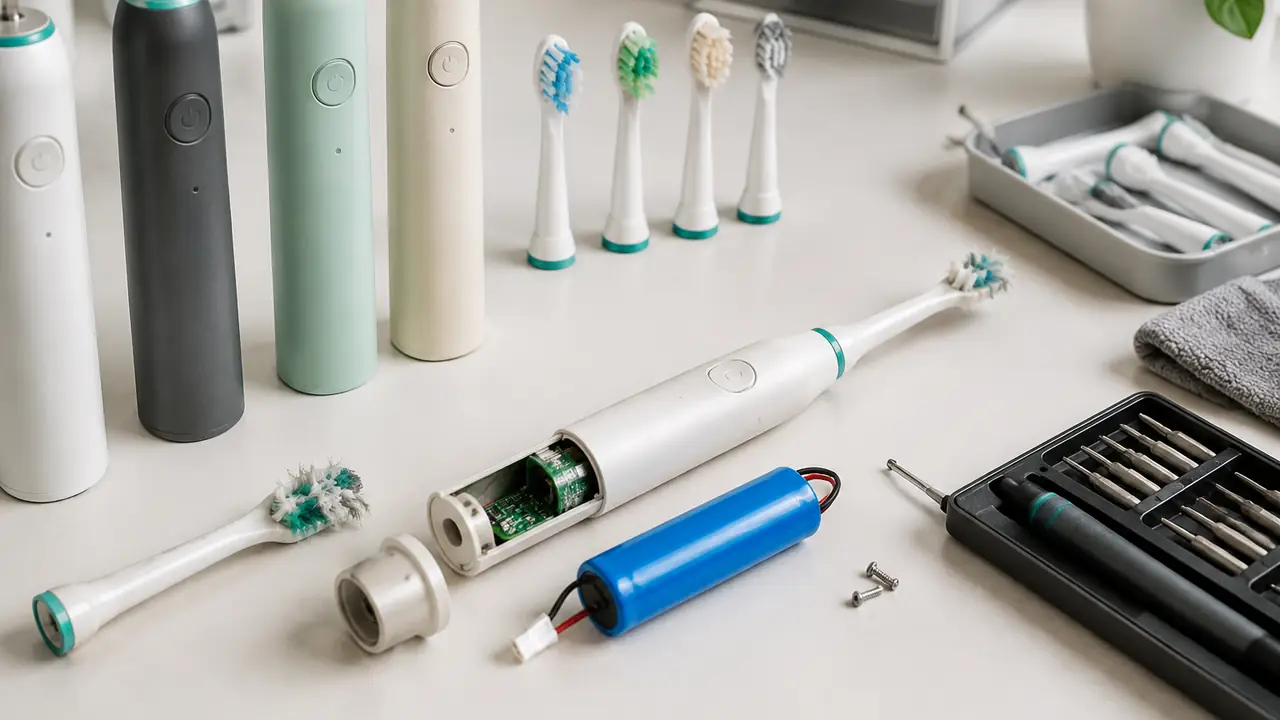
What swelling actually is
A lithium cell - the polymer pouch or 18650 formats common in handles, typically 3.7 V and 800-1,400 mAh - generates gas inside its sealed case when its chemistry is stressed. The gas has nowhere to go, so the case deforms: on a pouch cell the foil puffs, and in a sealed handle the shell itself shows the bulge first, usually at a seam or cap. The stressors are well understood - sustained heat, excessive charge or discharge, internal defects, and plain age - and every one of them is addressable at design, sourcing or storage. That is the useful reframe for a brand: swelling is not random, it is the visible end of a stress history, and the program can shorten that history at several points.
Sealed construction changes the story in one more way worth noting. Because the handle is sealed for waterproofing, the user never touches the cell, so every swelling event ends the same way: the handle comes back through warranty rather than being repaired on a kitchen table. That concentrates the cost and the information in one channel, which is bad for the returns budget and good for engineering - a traced batch of claims says more about a cell lot or a charging threshold than a hundred scattered anecdotes ever would. Brands that log swelling claims by batch and shipment get a feedback loop most categories would envy.
The causes, in order of likelihood
| Order | Cause | Typical story behind it | Where the program acts |
|---|---|---|---|
| 1 | Chronic heat exposure | Charging in direct sun, stored in a hot car, on a radiator or sunny windowsill | Manual wording; thermal layout in the shell |
| 2 | Age after years of cycles | A well-used handle near the end of its cell life | Honest runtime spec; warranty window |
| 3 | Repeated deep discharge | Left flat for long stretches, recharged, left flat again | Over-discharge protection; stock rotation |
| 4 | Charge-control fault | A failed circuit holds the cell at too high a voltage | Protection design; charging tests at inspection |
| 5 | Cell-grade or manufacturing defect | Internal fault present from the start | Cell sourcing, incoming inspection, certification |
Reading the table from the top: the first three causes are conditions the product meets after it ships, which is why manuals and logistics carry more of the weight than most buyers expect. The last two are the plant's side of the table, and they are closed by specification and inspection rather than hope.
Handling a swollen handle
The customer-facing script should be short, calm and identical everywhere it appears - manual, support reply, warranty page. None of the steps below is dramatic; it is ordinary damaged-battery handling.
- Stop charging and stop using the handle. Lift it off the dock or unplug the cable.
- Do not press, bend, heat or attempt to open the shell. The cell inside is not user-serviceable.
- Move the handle to a non-flammable surface, away from anything that burns, and let it return to room temperature.
- Take it to a battery collection or recycling point, following local rules for damaged batteries; do not dispose of it with household waste where local rules forbid it.
- If the handle is within the warranty window, note the batch or order number so the claim can be traced to its shipment.
Two wording notes for the brand. Keep the script free of worst-case imagery - the steps above are the whole message, and calm wording gets followed where alarm gets screenshotted. And make the collection-point sentence local: disposal rules differ by market, so the manual carries the rule for its market rather than a global line.
Design and sourcing choices that keep it rare
On the plant side, four decisions do most of the work. Cell sourcing comes first: reputable-grade cells in the right format, with UN 38.3 transport tests and IEC 62133-2 safety tests for the cell, documents the desk verifies per project rather than accepting from a brochure. Protection comes second: a charge-management circuit that enforces over-charge, over-discharge and over-current limits, matched to the cell it protects. Layout comes third: the cell positioned away from motor heat, with no crush points in the shell assembly. Replacement policy comes fourth and is a brand decision: sealed handles are not user-serviceable by design, so a swelling claim routes through warranty to the plant, and the flow - evidence, replacement, traceability - is agreed before the first shipment. The UN 38.3 and IEC 62133 note covers the cell paperwork in detail.
What brands and importers do
Between factory and customer, three practices lower the odds further. Incoming inspection checks cells and packs against their documents before assembly. Storage keeps finished goods cool and dry, with stock rotation so handles do not sit deeply discharged for months - the same discipline the charging note recommends, and the one marketplace sellers with slow-turning stock feel first: a pallet parked in a warm warehouse through a slow season is a stress history of its own, and first-in-first-out is the simplest mitigation in this note. And the warranty flow treats a swelling claim as traceable evidence: the batch number routes back to the shipment, the plant sees the unit, and the specification changes if the pattern says so. Swelling claims are rare when these layers hold, and their rarity is the sum of unglamorous decisions - which is also why they are worth budgeting for rather than ignoring. Shipment itself follows the lithium rules covered in the shipping note and the compliance page.
Back to specification and inspection
The specification carries the whole program: cell format and grade, protection thresholds, thermal layout, and the warranty routing for a sealed handle. The inspection plan then verifies it per batch - cell incoming checks against UN 38.3 and IEC 62133-2 documents, charging behavior tests against the datasheet, and an appearance check that includes a bulge screen before packing, since a deformed shell is visible to a trained eye. The appliance route runs under IEC/EN 60335-2-52 or UL 859 as usual, verified per project. A program with these lines written down and checked is one where swelling stays a rare, traceable event instead of a review headline - and the brief that starts it belongs on the quote form, with the test items organised as on the testing and inspection page.