
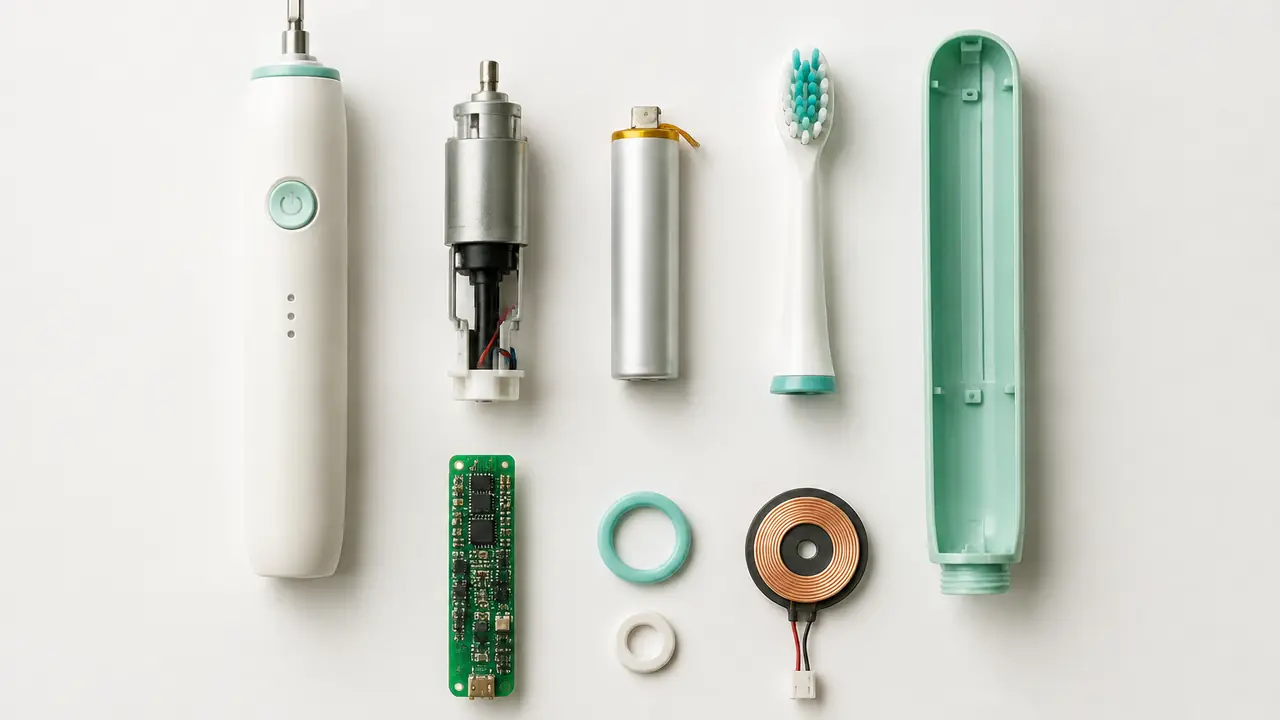
Two ways to make a handle sweep
A sonic handle asks its drive for a specific output: a shaft swinging side to side at roughly 20,000-40,000 strokes per minute, with bristle-tip travel of about 1.5-3 mm, sustained for years of two-minute sessions. Two engineering routes deliver that output, and both are in wide production across the Chinese oral-care cluster. The eccentric route converts rotation into vibration with an offset weight. The linear route pushes the shaft directly with a magnetic coil arrangement, the way a loudspeaker moves its cone. They reach the same frequency band by different physics, and the difference between them shows up in feel, in noise and on the cost sheet.
Which one sits in a given handle is rarely printed on the box, but it is always the first question the desk asks a plant, because everything downstream - the shell's internal ribs, the battery budget, the noise target, the life test plan - follows from the drive's character.
The eccentric-motor drive
The eccentric arrangement is the category's workhorse. A small DC motor carries an offset weight on its shaft; as the motor spins, the imbalance shakes the whole assembly, and the handle's suspension converts that shake into the head's side-to-side sweep. Frequency follows motor speed directly, which is why eccentric handles quote their strokes per minute so confidently - the number is the motor's operating point, stable and easy to verify on a tachometer. Amplitude follows the weight, the suspension and the head mass together, which is why amplitude claims deserve more scrutiny than frequency claims: the same motor can deliver very different tip travel under different heads.
The route's virtues are cost and maturity. Eccentric drives are inexpensive, produced at scale by many suppliers, and thoroughly understood by every plant in the cluster, which is why they carry the mass market and most entry-to-mid handles. Their trade-off is that vibration is generated everywhere and focused nowhere: without careful balancing, the whole handle buzzes, which users read as cheap. Plants manage it with counterweights, shell ribs and overmoulded grips - the same damping work a buyer feels when comparing a tuned mid-tier handle against a rough entry unit.
The linear magnetic drive
The linear route replaces spinning mass with a reciprocating magnetic circuit. A coil and a magnet arrangement - mechanically a voice coil - push the shaft left and right directly, against a sprung return. Nothing rotates, so the motion is generated at the point where it is wanted, and the stroke profile can be shaped by the drive signal rather than fixed by an offset weight. Handles built this way offer finer control of the sweep, a different in-hand character - less diffuse buzz, more directed stroke - and a noise profile that many users describe as smoother.
The costs are the usual costs of refinement. Linear drives ask more of the magnetic assembly and the control electronics, sit higher on the bill of materials, and are built competently by a narrower set of plants. They appear where a brief wants the feel itself to differentiate - premium tiers, or a brand positioning on refinement rather than price - and they reward a buyer who brushes samples, because the difference they make is felt in seconds and never captured in a frequency figure.
The two drives compared
| Aspect | Eccentric micro motor | Linear magnetic drive |
|---|---|---|
| Motion source | Offset weight on a spinning shaft | Coil and magnet pushing the shaft directly |
| Frequency behavior | Follows motor speed; easy to verify | Set by drive signal; shapeable |
| Feel in hand | Whole-handle buzz unless damped | Directed stroke, less diffuse buzz |
| Noise work | Balancing, ribs, overmould | Smooth by nature, still tuned |
| Cost position | Mass-market default | Premium and differentiation tiers |
| Plant base | Broad, every cluster plant | Narrower, specialist builds |
Noise and what users hear
Noise is where drive choice meets the shelf. Typical across the category, plants hold the motor bay at or below 55-60 decibels on the assembled unit, measured with the shipping head attached - and the measurement conditions matter, because the same drive reads differently depending on head fit and shell construction. A worn or loose collar adds a clicking layer no datasheet mentions. The desk listens to several units from each shortlisted plant rather than one showroom piece, and the practical guidance is in toothbrush noise levels. Buyers writing a brief should state the target and the measuring conditions together, since a decibel figure without conditions is not comparable between plants. Vibration transfer follows the same logic: two handles at the same decibel reading can feel entirely different in the hand, which is why the desk brushes samples before reading numbers.
Life testing and wear points
Both drives are wear systems. An eccentric motor lives on its bearings and its press-fitted weight; a linear drive lives on its sprung suspension and coil. Both transfer their output through the collar joint, the mechanical interface the user works hardest. Plants qualify all of it with life testing: the motor runs continuously for an agreed number of hours under the factory's own standard, then is rechecked for noise, play and output. The run hours are a per-order agreement, not an industry constant, which is why the desk writes the figure into the test list rather than assuming it - the same discipline the sonic mechanics note describes from the user's side. Frequency and amplitude are re-measured after the life run, because a drive that survives but slows down has still failed the customer.
Sourcing motors: what the desk asks
Motors are procured by the thousand, on datasheets that compress everything above into four lines: frequency band, amplitude under a stated head, noise under stated conditions, and life hours under the factory standard. The desk asks partner plants for exactly those four, verified with samples run on assembled handles rather than bare motors, because the assembly - suspension, collar, head - is where the numbers become experience. A motor upgrade on an existing platform is a development conversation, not a swap: shell ribs, battery budget and control electronics all move with the drive, and the schedule follows the change. Reference quantities and lead windows for motor programs sit on MOQ and lead time, and a drive question - new program or upgrade - can be raised through the quote form. The wider component context, where motors sit beside cells, heads and docks as separately sourceable lines, is on toothbrush components.