
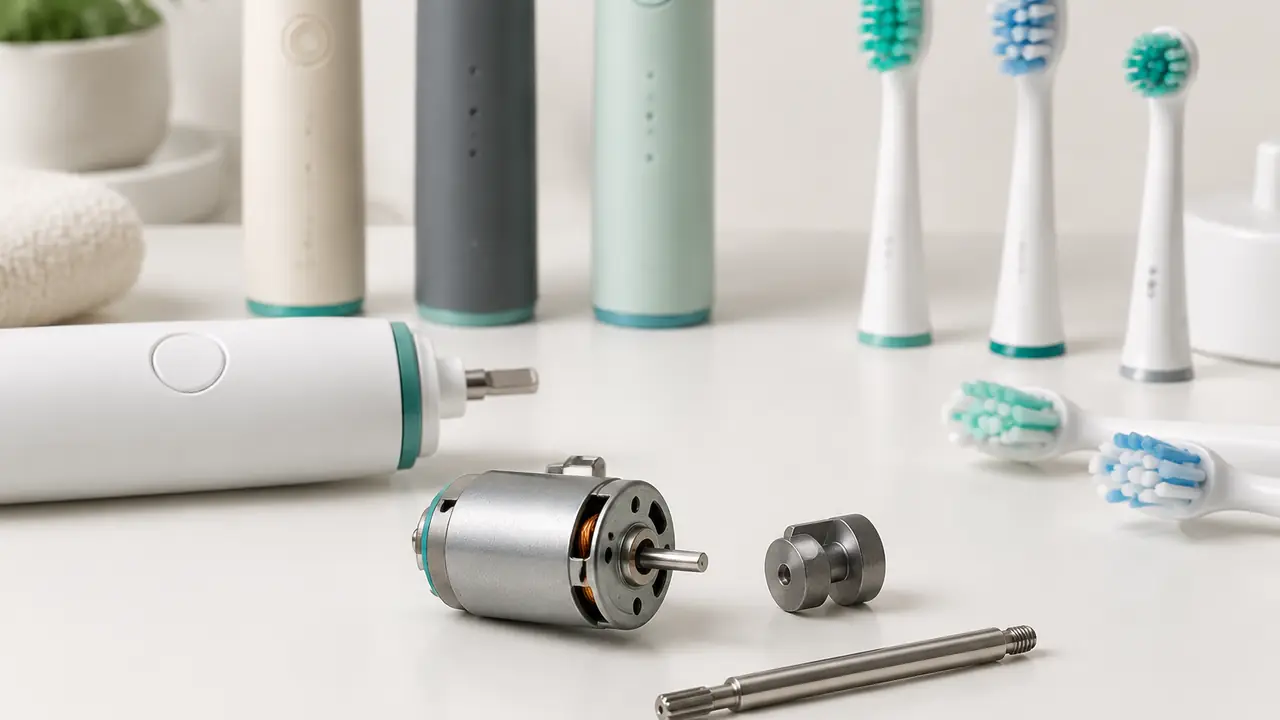
Two ways to make bristles sweep
Sonic handles move their heads in one of two ways. An eccentric drive spins an off-centre weight, turning rotation into vibration - the older, cheaper family, found across entry and mid-range handles. A linear voice-coil drive moves the shaft directly with a coil and magnet, the family behind most premium handles: faster response, tighter control of the mode curves, and a different felt signature in the hand. Neither is better in the abstract; the right choice follows the price point, the battery budget and the modes the firmware wants to run. The motor types guide compares them in detail, and the how sonic brushes work piece shows what the vibration does in the mouth.
The six parts on the card
The waveform sketch traces the sweep, but a motor is quoted by the parts below, in the order a plant prices them. The mount row matters more than buyers expect: the same motor can feel harsh or smooth in the hand depending on how it is isolated from the shell.
| Part | What decides performance | Typical options |
|---|---|---|
| 1 Housing | Can size, bay fit, thermal path | Standard cans, silicone sleeve options |
| 2 Rotor assembly | Drive family, frequency ceiling | Eccentric weight or linear voice-coil rotor |
| 3 Drive shaft | Runout, coupling to the head shaft | Tolerances set per head platform |
| 4 Bearing set | Life, noise, wear behaviour | Sleeve or ball bearings |
| 5 Coil and PCB | Mode curves, efficiency, driver control | Windings per frequency target, driver board |
| 6 Mount | Felt noise, vibration path to the shell | Isolation mounts and clips |
Speed, amplitude and what buyers feel
Motor speed for sonic handles sits between 20,000 and 40,000 strokes per minute, entry models at the bottom of the band and flagships at the top. But speed alone decides little: amplitude, head mass, bristle taper and the firmware curve decide what the user actually feels, which is why two handles quoting the same figure can brush differently. Listings should quote the figure from the model datasheet and leave the sensation to the mode names. The numbers behind this are explained in strokes per minute explained and vibration and amplitude.
Life on the run-in rig
Motor life is proven on a run-in rig: units run continuously or in duty cycles until the plant's standard hour count is reached, then tear-down checks measure wear on bearings, commutation and mounts. The hour target follows each plant's standard and is agreed per program, not quoted from this page. Noise travels with life: a healthy sonic motor sits at 55-60 dB or lower at the handle in normal use, and a rising noise figure across the run-in hours is the usual early warning. What buyers hear in the box is covered in noise levels explained.
Matching a motor to a handle program
A motor is never chosen alone. The bay dimensions fix the can; the battery draw budget fixes the winding; the mode set fixes the drive curves the coil and PCB must follow; and the head platform fixes the shaft coupling. Changing one row ripples into the others, which is why the desk asks for the host handle specification before quoting a motor, not after. Programs migrating from catalog handles to private molds usually re-open the motor choice at the same time - the trade-offs are in private mold versus catalog mold, and the electronics side is in PCBs and firmware.
Ordering motors as components
Component orders run differently from finished handles. Quantities are quoted per thousand pieces, samples come with the plant's own test report rather than a retail box, and certification happens inside the finished appliance's file - IEC/EN 60335-2-52 with CE for Europe, UL 859 via UL or ETL for North America - with RoHS and REACH declarations from the motor plant verified per project. Component orders fit the sourcing flow described in the sourcing process, and batch checks follow the same logic as testing and inspection.
Checks before a motor lot is approved
- Speed in strokes per minute on a rig against the plant's test report.
- Noise at a set distance in the handle or a test jig, against the agreed figure.
- Mode curve behaviour through the host PCB on sampled units.
- Run-in hours evidence for the lot against the plant standard.
- Shaft runout and coupling fit against the head platform tolerance.
- RoHS and REACH declarations and lot traceability against the order file.
The checks are written per program and confirmed before the first batch; see quality control. Reference quantities and timing sit on the MOQ and lead time page, and the quote form opens the motor conversation.