
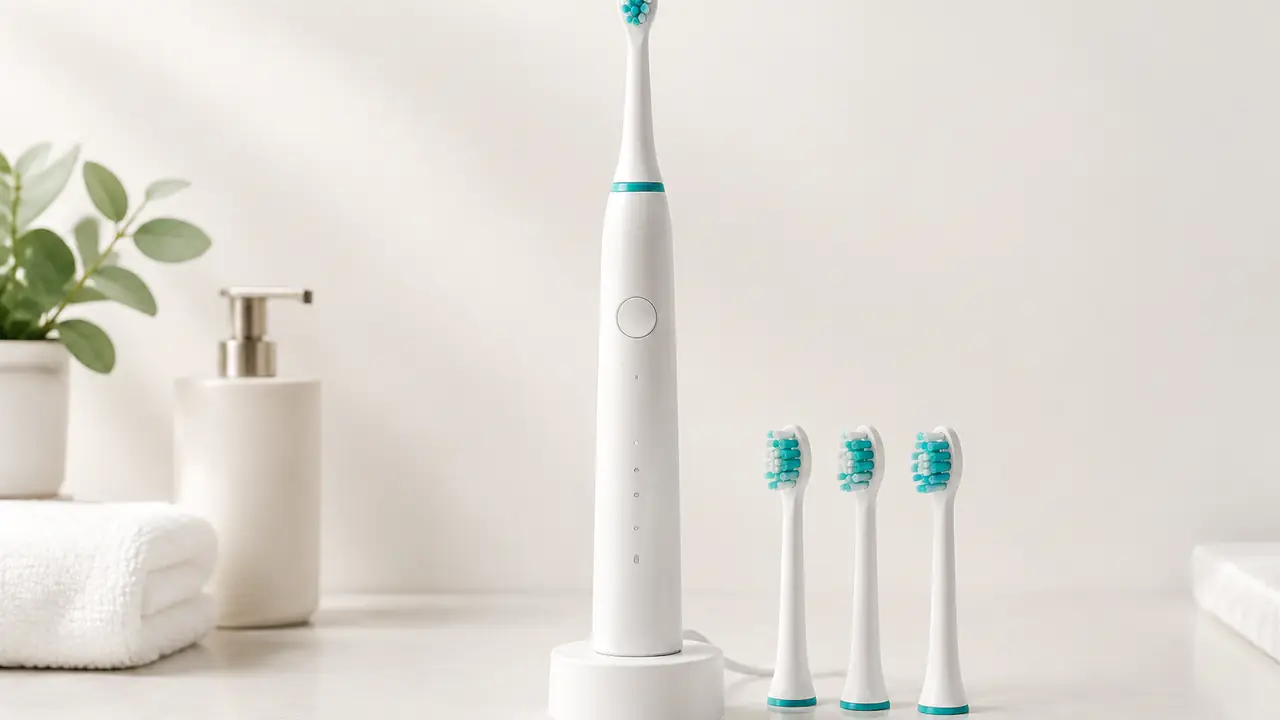
What a sonic toothbrush is
A sonic toothbrush cleans with high-frequency vibration. A small motor in the handle drives the brush head at roughly 20,000 to 40,000 strokes per minute; the fast bristle sweep also agitates the foam in the mouth so fluid reaches between teeth beyond where the bristles touch. Handles seal to IPX7 so they survive rinsing and a drop in the sink, and a two-minute timer with a thirty-second quadrant pacer paces the brush. Consumer research firms put the 2025 global oral-device market between roughly USD 3.5 and 5.4 billion with North America the largest share, which is why the sonic flagship is usually the first SKU a brand specifies.
The trade-off buyers learn quickly: two handles quoting the same 40,000 strokes can brush differently, because amplitude, head mass, bristle taper and the mode firmware decide what the user feels. That is why the nameplate card on this page lists six parts and what can change in each.
The six parts on the card
The waveform sketch numbers nothing, but the parts are listed in the order a plant quotes them.
| Part | What decides performance | Typical options |
|---|---|---|
| 1 Handle and shell | Seal design, overmould, balance in hand | ABS or PCR-ABS, soft-touch TPE, metal ring trim |
| 2 Sonic motor | Stroke frequency, amplitude, life on the run-in rig | 20,000-40,000 strokes/min, eccentric or linear drive |
| 3 Battery | Capacity, protection board, cycle life | 3.7 V, 800-1,400 mAh, Li-ion or polymer |
| 4 Brush head | Bristle type, collar fit, head size | DuPont nylon soft or medium, snap-on, 2-4 profiles |
| 5 PCB and modes | Mode set, timer logic, charge management | Clean, soft, white, gum; 2 min timer with quad pacer |
| 6 Charging and accessories | Charge time, travel sealing | USB or Type-C cable, wireless dock, travel case |
Strokes per minute, runtime and charging times are typical ranges seen across the category, not a datasheet. Each model carries its own test report, and the figures a brand prints are confirmed from that report, not from this page. The sonic versus rotating guide explains how the two drive systems differ.
Runtime, charging and the rules that come with the cell
Runtime is the number customers notice after noise. An 800-1,000 mAh cell at 3.7 V running two two-minute sessions a day lands in the 14-30 day band on most spec sheets; a 1,200-1,400 mAh cell pushes the top of that range and adds weight. Shipping the finished handle needs UN 38.3 test reports for the cell and pack and, in most markets, IEC 62133-2 for the battery. The battery guide and shipping toothbrushes cover the paperwork.
Heads, modes and the whitening wording
Brush heads are a business of their own: soft and medium DuPont nylon, tapered tips for the gum line, charcoal-fibre variants for visual merchandising. Compatibility is fixed by the collar tooling, which is why brands lock a shaft platform early and sell heads against it for years; the head compatibility guide explains the mechanics. Mode sets are firmware: clean and soft as standard, white and gum modes across mid-range. White modes polish with motion, not chemistry, so listings stay at helps remove surface stains and never promise to whiten teeth.
Options worth specifying
- Housing finish. Matte white and soft-touch mint are the stock looks; metallic rings and two-shot grips are tooled per program.
- Pressure sensing. A sensor that drops amplitude under load; standard on premium builds.
- Display. None, a mode LED ring, or a small segment display for charge and mode.
- Packaging. Plain brown carton for marketplaces or a colour box with pulp insert for retail; see packaging.
- Branding. Logo by pad print, laser or moulded-in; manuals and app assets by the brand; see OEM and private label.
Where the handles are built
Sonic handles come from the Shenzhen and Dongguan OEM belt in Guangdong, where motor, moulding, SMT and assembly plants sit within an hour of each other, and from Ningbo and Hangzhou in Zhejiang, where dedicated sonic-brush factories run their own motor lines. Hangji in Yangzhou adds the manual-brush heritage and packaging depth. The desk shortlists plants by motor platform, seal process and the test lab they use rather than by catalogue size. More on the clusters.
Inspection before shipment
- Stroke frequency and amplitude on sampled units against the model's own test report.
- Mode switching, timer and quadrant pacer behaviour on every sampled handle.
- Runtime in the highest mode from a full charge; charge time to full.
- IPX7 soak on sampled units; button and seal check after the soak.
- Head retention force, shaft runout and bristle retention on sampled heads.
- Carton drop test and label, manual and pack contents against the approved sheet.
The plan is written per program and confirmed before the first batch; see quality control. For reference quantities and timing, the MOQ and lead time page sets the ranges, and the quote form asks what a plant will ask.