
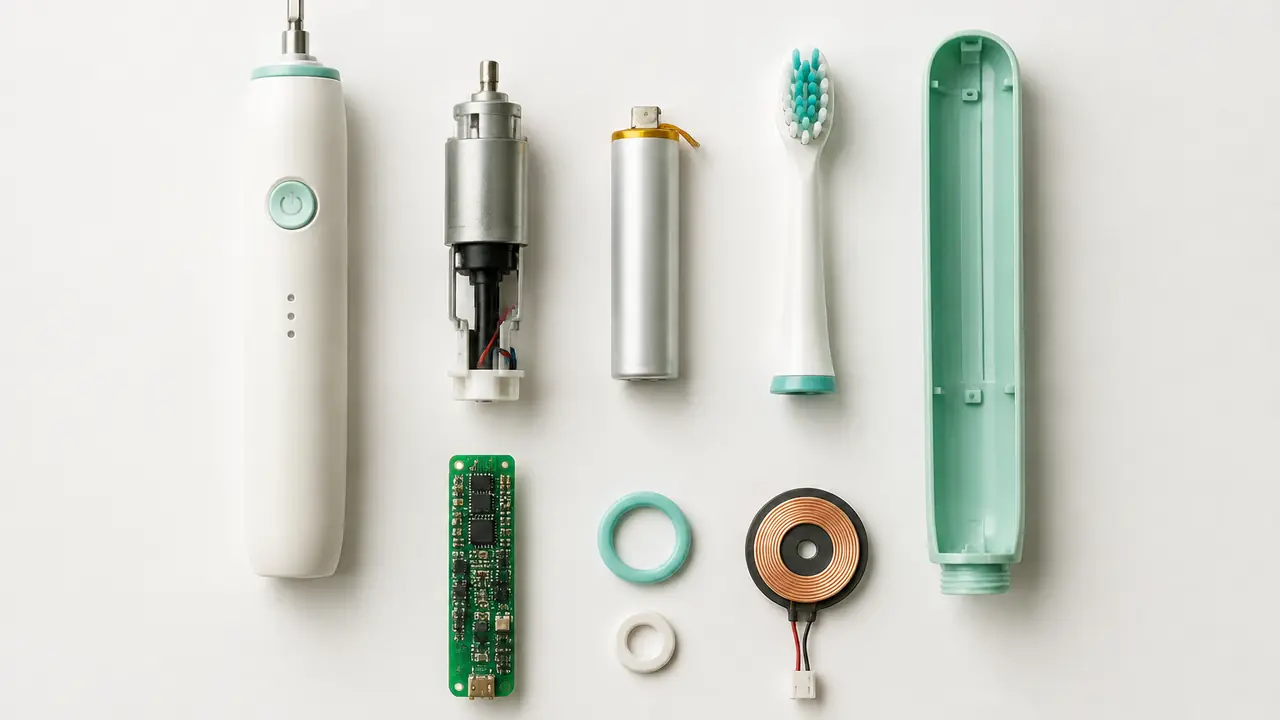
What the board actually does
A toothbrush PCB is a single board wearing four hats. It manages power - charging the cell through the dock or cable, protecting it, reporting charge state on an LED. It drives the motor, switching between the frequency and amplitude points the firmware defines. It senses - reading a pressure sensor, a button press, sometimes a Hall signal from the dock. And it times, holding the two-minute session clock and the interval prompts without any user input. All of it lives inside a sealed shell, which shapes every design choice: no connectors that corrode, no openings for service, diaphragm buttons instead of mechanical switches where the seal demands it. The board is also the least visible failure point in the field - a user never sees it, only its symptoms - which is why the test list around it matters more than its datasheet, and why a buyer should know which features live in silicon, which in firmware, and which in the seal.
Modes are firmware, not hardware
When a listing says a handle has five modes, it is describing firmware. The motor and board are identical across most mode sets; what changes is the drive profile each mode commands - a frequency point, an amplitude ceiling, a ramp-in curve, sometimes a duty cycle. Two to five named programs is the category norm, with a gentle profile for users who want a softer feel sitting beside the full-power default. Because modes are software, they are cheap to adjust late in development and dangerous to leave vague in a contract: the desk asks partner plants for the mode table - name, frequency, amplitude target, ramp behavior - as a written deliverable, and verifies on samples that pressing the button produces what the table says. The named programs themselves, and how they are marketed, are covered in brushing modes explained; the claims discipline travels with the firmware, so a whitening-named mode is still only ever described as helping remove surface stains. Two handles can share a board and differ entirely in character, which is how close the link between silicon and experience has become.
The timer and quadrant pacing
The two-minute session clock is the most universal feature in the category, and the thirty-second quadrant prompt is its other half: at each interval the handle pulses or stutters briefly, cueing the user to move zones. Both live in the timer block of the firmware, and both are test items on the agreed list - timer accuracy and prompt behavior are checked on samples, not assumed. Buyers sometimes ask for variations: a slightly longer cycle for U-shaped siblings, an audible cue instead of a haptic stutter, a pulse pattern matched to a competitor's rhythm for familiarity. All are firmware work, cheap on an existing platform, and all belong in the written specification rather than in a follow-up email. The user-side story is in timers and quadrant reminders.
Sensors: pressure and beyond
The pressure sensor is the category's most valuable single sensing feature. Mounted in the board stack or the neck, it detects when the user presses too hard and responds - a light, a pulse, a mode pullback - and it appears on most mid and premium tiers. Its value is mechanical: heavy pressing is a common habit, and a handle that notices changes the experience without claiming to treat anything. The sensing chain and its wording are covered in pressure sensors in toothbrushes. Beyond pressure, the sensing that defines the smart tier is motion tracking - a motion sensor logging brushing zones for the app - which moves the product from a sealed appliance into a connected one, with everything that follows.
Radio models: FCC and CE RED
The moment a board gains Bluetooth, the approval map changes. A radio in a product sold into the United States needs FCC Part 15 authorization; the European route adds CE RED. These sit on top of the appliance safety route - IEC/EN 60335-2-52 or UL 859 - and on top of the cell paperwork, and they add real calendar time to a program, so the desk plans them from the first schedule rather than discovering them at shipment. Radio models also carry data-privacy questions a plain handle never asks: what the app collects, where it is stored, what the firmware reports home. Those are brand questions as much as engineering ones, and the smart tier's full picture is on the smart toothbrush line page, with the approval detail in FCC and CE RED for Bluetooth toothbrushes.
Tiers on the shelf
| Tier | Board and firmware | Typical features |
|---|---|---|
| Entry | Single board, basic drive profile | 1-2 modes, 2-minute timer, LED charge state |
| Mid | Multi-profile firmware, sensor input | 2-5 modes, quadrant pacing, pressure sensor |
| Smart | Radio plus motion tracking | App pairing, zone reports, FCC / CE RED route |
The tier split is firmware economics as much as feature economics: the same platform can serve all three rows with different board populations and different firmware builds, which is why plants quote tiers quickly and why the desk compares what is actually on the board, not what the box says.
Buttons, sealing and the test list
The interface between user and board is a button, and the interface between water and board is whatever stands behind that button. Sealed diaphragm and capacitive designs dominate because they keep the IPX7 envelope unbroken; a leaky button seam is a classic field failure. Button life is a named test item - pressed through an agreed cycle count, then rechecked - alongside mode switching and timer verification, all inside the pre-shipment list the desk assembles per order. The firmware questions complete the specification: who owns the code, what documentation ships with the program, and how a future order reproduces this exact behavior. Firmware ownership is a contractual fact worth more than its paragraph in the agreement, because it decides whether a brand can move platforms later, reissue a mode set, or fix a prompt without starting development again. Reference quantities and schedules for board-level changes follow the usual windows on MOQ and lead time, and a firmware or modes question can be raised through the quote form; the trade-offs between single-mode simplicity and multi-mode complexity are set out in single vs multi-mode toothbrushes.