
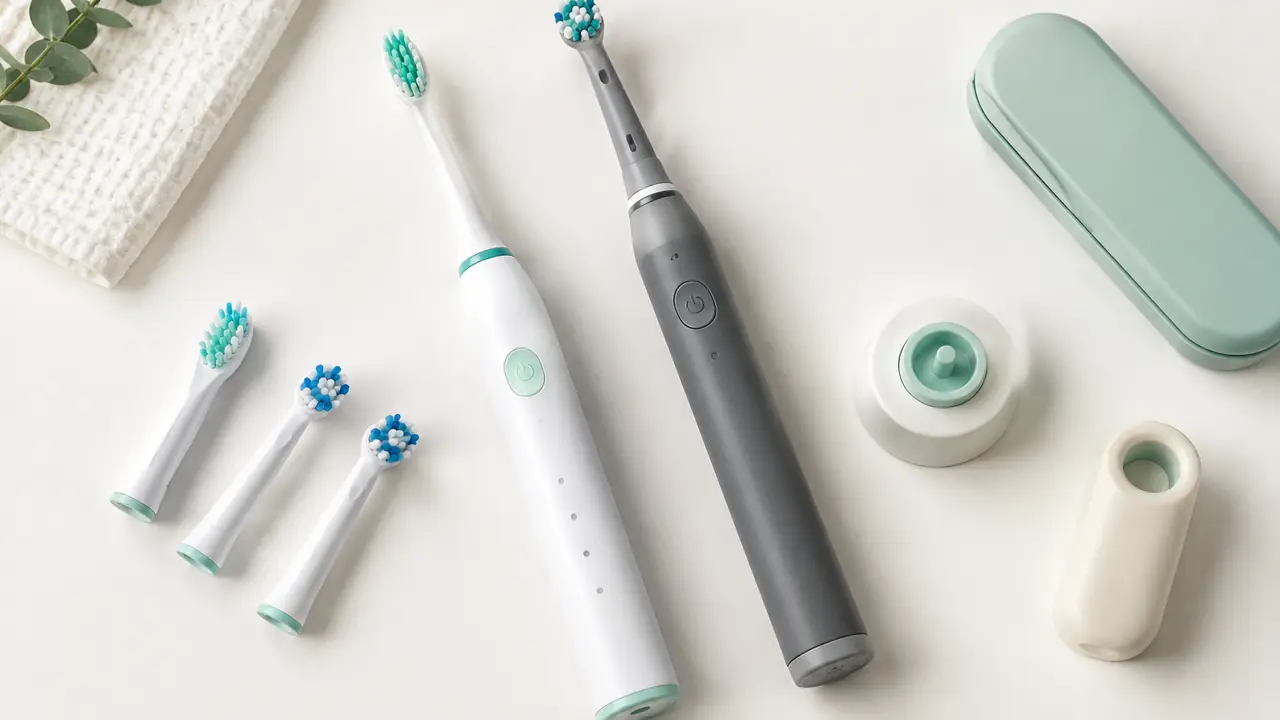
What a mode actually is
A mode is a named program in the handle's firmware: a frequency or amplitude setting, usually with its own prompt behaviour, switched by a button press and announced by a light. Behind the label sits a small stack of engineering - a board that stores the settings, a motor that delivers them consistently, and code that switches between them without a hiccup mid-session. Single and double modes dominate the entry formats, including battery handles in the 7,000-12,000 strokes/min band; two to five named programs are standard on sonic handles, scaled across clean, gentle and specialised settings. The mode count is therefore not decoration: it is the visible tip of firmware scope, and firmware is where inexpensive handles quietly save money - with coarse steps, abrupt prompts and switching that stutters. A buyer who understands the trade can read a mode line on a quotation and know what is behind it.
Side by side
| Dimension | Single / double mode | Multi-mode (2-5) |
|---|---|---|
| Typical formats | Battery handles, entry tiers, kids models | Sonic handles, mid and premium tiers |
| Firmware scope | One or two settings, fixed prompts | Named programs, per-mode frequencies, prompt scripts |
| Drive ceiling | 7,000-12,000 strokes/min on battery formats | 31,000-40,000 flagship; 20,000-31,000 entry sonic |
| Testing load | Simple switching and timer checks | Mode switching, per-mode frequency, prompt timing, sensor interplay |
| User experience | One button, one behaviour, nothing to learn | Choice and ritual; longer learning curve |
| Listing clarity | One line explains the product | Each mode must be named and explained honestly |
| Return drivers | Few - the product does what it says | Confusion modes, weak differentiation between settings |
| Cost drivers | Basic board, simple motor | Board memory, motor control, firmware development hours |
| MOQ reference | Catalog 500-1,000 pieces | Catalog 500-1,000; private label 1,000-3,000 plus tooling |
| Strongest fit | Entry tiers, travel, hospitality, kids | Flagship tiers, brand ladders, pressure-sensor platforms |
The firmware row is where quotations quietly diverge. Two handles can print the same mode count while one switches crisply, paces prompts evenly and holds each mode's frequency under load, and the other stutters between settings and drifts as the cell drains - the difference is engineering hours, not parts. That is why the desk treats firmware as a deliverable rather than a given: the mode list with per-mode targets, the prompt script, the version number and a written change process all go into the program documents, and a sample session exercises every path - switch up, switch down, mid-cycle interruption, low-battery behaviour - before the purchase order. On a single-mode handle the same discipline takes ten minutes; on a five-mode platform it is the core of the qualification, and skipping it is how a listing's mode table turns into a returns log.
Where single and double modes win
Simplicity is a feature when the audience wants it. A battery handle with one button and one speed tells the user everything in five seconds of listing, never surprises a guest in a hotel bathroom, and gives a support team almost nothing to explain. Kids models belong here by design: a child needs one gentle setting and a friendly timer, not a five-way decision - the 7,000-20,000 strokes/min kids band with one or two modes is the norm for good reasons set out in toothbrushes by kids' age. The engineering benefits are real too: a small board, a modest motor and firmware that fits on one page cost less, test faster and fail less. The ceiling is equally real - a single-speed battery handle cannot pretend to the flagship shelf, so the format wins exactly as far as its honest price band and no further. In practice that honesty is an asset: the listing, the manual and the product all agree, which is more than some multi-mode programs can say after their fifth mode ships.
Where multi-mode earns its complexity
Modes earn their place where one setting cannot serve one handle's whole audience. A gentle program opens the format to users who find a full-power sweep uncomfortable - sensory wording, not medical: soft bristles and gentle modes are experience descriptions. A deep-clean setting at the top of the frequency band satisfies power-oriented users; specialised programs give a mid-tier handle something to say beyond its motor. Modes also carry the pressure-sensor platform: a sensor that softens output when the user presses hard needs at least a second program to soften into. The costs are the firmware hours, the board memory, and above all the testing: mode switching is a named test item, and each mode's frequency, prompt timing and sensor interplay are verified per model with documents checked per project. The board behind it is described on the components hub and in PCBs and firmware.
The trade-offs buyers actually meet
Three trade-offs dominate real programs. First, clarity versus content: a five-mode listing looks richer, but if two modes are indistinguishable in the hand, reviews will say so - the desk asks plants to demonstrate each mode's difference on samples and drops modes that do not earn their label. Second, button design versus mode count: cycling through five programs with one button is a morning-routine annoyance, solved with long-press shortcuts and a return-to-default that users must learn - design work that costs firmware hours. Third, name discipline: mode names are the listing's promise, so clean, descriptive names beat marketing poetry that a warehouse packer cannot verify. A mode that cannot be described mechanically should not ship. The vocabulary of modes and prompts is defined in brushing modes explained.
What to specify on each strategy
On a single or double-mode handle, specify the speed band, the timer and prompt behaviour, the button's single action, and the switch test - one setting done consistently is the whole product. On a multi-mode handle, specify each mode by name with its frequency and amplitude target, the switching order and long-press behaviour, prompt timing per mode, pressure-sensor interplay, and the firmware version that ships, with a written change process for updates. Both strategies share the appliance route - IEC/EN 60335-2-52 or UL 859, plus cell tests where lithium - and the mode plan should be frozen before certification, because a late mode addition reopens testing. Reference minimums and schedules sit on MOQ and lead time, confirmed in writing per program, and a mode-strategy brief starts at the quote form.