
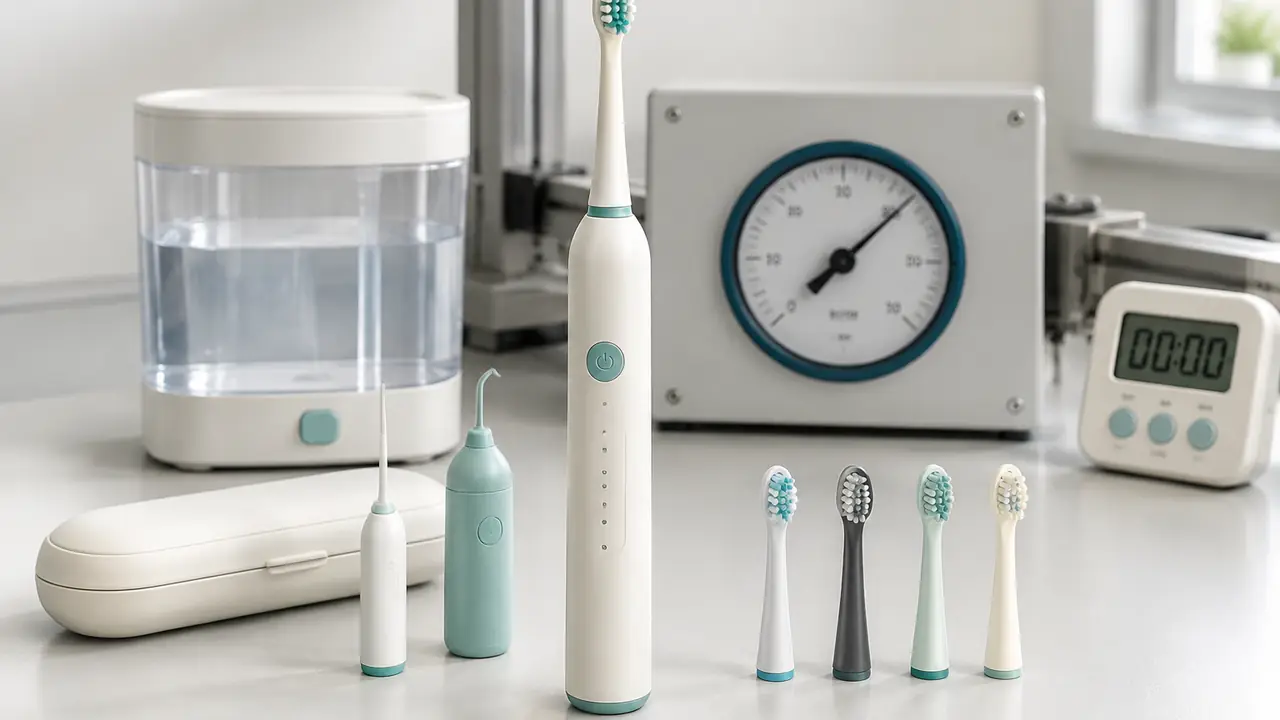
What the timer is for
The two-minute timer is a pacing convention the whole category has adopted: the handle runs a session of that length, then signals the end with a stop, a pulse or a light. Its job is behavioural, not mechanical - most users brushing manually finish in well under a minute by feel, so the timer holds them to a fuller session without anyone prescribing what the right time is for any particular mouth. The quadrant pacer rides on top: every thirty seconds the handle gives a short cue, dividing the two minutes into four zones so the user moves around the mouth instead of hovering over one area. Together they turn a powered brush into a metronome, and they cost a plant almost nothing - a firmware routine and a cue - which is why the pair appears on everything from flagship sonic handles to entry battery models.
How the pacer is built
The mechanics live in firmware. The board counts the session, and at each thirty-second boundary it commands a cue: a brief pause in the motor, a stutter pulse, a light blink on the ring, or a combination. At the two-minute mark the session ends - some handles cut cleanly, others wind down, and a common convention lets the user run a bonus stretch for missed spots. Button behaviour is part of the same routine: pressing power mid-session and resuming may restart the count or continue it, and the mode switch may or may not reset the clock, details users discover fast and reviewers mention quickly. None of the conventions is standardised, so the desk writes the desired behaviour into the specification - the cue style, the boundary actions, the resume rule - and the plant programs exactly that.
| Line | Session structure | Typical cue style |
|---|---|---|
| Sonic, rechargeable | Two minutes with a thirty-second quadrant pacer | Motor pause or pulse at each boundary; end signal at two minutes |
| Battery (AAA) | Two minutes, single or dual mode | Simple stop or pulse; minimal lighting |
| Kids | Two minutes with fun reinforcement | Lights, sounds or character cues to hold attention |
| U-shaped | Automatic session of 45-60 seconds | Auto start and stop; the tray replaces pacing |
| Smart handles | Two minutes plus app-guided zones | In-handle cues plus phone-side session map |
Why the pair works deserves one mechanical sentence: coverage is a function of time and placement, and the timer secures the time while the pacer nudges the placement. A user who follows the cues finishes four zones with roughly equal dwell, which is more than most manual sessions deliver, and the effect costs no hardware at all. That efficiency is why the two-minute frame survived every design generation - it asks nothing of the motor, the battery or the head, yet it is the feature most often cited when users describe switching from manual brushes. For listings it is also the rare spec line that never needs qualifying: no range, no test condition, no standard to cite, just a behaviour the sample will demonstrate in the first session.
The variants across the range
The two-minute frame holds across most of the category, with two families diverging. U-shaped trays replace pacing with geometry: the silicone wraps the arch, so the session shortens to an automatic 45-60 seconds and the timer's job is simply starting and stopping. Kids models keep the two minutes but fight the real enemy - attention - so the cue becomes entertainment: flashing lights, melodies or an app character, and the kids line pairs those cues with gentler drives at 7,000-20,000 strokes per minute. The age-by-age selection is covered in the kids note, and the tray logic in the U-shaped page. Battery models keep the simplest implementation, where the cue is often just a pause, because every feature on a two-dollar board has to earn its place.
Smart handles: the timer grows a memory
Connected models extend the same routine with a record: the board logs which zone was active - via orientation sensing or timing alone - and the app renders the session as a coverage map with missed areas flagged. The in-handle behaviour stays the familiar two-minute, four-cue pattern; what the radio adds is the after-the-fact view and streaks that bring users back to the app. For buyers this tier carries extra homework rather than new mechanics: the Bluetooth radio needs FCC Part 15 or CE RED approvals alongside the appliance standards, and the app is a product in its own right with its own update expectations. The tiering logic around the feature sits in the smart line page and the smart versus standard note.
How the timer is verified
Because the timer is firmware, its verification is functional: sample units are run through full sessions, cues checked at each thirty-second boundary and the end signal at two minutes, across every mode on the ladder - a cue that drifts in soft mode reads as a defect. The item is a standing line in per-order test lists, alongside mode switching and battery behaviour, which is how it lands in the testing and inspection flow the desk runs before shipment. Buyers reselling under their own brand add one more check: the printed manual must describe the behaviour the handle actually shows, since timer mismatch between box and handle generates support tickets that no firmware update can recall.
Range planning uses the timer as a tier marker too. The full pattern - two minutes, four cues, end signal - is table stakes on rechargeable models, so differentiation moves to the refinements: a bonus-interval convention for missed spots, a longer professional-style session mode, or the app-side memory on smart handles. Entry battery models compete on having the pattern at all, printed plainly on the card. What avoids confusion in a tiered range is consistent cue language across models from the same brand: users who upgrade within a line expect the same pulse rhythm and the same end behaviour, and plants can hold firmware conventions stable across a family for exactly that reason. The desk asks for the convention table per family, not per model, when a program spans several tiers.
Writing the session into a brief
A timer line in a specification is short but complete: session length, cue style at each boundary, end behaviour, resume rule and any mode differences - one sentence each, confirmed in writing per program. From there the routine becomes an inspection item like strokes or IPX7, and the marketing can lean on it honestly, because pacing is one feature every reviewer checks and few complain about when it works. Program frames sit on MOQ and lead time, and the quote form carries the session behaviour field so plant quotations describe the same firmware the samples will show.