
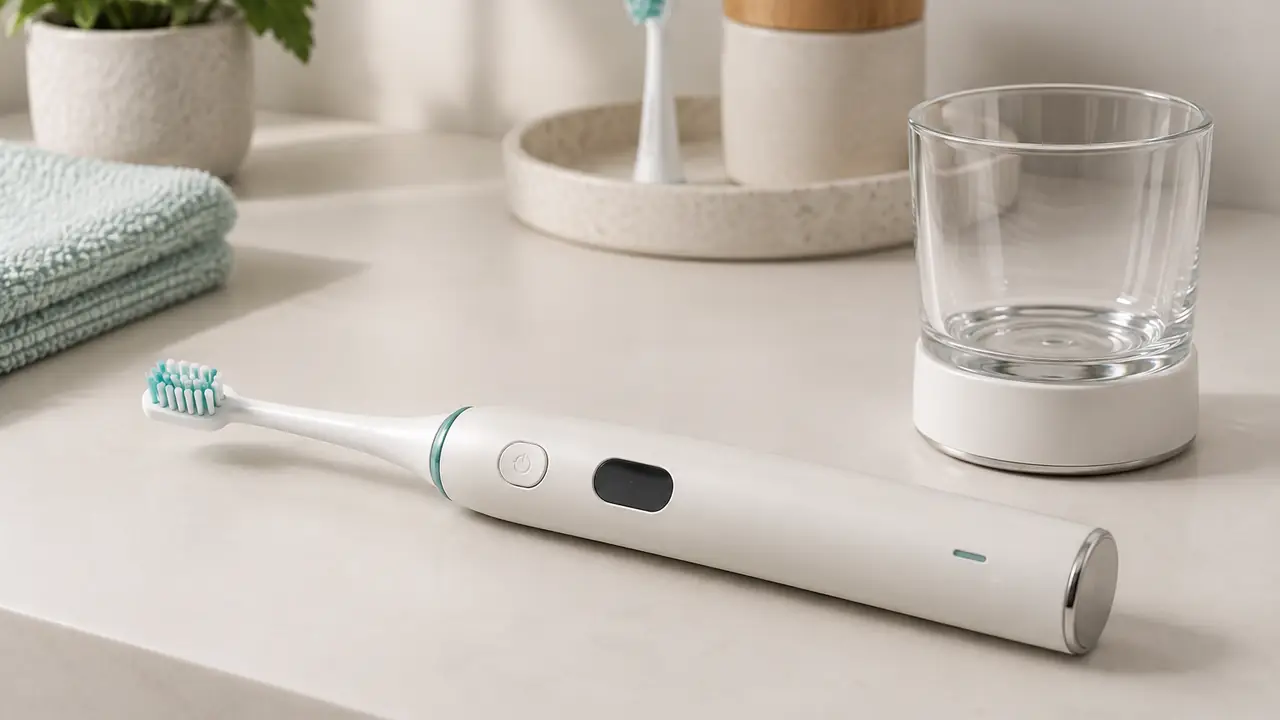
What makes a toothbrush smart
A smart toothbrush is a sonic handle with a radio and a sensor. The motor still sweeps a snap-on head at roughly 20,000 to 40,000 strokes per minute, the handle still seals to IPX7, and the two-minute timer with a thirty-second quadrant pacer still paces the brush. What changes is the electronics: a Bluetooth radio pairs the handle to a phone app, a pressure sensor watches how hard the user presses, and the firmware logs zone coverage, session length and mode use into a brushing report. Buyers usually arrive at this line from the standard one, and the smart versus standard comparison sets out where the value adds up.
Because the handle carries a radio, the compliance route grows: the United States expects FCC Part 15 evidence for the Bluetooth link and Europe expects CE RED alongside the CE work the handle already needed. That is schedule, not risk, as long as the radio tests are booked early; the desk flags it at quotation.
The six parts on the card
The waveform sketch numbers nothing, but the parts below are listed in the order a plant quotes them. Rows marked customizable change per program; the accessories row is where brands add or remove items to hit a retail price point.
| Part | What decides performance | Typical options |
|---|---|---|
| 1 Handle and shell | Seal design, display window, grip | ABS body, soft-touch TPE, LED or segment display |
| 2 Sonic motor | Stroke frequency, amplitude, felt noise | 20,000-40,000 strokes/min, eccentric or linear drive |
| 3 Battery | Capacity, protection board, cycle life | 3.7 V, 800-1,400 mAh, Li-ion or polymer |
| 4 Brush head | Bristle profile, collar fit | DuPont nylon soft or medium, snap-on, platform-locked |
| 5 PCB and modes | Radio, sensor, mode curves, timer logic | Bluetooth SoC, pressure sensor, 2-5 modes, 2 min timer |
| 6 Charging and accessories | Charge route, travel kit | USB or Type-C cable, wireless dock, travel case |
Strokes per minute, runtime and charging figures are typical across the category and are confirmed from each model's own test report, not from this page. How to weigh them is in how to read toothbrush specs.
The radio: FCC and CE RED
Bluetooth puts the handle in a different regulatory drawer from a plain sonic brush. For the United States the radio needs FCC Part 15 authorization; for Europe it falls under CE RED on top of the LVD, EMC and RoHS file the handle already carries. Radio testing adds lab time to the project plan, so the desk schedules it in parallel with tooling rather than after it. The FCC and CE RED guide walks the sequence, and the route by market sits in the certifications guide.
Pressure sensing and mode firmware
The pressure sensor is the second headline feature. Under load the firmware drops amplitude or lights a warning, which keeps the experience calm for first-time users of a powerful handle. Mode sets stay firmware: clean and soft as standard, white and gum modes across mid-range, each one a drive curve on the same motor rather than new hardware. Copy stays sensory and mechanical - gentle modes, soft bristles - and white modes are described as helping remove surface stains, never as whitening teeth. The pressure sensor guide and the PCB and firmware guide cover what buyers specify.
App data and privacy wording
The app is part of the product, and its data practices are part of the offer. A brushing report holds usage data: session length, zones covered, mode choice, pressure events. Which fields the app records, where servers sit, how long logs are kept and what the privacy policy states are questions the desk puts to the plant and the app vendor in writing before a program starts. Brands selling into Europe should expect the app privacy policy to align with their own, and retail chains often ask for it in the vendor pack. The buyer guide for this line lists the questions to close first.
Where smart handles are built
Smart handles come from the same clusters as standard sonic brushes. The Shenzhen and Dongguan belt in Guangdong has the SMT depth radio boards need, and Ningbo and Hangzhou in Zhejiang run dedicated sonic lines with in-house motor and electronics teams. The desk shortlists plants by radio test experience and firmware change control rather than by catalogue size; more on the clusters.
Inspection before shipment
- Pairing and re-pairing on sampled handles; app report fields matched to the agreed specification.
- Pressure sensor behaviour under load in every mode.
- Mode switching, timer and quadrant pacer on every sampled unit.
- Runtime in the highest mode from a full charge; charge time on the agreed charger.
- IPX7 soak on sampled units; radio and button check after the soak.
- Radio label, manual, app assets and carton contents against the approved sheet.
The plan is written per program and confirmed before the first batch; see quality control. Reference quantities and timing sit on the MOQ and lead time page, and the quote form collects what a plant will ask for.