
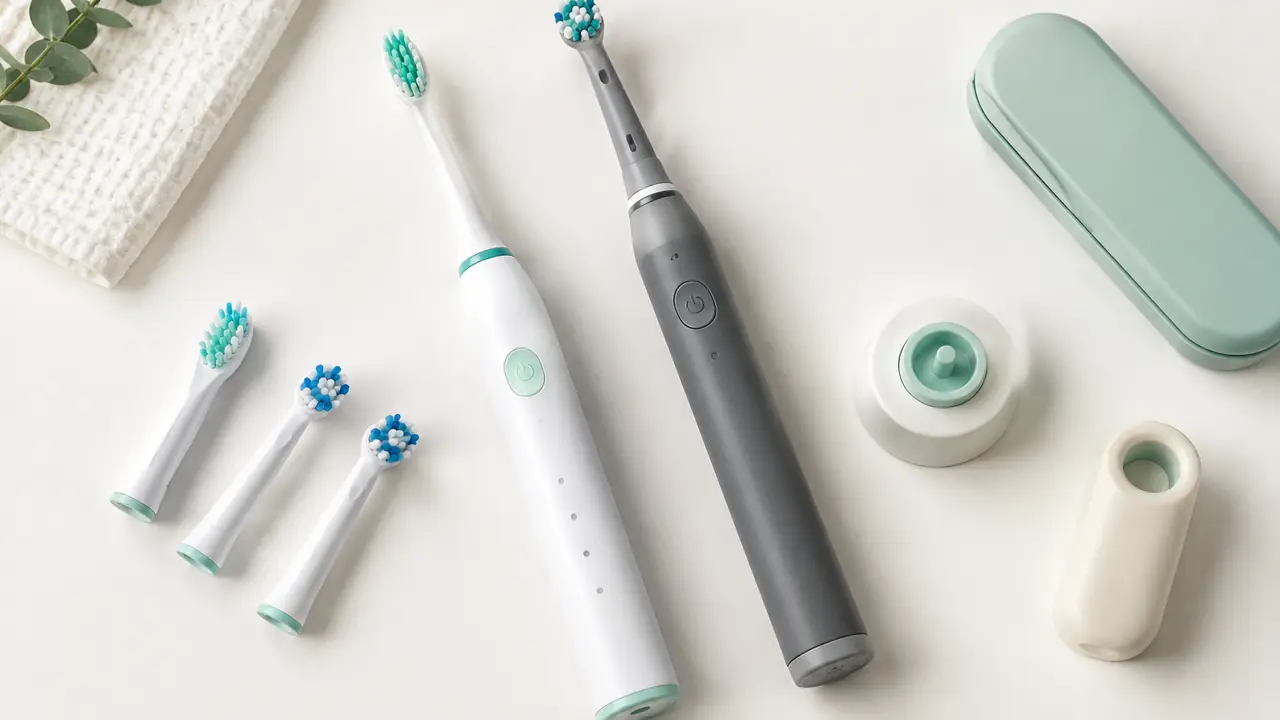
What the word smart actually adds
Strip the marketing and the delta is precise. A standard sonic handle carries a drive, a cell, a mode board with two to five programs, a two-minute timer with thirty-second prompts and IPX7 sealing - a closed machine that needs no account, no radio and no updates. A smart handle adds a Bluetooth radio, a pressure sensor feeding data rather than only a prompt, and firmware that logs sessions and reports them to a phone app, where zone tracking and brushing reports live. The brushing mechanics underneath - the 31,000-40,000 strokes per minute sweep, the 1.5-3 mm amplitude band, the 3.7 V cell of 800-1,400 mAh - are the same machine. That is the first useful fact for a buyer: smart is a layer on the platform, not a different platform, and the question is whether the layer pays for itself on the target shelf.
Side by side
| Dimension | Standard handle | Smart handle |
|---|---|---|
| Electronics | Drive, cell, mode board, timer | Same, plus Bluetooth radio and session logging |
| Feedback to user | Prompts, lights, pressure pulse on handle | App reports, zone coverage, session history |
| Sensors | Optional pressure sensor (mid tiers up) | Pressure sensor standard; motion data in firmware |
| Certifications | IEC/EN 60335-2-52 or UL 859; UN 38.3 and IEC 62133-2 if lithium | Same, plus FCC Part 15 (US) or CE RED (EU) for the radio |
| Product obligations | Ends at the box | App store presence, firmware upkeep, data handling questions |
| Cost drivers | Motor grade, amplitude, modes, collar fit | Radio module, sensor, firmware development, app upkeep |
| Return drivers | Charging, runtime, head fit | All of these plus pairing and app onboarding friction |
| MOQ reference | Catalog 500-1,000; private label 1,000-3,000 plus tooling | Same bands; firmware and app work sit in the schedule |
| Strongest fit | Core tiers, distributors, retail own brand | Premium tiers, app-led brands, subscription programs |
Read the table as a cost map rather than a scorecard. Every row where the smart column grows is a place where money, time or obligation is added: the radio row is an approval track measured in weeks, the app row is a maintenance tail measured in years, and the pairing row is a return reason that standard handles never generate. The rows that stay identical - motion, strokes, runtime, sealing - are the reminder that the user's two minutes feel the same either way. A buyer who wants connectivity should be able to say which row justifies it for their shelf; a buyer who cannot name that row is usually describing a premium price, not a premium product.
Where the standard handle wins
For most shelves, the standard handle is the correct core. It carries the full mechanical specification a buyer should want anyway - flagship stroke bands, a real mode ladder, honest IPX7 sealing, 14-30 day runtimes - without the radio's approval track or the app's maintenance tail. Certification is one file instead of two: the appliance route under IEC/EN 60335-2-52 with IEC 60335-1, or UL 859 for North America, and the cell tests where lithium. Quotations are comparable across a wide plant base, samples run on the usual catalog rhythm, and the failure modes a support team must know fit on one page: charging, runtime, head fit. Distributors, retail own-brand programs and first-time importers usually convert more shelf value per dollar here than anywhere else in the catalogue. There is also a breadth argument: two or three standard handles at distinct price points give a shelf more ladder than one connected model plus nothing beneath it, and every rung shares the same head platform, dock options and support script.
Where the smart handle earns its premium
Connectivity pays in three situations. First, premium tiers: at the top of a ladder, buyers expect something to justify the step, and a pressure sensor plus app reporting is the natural content. Second, app-led brands: when the product story is coaching - coverage, streaks, reports - the handle and app are one product, and cutting the radio cuts the brand. Third, subscription programs: session data deepens the replenishment relationship that heads already anchor. Against those wins sit permanent obligations the quotation must carry: FCC Part 15 or CE RED approval for the radio, an app that must exist in the target market's stores and keep working, firmware that needs version control and a written change process, and data-handling questions a brand must be able to answer plainly. The radio approvals are covered in FCC and CE RED for Bluetooth toothbrushes and listed market by market in the certifications guide.
The app is a product, budget it like one
The most underestimated line in a smart program is not hardware but the app's life after launch. Stores require accounts, privacy statements and update cadence; operating systems move; and a handle that pairs with an abandoned app becomes a return magnet and a review problem. Plants supply the reference app and firmware, but a brand that intends the connected story as a differentiator should treat the app as its own deliverable with an owner, a version number and a maintenance budget - the desk writes firmware and app responsibilities into the program documents rather than leaving them as a handshake. Ask, at quotation: which app, whose store accounts, what data the handle sends, where it is processed, and who fixes pairing failures in year two. The answers separate serious smart suppliers from ones who printed a Bluetooth logo.
What to specify on each tier
On a standard handle, specify the stroke band and amplitude measurement, the mode set, noise at or below the 55-60 dB band typical for sonic motors, IPX7, the 3.7 V cell at 800-1,400 mAh with runtime of 14-30 days at two two-minute sessions a day, and the charge path - USB in 4-6 hours or a wireless dock in 12-16 hours. On a smart handle, add the radio and its approvals by market, the pressure sensor's behaviour (threshold and response), the data the handle logs, the app's platforms and accounts, firmware versioning with a written change process, and pairing behaviour after battery removal or phone change. The spec-reading habit that keeps both tiers honest - every number paired with its measurement method - is in how to read toothbrush specs. Reference minimums and schedules sit on MOQ and lead time, confirmed in writing per program; a tier-plan brief starts at the quote form.