
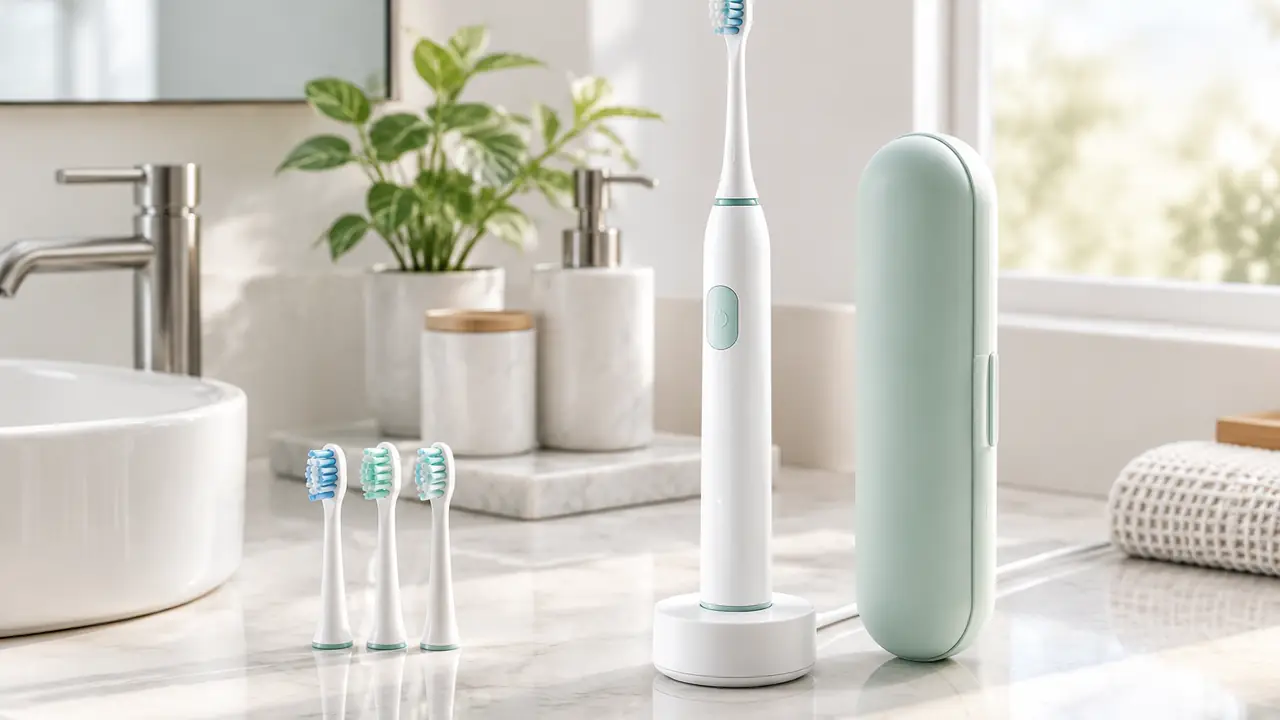
What gum care means on a spec sheet
Gum care sells strongly on shelves because it names its audience precisely: users who describe their gums as tender and want a brush that respects that. In the factory, though, the label is not a feature. Nothing in a motor or a mold is gum-specific, so a gum-care line is a selection exercise - choosing, from the standard sonic option grid, the combinations whose whole character is soft contact and low harshness, then presenting them honestly. Plants will quote any configuration a buyer asks for, but they rarely volunteer which combinations actually deliver the sensation, so the discipline has to come from the buyer's side.
The practical test the desk applies is simple: every statement the box makes must point at a feature that can be read on the datasheet or felt in a sample. Soft bristles are a filament spec. A gentle mode is a firmware entry. A pressure alert is a sensor option. A quiet drive is a measured decibel figure. If a phrase on the artwork cannot be traced to one of those, it does not belong there - and this rule is what keeps the position defensible in strict retail channels, where listing reviewers strip unsubstantiated wording before the product ever reaches the shelf.
The feature set that carries the position
Five features do almost all of the work in a gum-care positioned line, and all five are standard options on the sonic platform rather than custom engineering. The table below is the version of the brief the desk sends to plants.
| Feature | What it is on the datasheet | Why it carries the position |
|---|---|---|
| Soft tapered head | Soft nylon filaments, tapered tips, compact head | Contact pressure per tip is lower; the whole brushing feel reads gentle |
| Gentle mode | Firmware entry lowering stroke rate or amplitude | The floor setting of the handle drops without changing the routine |
| Pressure sensor | Optional component on mid and premium tiers | Corrects the over-firm hand with a pulse or a light, in the moment |
| Quiet drive | Motor bay typically kept at or below 55-60 dB | Low noise reads as calm operation before the user forms an opinion |
| Two-minute timer | Standard timer with 30-second prompts | Keeps sessions even without the user counting, at any mode |
The head and the mode are the pair that must be specified together; one without the other fails the brief, and samples should always arrive with the shipping head fitted. The replacement brush heads line lists the soft and tapered options, the brushing modes note explains what gentle modes typically change, and the pressure sensor note covers the sensing options and their response behaviours.
Line structure: how the SKUs tier
Most gum-care lines the desk coordinates settle at two or three handles plus a refill stream. The hero SKU carries the full feature set - soft tapered head, gentle mode, pressure sensor, three programs - and holds the premium shelf slot. The companion SKU shares the platform and the head but drops the sensor and one mode, holding a mid price without looking like a stripped leftover, because the box keeps the same soft-contact story. Below those, some assortments add a AAA-battery entry handle at 7,000-12,000 strokes per minute whose lower mechanical energy suits the same audience at an entry price. Three handles is the practical ceiling: beyond that the SKUs start competing for the same shelf meter and the plant's mode firmware multiplies for no commercial return.
Platform sharing is the quiet cost saver in this structure. Because the companion uses the same head collar and the same charging furniture, the plant tooling stays on catalog molds, spare parts pool across SKUs, and the artwork changes rather than the engineering when the line is refreshed. Buyers planning a private label program should hold that platform discipline deliberately - it is the difference between a line and a pile of models.
Heads and the replenishment loop
The position lives or dies after the first purchase, in the refill. A user who chose the line for soft contact will judge every replacement head against the first, so the head spec has to survive series production: the same filament call, the same tuft layout, the same trim quality, order after order. This is a supplier-management question more than a design one, and the desk handles it with head approvals at the start of the program plus lot checks against the golden sample. Heads carry their own reference minimums - typically 5,000-10,000 pieces per style - and they are where the line's repeat revenue concentrates, so the head supply terms belong in the first negotiation, not the last. Refill packaging can repeat the soft-contact wording, within the same limits as the handle box.
Wording: where the line has to stop
Gum care has a harder wording ceiling than any other positioning in the category, and it is worth stating plainly. The label describes a brushing sensation and an audience, not an outcome. Packaging and listings stay mechanical and sensory: soft bristles, gentle mode, pressure alert, quiet operation, a routine paced by the timer. They do not promise gum-health results, do not imply treatment, and do not borrow medical framing. Where a cleaning claim is needed at all, the honest ceiling is that mechanical brushing helps remove surface stains. Different markets enforce this at different strictness, but the strict version is also simply the true version of what the product is, so there is no commercial reason to write anything stronger. The desk's packaging review checks artwork against these limits before print, which is far cheaper than reprinting a box run or rebuilding a listing after a channel rejects it.
Program shape: minimums, samples, documents
Commercially the line follows the category's reference ranges. Catalog-mold handles start around 500-1,000 pieces per model; private-mold or branded programs run 1,000-3,000 pieces plus tooling; heads from 5,000-10,000 pieces per style. Public-mold samples usually take 7-15 working days and branded samples 15-25 days. The documents follow the platform: appliance safety under IEC/EN 60335-2-52 for most markets or UL 859 for North America, and UN 38.3 with IEC 62133-2 for the lithium cell. Certificates belong to the partner plants and are verified per project; every quantity, lead time and spec figure is confirmed in writing before the purchase order. Reference schedules sit on the desk's MOQ and lead time page, and a gum-care brief - platform, tier list, feature grid - can be sent through the quote form in the same format as the table above.