
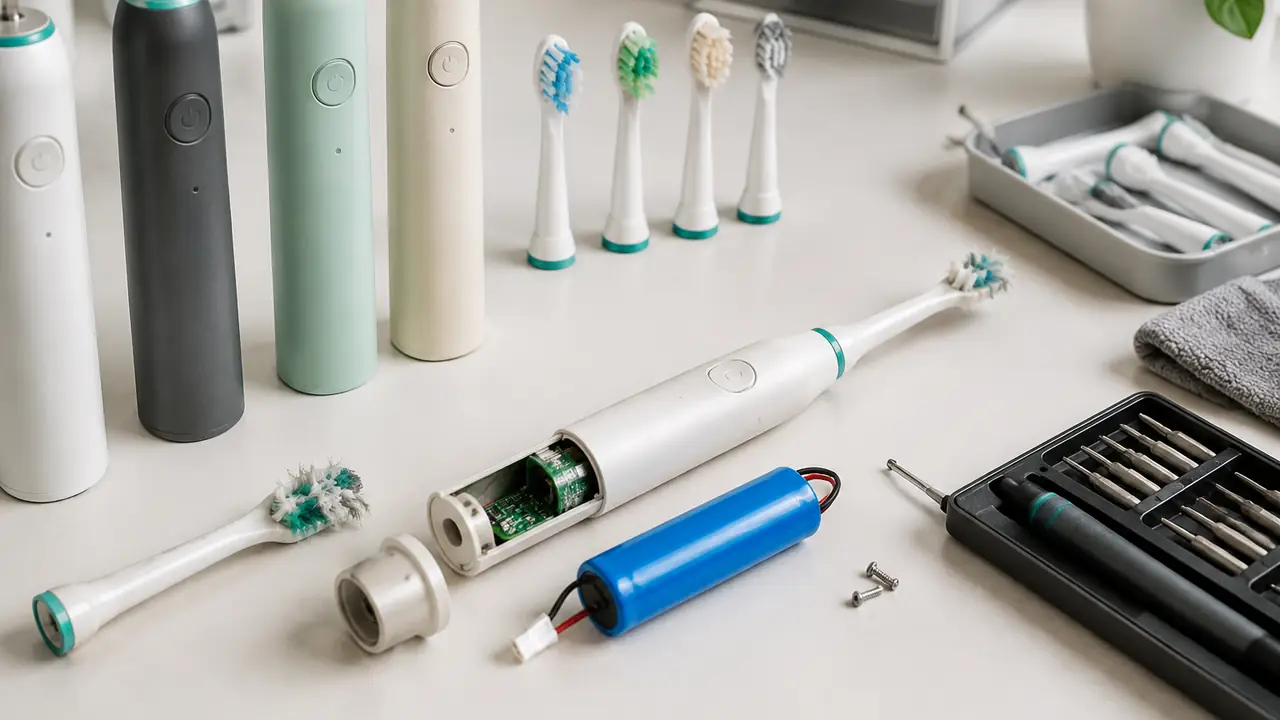
What holds a head on
The coupling is a snap fit: a collar molded into the base of the head grips a seat on the shaft, usually with a plastic snap ring riding a groove and sometimes a sealing ring adding friction. The joint has to satisfy two opposing demands at once. It must hold through a full session - tens of thousands of strokes, a pull against the teeth, a wet soapy environment - and it must still release with a thumb press, because the user swaps heads on a regular rhythm. That balance is set by dimensions and materials: the gap between collar and seat, the depth of the groove, the stiffness of the snap ring. In other words, retention is a designed number, not a happy accident, and everything in this note follows from treating it as one.
The same logic carries across drive families with different fittings. A rotary handle couples its round head through a socketed stem, and its wear point is the socket rather than a snap ring; a U-shaped tray couples through a wide snap joint where durometer and geometry share the job the snap ring does alone on a sonic handle. The parts differ, the questions do not: what holds the head, what wears first, and what number on a gauge proves the joint is within band.
The causes, in order of likelihood
| Order | Cause | What the user notices | Where the program acts |
|---|---|---|---|
| 1 | Mismatched head and shaft | Fit differs between head packs, or after buying third-party heads | Head pairing rules; first-article checks against the drawing |
| 2 | Collar wear after many swaps | The click grows weaker over months of use | Cycle testing; replacement rhythm printed in the manual |
| 3 | Debris and paste in the socket | Head seats half-way, then works loose | Cleaning line in the manual; drain-friendly geometry |
| 4 | Retention set too low | Head lifts under load against the teeth | Retention force band written into the spec |
| 5 | Shaft or seal wear on the handle side | Every recent head feels loose, not just one | Wear testing at qualification; life run-hours |
Note how far down the list the handle itself sits. In practice, most pop-off complaints trace to the head side of the joint - which head, whose collar, how old - and that is good news for a brand, because the head side is the half a brand controls through its sourcing rules.
Tolerance: the number behind the click
The collar and the shaft seat are two moldings, each with its own tool and its own tolerance, and the fit lives in the space between their dimension chains. A plant that molds both parts on its own platform holds that space by process control. The fit story changes the moment a second party enters: a head vendor working from a sample rather than the drawing, a tool copied from a worn part, or a batch molded on a machine running at a different shrink all shift the collar dimensions, and the click that answered firmly last quarter answers vaguely now. This is why the sourcing rules matter more than the inspection here - heads are bought to a drawing with first-article checks, or they are bought to luck. The tooling question underneath - who owns the mold, what a catalog platform commits a brand to - is laid out in private mold vs catalog mold, and it is worth settling before the first head order rather than after the first mismatch.
Retention force: measured, not guessed
The retention of a head is a listed test item, and the measurement is unglamorous and effective: a pull gauge reads the force to fit the head on and pull it off. The specification is a band, not a single number. Too low and the head lifts against the teeth; too high and thumbs lose the argument, which drives users to pry the head sideways and damage the collar they are trying to remove. Around the band sit two companion checks. Repeated fit-and-remove cycling confirms the snap survives the months of swaps a real user performs. And a vibration run with the head attached confirms the joint does not loosen itself under the very motion it exists to transmit. A plant that can show gauge readings and cycle counts for a platform is telling a buyer the joint is engineered; a plant that demonstrates by clicking a head on in the meeting room is not.
Platform and supply: heads that must match for life
Heads are the repeat purchase of the whole category - the part the customer buys again and again for the life of the handle - so the pop-off question is also a supply question. Every head a brand sells must match the collar drawing of every handle it ever shipped, including handles sold years earlier. That calls for a supply commitment in writing, drawings archived beyond the last shipment, and a compatibility statement a support team can quote. Where heads are sourced second-hand from the platform's own ecosystem, the first-article check is the gate. There is a support dividend too: a listing that names which handles a head pack fits, in the same words the manual uses, removes the mis-buy that generates half of all pop-off complaints in marketplaces. Reference order quantities for heads sit on MOQ and lead time, the bristle and collar details are in the replacement heads guide, and the platform logic behind compatibility is in the compatibility note.
Back to specification and inspection
The specification lines are short: a retention force band with the gauge method named, a fit-and-remove cycle count, head pairing rules that name the drawing, and a supply commitment for the platform. The inspection plan then verifies per batch - gauge readings on sampled heads at incoming, retention checks on assembled units on the line, and a pre-shipment pull test so the record ships with the goods. Items are agreed per order and confirmed in writing, and a program whose heads and handles share a drawing is one where the pop-off complaint becomes rare enough to investigate individually. A head or handle brief starts on the quote form, and how the test items sit in the plan is on the testing and inspection page.