
Why heads decide the economics
An electric toothbrush handle is sold once; its head is bought for years. That asymmetry shapes the sourcing picture more than any line on a datasheet. A handle program that ships without a head plan leaves its most reliable margin unclaimed, and a head program locked to one plant's collar format loses leverage the moment volumes grow. Buyers who treat heads as a component line in their own right - with their own specifications, minimums, test list and packaging - build the assortments that replenish steadily and hold shelf space. Subscription-led brands make the point sharpest: the handle is the acquisition cost, the heads are the annuity, and head quality decides whether the annuity survives contact with the customer.
The category orders heads separately from handles, in larger quantities and on faster cycles. Typical reference minimums start at 5,000-10,000 pieces per specification, roughly ten times the 500-1,000 pieces a catalog-mold handle usually needs. That gap is worth planning early, because volumes of that size justify a supplier review of their own rather than a rider on the handle quotation. Reference timing for samples and bulk sits on MOQ and lead time, and every figure is confirmed in writing per order.
Anatomy of a replacement head
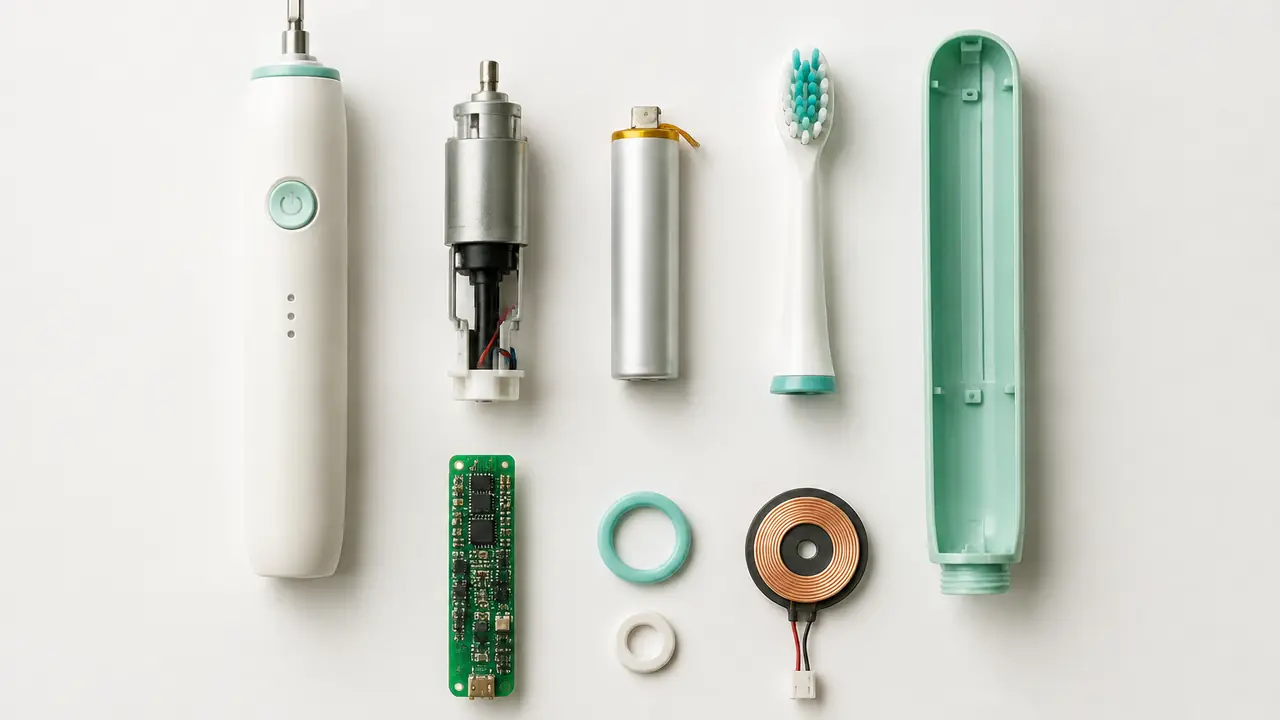
Four features define any head. The collar is the outer shell that snaps over the handle neck; its inner geometry is cut into the mold and decides which handles the head fits. The socket is the cavity that receives the metal shaft, and its tolerance decides how much of the motor's stroke reaches the bristles instead of escaping as rattle. The tuft plate is the molded face carrying the bristle holes; hole count and pattern set the planting density. The bristle field itself - material, filament diameter, tuft heights and angles - is the part of the specification users actually feel.
Each feature is a checkpoint in development. Collar pull-off and push-on forces are gauged so the head seats firmly and releases without tools. Socket fit is rechecked for play after repeated fit cycles. Tuft retention is pulled per tuft against the plant's own standard so bristles stay anchored in service. None of these tests is exotic; all of them belong on the order's agreed test list, which the desk confirms in writing with the plant before production starts.
Bristle options and what to claim
Three bristle families cover most programs. Soft nylon filaments - DuPont nylon is the material name plants quote most often - are the default for adult heads, with filament tips rounded so the edge is smooth against the gum line. Spiral bristles twist fine filaments into a helical tuft that carries paste differently from a straight one. Charcoal-infused filaments carry pigment through the nylon itself; they are a color and shelf-story choice, and listings should describe them as exactly that rather than promising results. For all three, the honest claim stays mechanical: bristle softness, tip finish, tuft layout. A brush helps remove surface stains and paces a routine; it does not treat anything, and head packaging should be written under the same rule. The materials are compared in depth in brush head bristle materials.
Softness is a range, not a switch. Filament diameter, tip treatment and tuft height set how gentle a head feels, and kids programs and sensitive-gum assortments sit at the soft end of that range with smaller heads to match. The sensitive gums note shows how those choices cascade through a full specification.
The spec sheet a head program needs
| Item | Typical situation across the category | Confirmed by |
|---|---|---|
| Collar fit | Per platform; pull-off and push-on forces measured | Gauge check on samples |
| Tuft density | Hole count and pattern set per mold | Mold drawing and sample |
| Tuft retention | Per-tuft pull against the plant standard | Test report per lot |
| Fit cycling | Repeated snap-on and snap-off before recheck | Agreed test list |
| Bristle material | Nylon, spiral or charcoal-infused filaments | Material declaration |
| Packaging | Blister card or box, per channel | Artwork approval |
These are reference checkpoints, not a promise about any particular head; the binding figures come from the plant's own drawings and reports, verified per project.
Compatibility: the collar is the contract
Heads do not interchange across platforms. The collar's inner profile is cut for one handle neck, so a head program is always locked to the handle family it serves - unremarkable while that plant supplies, and a real problem the day it stops. Buyers should confirm in writing how long a plant commits to supplying heads for a given collar, and what happens to the tooling if the relationship ends. The mechanics of collar formats and mold ownership are set out in brush head compatibility, and the buyer-facing summary lives in the compatibility guide.
A second question comes from assortment design: one platform, several heads. Most lines carry a standard head, a compact head and a smaller profile for kids, all on the same collar. Because the collar mold is shared, each variant costs far less to add than the first head - the tuft plate and bristle specification change, the collar does not. That is the most economical breadth a toothbrush line can buy, and it is worth deciding before the first collar mold is cut.
Quality checks that matter most
Three failures dominate head complaints in the field: shedding, loose fit and early splaying. All three are testable before shipment. Tuft retention is pulled per tuft and recorded per lot against the plant's standard. Fit is cycled - the head is snapped on and off through an agreed number of repetitions, then rechecked for play and pull force. Splaying resistance is judged by running heads on a rig and inspecting filament tips under magnification. The desk writes these items into the pre-shipment checklist for every head order, alongside the appearance and packaging inspection that closes the standard list; the routine is described on the testing and inspection page.
Head materials also carry paperwork. Material declarations for the filaments and collar resins, plus RoHS and REACH support where the destination market requires them, are reviewed per project like any other component document. None of it is heavy; all of it is cheaper to collect before the purchase order than after.
Ordering heads as a program
Practical sequencing for a buyer: fix the collar and platform first, add variants second, set packaging last. Heads ship small and light, so they consolidate well with handle orders by air or by sea, and they classify for export either under the appliance heading or under the toothbrush-and-parts heading depending on the destination's practice - a point the desk always leaves for the customs broker to confirm rather than assuming. Typical minimums of 5,000-10,000 pieces per specification and normal production windows are on MOQ and lead time, and a head-only program can be briefed through the quote form without a handle order attached.