
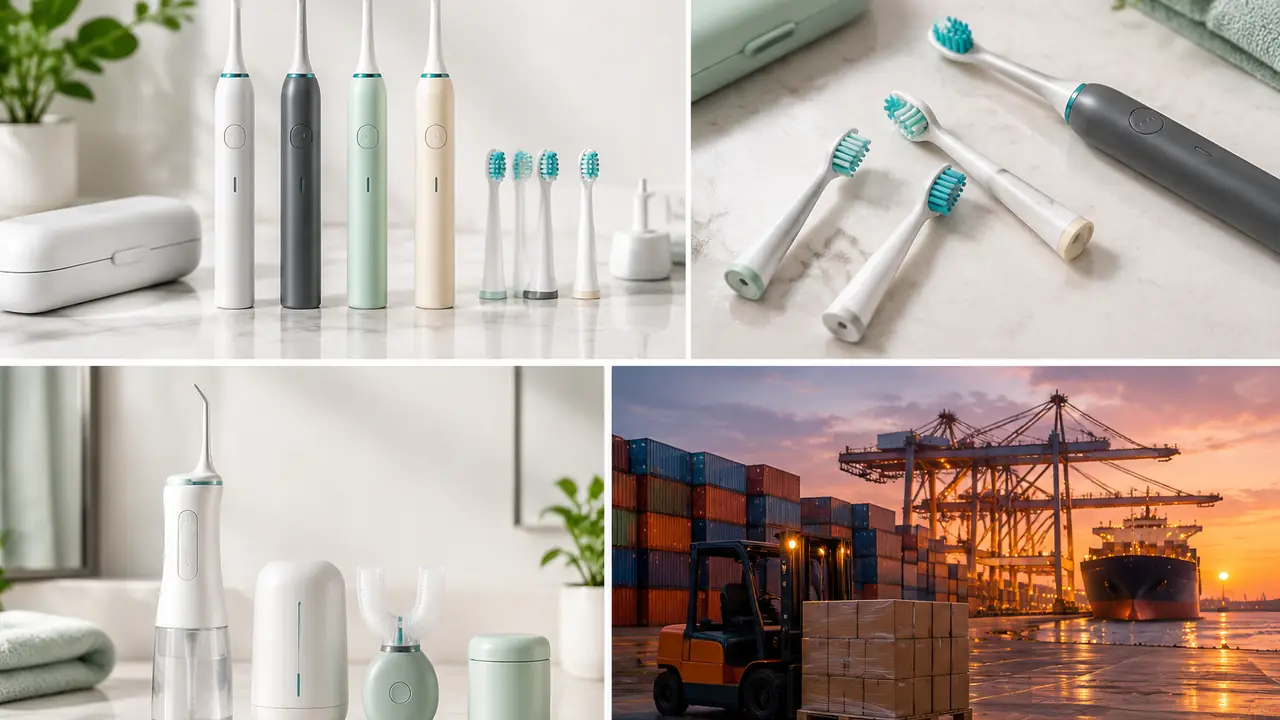
What private label covers on a toothbrush
On a plant's platform, private label reaches six layers. Identity on the shell: pad-printed or laser-etched logo, colorways, finish. Shell geometry itself, where the budget supports a private mold. Firmware: mode names, mode count within the platform's two-to-five range, prompt behaviour, low-battery signals. The head: bristle specification at minimum, and the collar platform at the strategic extreme. Packaging: box structure, artwork, insert, manual. And the accessories that frame the offer - dock, cable, travel case, gift sleeve. A credible private-label brief names which layers it intends to touch, because each added layer moves the minimum, the schedule and the paperwork.
The layers are not independent either. A custom box presupposes the handle geometry is frozen, firmware mode names print on that box, and the head-pack artwork must match the collar actually cut - so the layers sequence as geometry, then firmware, then artwork. Programs that reverse the order redesign their packaging mid-schedule; programs that hold it spend their energy on the product.
The promise worth making explicit: on a mature platform, private label is not a lesser product. The drive, the cell, the seals and the certification routes are the plant's engineered assets; what the brand adds is the parts the customer sees and the replenishment stream that follows. Done deliberately, that is the whole value of the route - the brand owns the experience layers while inheriting a tested machine underneath.
The customisation ladder
| Rung | What changes | Typical effect |
|---|---|---|
| Logo and finish | Mark on shell, colorway, surface finish | Lowest added effort; fastest artwork path |
| Packaging | Box structure, artwork, insert, manual languages | Print plates and proofs; the brand's first real asset |
| Firmware | Mode names and set, prompt behaviour | Version-controlled deliverable with a written change process |
| Head specification | Bristle type, trim, tuft layout on the platform collar | Head minimums apply; refresh cycle planning begins |
| Private mold shell | New tooling for the buyer's geometry | Tooling fee; 1,000-3,000 pieces plus tooling; longer first round |
| Own collar platform | Head interface cut to the brand | Proprietary replenishment; the deepest rung |
Climbing is a decision per rung, not a package deal. Many strong programs stop at rung four: brand identity, custom box, tuned firmware and a specified head - the full machine underneath, the visible layers owned. The comparison with staying on a catalog mold is set out in OEM vs ODM.
The head platform: the decision that outlives the launch
The handle launches once; the head ships for years. On a shared collar, any buyer of the platform sources compatible heads, so the brand's replenishment competes on price from its first repeat order. On a collar cut to the brand's own platform, the head stream is proprietary - which is why the deepest rung exists and why the desk raises the collar question at quotation, not after launch. The mechanics of collars and platform lock-in are in the brush head compatibility guide, and the head line itself, with bristle options and typical minimums of 5,000-10,000 pieces, is on replacement brush heads.
The planning rule: decide the collar rung before the first handle order, because changing it later means new tooling and a new head minimum. Brands built on subscription economics usually take the proprietary rung early; retail chains often stay shared and compete on the box; both are rational if chosen on purpose.
Quantities and timing for private label
The reference numbers for the route: private-mold and private-label programs typically run 1,000-3,000 pieces per model plus tooling, against 500-1,000 for catalog models. Samples take 15-25 days where artwork and color approvals drive the path, and 45-90 days where a private mold is cut and first-article validation is in scope. Batches run 35-50 days after approval. U-shaped and kids programs generally start around 1,000 pieces on their own tooling logic. Certification rides alongside: CE self-declaration with third-party testing in roughly 2-4 weeks, UL or ETL in 4-8 weeks, UN 38.3 for the lithium cell in about 2-3 weeks - and a model that already holds a file inherits it. All of these are the industry's common reference ranges, confirmed in writing per program on MOQ and lead time.
Artwork, manuals and the compliance set
Private label transfers the compliance burden to the brand as well as the visibility. Box copy stays on mechanical and sensory facts - stroke counts and modes as the datasheet states them, the two-minute timer, IPX7, runtime per test, soft bristles, gentle modes, and the fixed stain wording: helps remove surface stains. No treatment language, no germ claims, no implied approvals. Market markings follow destination: CE and the EU responsible-party details, UKCA for the United Kingdom, origin declared as Made in China, barcodes per the channel's data rules, and manual languages fixed before artwork lock. For US-market programs, the plant's FDA establishment registration is a facility layer, never to be phrased as product approval. The packaging workflow that carries this - dielines, proofs, retained reference prints - is on the packaging and retail boxes page.
Planning replenishment from day one
The private-label case is won on the second order, not the first, so the program plans replenishment at launch. Head counts: the replacement cycle sets pack formats and the reorder rhythm, and the 5,000-10,000-piece head minimums reward brands that consolidate pack types. Handle cadence: a launch quantity with a stated growth path quotes better than a one-off discounted order, because plants staff lines for relationships rather than transactions. Channels plan differently - subscription-led programs profile in the DTC brands page, shelf programs in retail chains - but both reduce to the same file: golden sample retained, artwork reference print retained, firmware version recorded, head minimums and availability confirmed in writing for the product's life.
How the desk runs a private label program
The desk's sequence is short enough to state: fix the rung - which layers the brand touches - and the collar decision first; shortlist partner plants whose platform already carries the specification band; quote the private-label and catalog versions of the same concept side by side so the trade is visible; put tooling ownership, exclusivity scope, head minimums and the artwork approval chain into the written program confirmation; and gate each batch with a pre-shipment inspection against the approved reference set. Every agreed figure is confirmed in writing before tooling or orders move. A private-label brief that names the rung and the market starts at the quote form; what the packaging layer carries is in packaging for export, and the mold-payback logic is in private mold investment.