
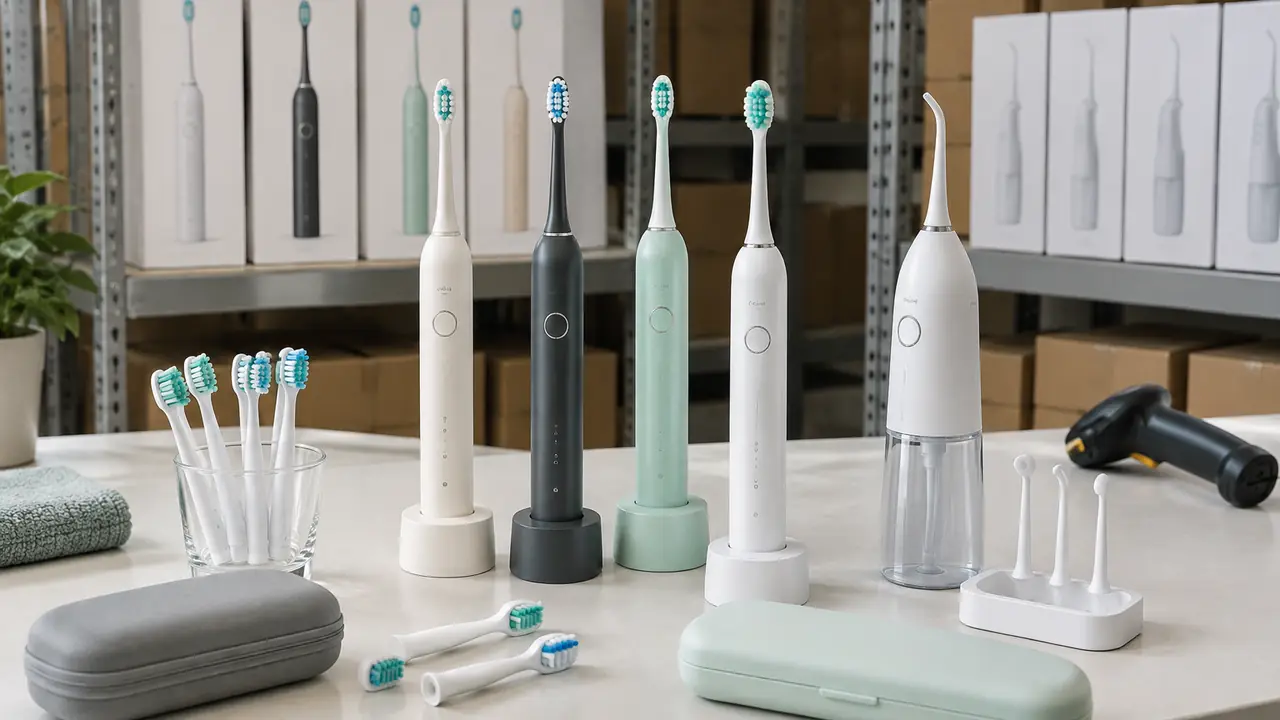
Three depths of customisation
Most first conversations about a custom handle conflate three routes that carry very different commitments. The catalog mold is the plant's existing model with the buyer's branding on packaging: fastest and lightest to enter, and shared with whoever else quotes the same body. The private-label route stays on the plant's platform but takes the buyer's identity deeper - shell colours, logo placement, packaging, and often a firmware mode set - with tooling limited to print plates, colour and packaging. The private mold cuts new tooling to the buyer's design: a shell nobody else can order, and optionally a head collar, dock or travel case geometry of the buyer's own. Each step deeper buys differentiation and pays for it in minimums, schedule and management attention, which is why the decision deserves arithmetic rather than enthusiasm.
| Route | What changes | Typical MOQ | Typical schedule |
|---|---|---|---|
| Catalog mold | Plant's existing model; buyer branding on packaging | 500-1,000 pieces per model | Samples 7-15 working days; batch 30-45 days |
| Private label | Platform shell in buyer colours, logo, packaging, mode set | 1,000-3,000 pieces plus tooling | Samples 15-25 days; batch 35-50 days |
| Private mold | Tooling cut to buyer design: shell, optional collar, dock or case | 1,000-3,000 pieces plus tooling fee | First samples 45-90 days; first batch 60-120 days including certification |
The ranges above are industry reference points, not quotations - the desk confirms minimums and schedules in writing for each program once the brief is fixed. The structural comparison between the routes is developed in private mold vs catalog mold and in the note on OEM versus ODM ownership.
What a mold is on a toothbrush
Tooling on this product is a family, not a single item. The shell is the obvious piece: usually two moulded halves plus any overmould grip, and it defines the silhouette a shopper recognises. Around it sit the quieter tools - a head collar set if the buyer wants heads on an owned geometry, a charging dock or travel case mold, and for a U-shaped program the silicone tray tools, which are the project. Packaging adds its own plates and blister forms, modest in cost but on the critical path for launch. Firmware is not a mold at all, yet it behaves like one economically: a custom mode set is a deliverable with version numbers, and owning it matters as much as owning steel.
Buyers rarely need to own the whole family. A common pattern is an owned shell with the plant's proven internals - motor, cell, PCB platform - so the differentiation sits where shoppers see it while the engineering stays on a qualified base. The collar is the strategic exception: because heads must keep flowing for the product's life, collar ownership decides whether refills are a brand asset or a dependency, a point the subscription economics note develops in full.
The cost logic, without prices
No prices appear in this note, and none are needed to describe the structure. A tooling fee is a one-time engineering cost: moulds are cut, sampled, corrected and only then approved for production, which is why first samples take 45-90 days on a private-mold program against 7-15 working days for a catalog body. After cut, the economics shift to per-unit terms, where a private mold may or may not beat a catalog body depending on complexity and volume - the honest comparison comes from an itemised quotation, with tooling listed separately from piece price, never blended. Molds also have lives: they wear, they need maintenance, and a high-velocity program should plan cavity additions rather than discover capacity limits in peak season. Colour, finish and packaging add their own smaller tooling and setup items. The desk's practice is to keep every one of these lines visible, so a client can see exactly what the one-time investment buys and what the recurring cost structure looks like before committing.
When the investment pays back
Payback is a volume and platform question, and it arrives through a few recognisable patterns. The first is velocity: a catalog model already selling at a pace that outruns its differentiation is the classic candidate, because the mold replaces a shared body with an owned one without changing the demand. The second is the platform effect: a shell family that carries several SKUs - colourways, a kids variant, a travel kit - amortises one tooling decision across multiple listings, which is the strongest arithmetic in the category. The third is the head platform: an owned collar turns every handle sold into a stream of refills on the buyer's geometry, and the mold cost should be judged against that whole stream, not the handle alone. The fourth is channel: retail chains building an own-brand shelf and hospitality programs ordering at project scale often want formats nobody else can quote, which the audience pages for retail chains and brand owners describe from the buyer's side.
The honest negative cases matter as much. A single test SKU in an unproven channel should stay on a catalog mold; a spec that is still moving belongs in samples, not steel; and a program whose first year depends on one seasonal window rarely recovers tooling inside it. When any of these hold, the catalog route is not a compromise - it is the correct instrument, and the examples in the desk's case studies include programs that started there on purpose.
Protecting the investment
Tooling money is only as safe as the paper around it. The items that belong in writing before a mold is cut: who owns the tooling, where it is custodied (usually at the plant, as buyer-owned property), who pays for maintenance and cavity work, what happens on transfer or at program end, and how design ownership is documented for the shapes the buyer commissioned. Design-registration and patent questions are handled per project with documents rather than assumptions, and the desk reviews them with the client's counsel where needed. None of this is adversarial; plants respect buyers who define terms early, and a written tooling agreement is a normal, expected part of a private-mold program. What is not normal is discovering at year three, when switching plants, that ownership was never stated - the one outcome this checklist exists to prevent.
A staged path, and where to start it
For most buyers the sequence is staged rather than binary: a catalog model to test the channel, a private-label step to build brand presence once repeat demand shows, and private molds when velocity or a platform plan justifies steel. Each stage generates the evidence the next decision needs - sell-through, return rates, head attach rate - and nothing is wasted, because the internals platform carries across all three. Reference minimums and schedules for every stage are collected on MOQ and lead time, each confirmed in writing per program. A brief that states the market, the target depth of customisation and the intended platform can be started through the quote form, and the desk will answer with the routes that fit rather than the one that is easiest to quote. The OEM and private label page carries the working detail of each route.