
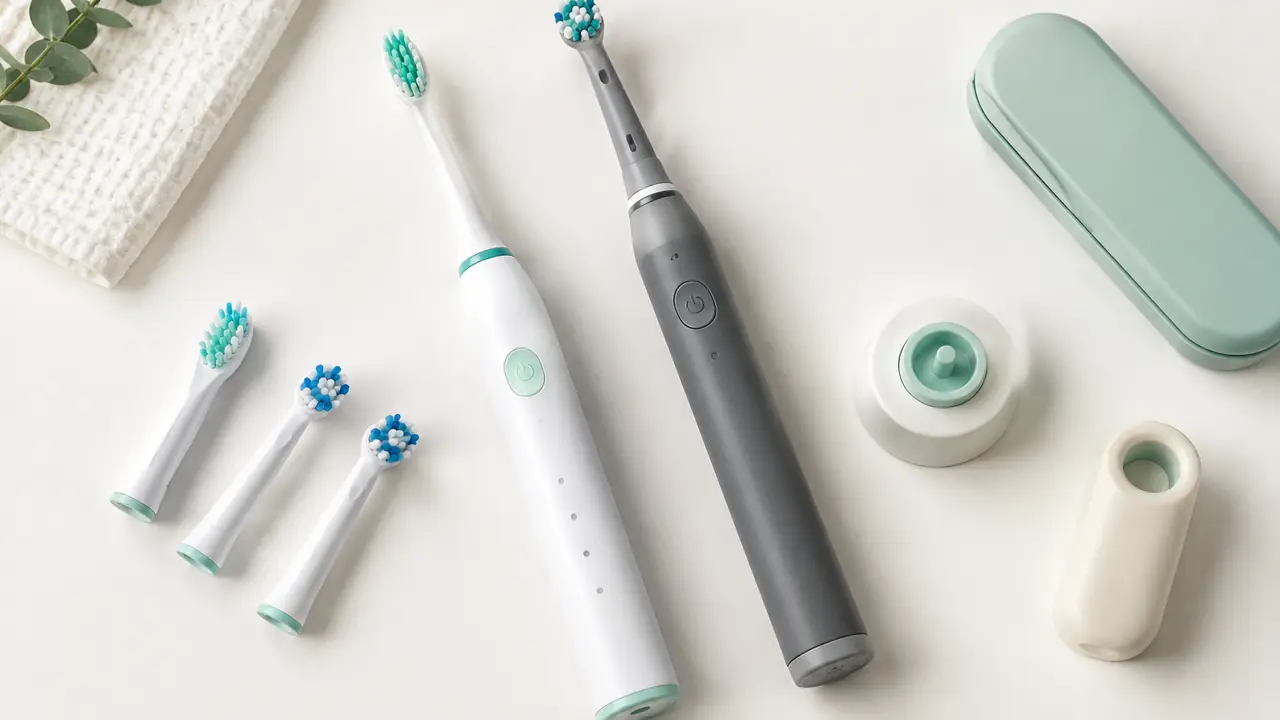
Two motions, two supply chains
A sonic handle swings an elongated head side to side at 31,000-40,000 strokes per minute on flagship models, or 20,000-31,000 on entry tiers, with bristle tip travel of roughly 1.5-3 mm. The fast sweep churns the paste-and-water mix so each pass reaches a little beyond the bristle tips. A rotary handle turns a small round head at about 7,000-8,800 rotations per minute, and some models stack a sonic-range stroke of 20,000-40,000 on the same head as a hybrid. The two headline numbers sit on different scales and were never comparable: a rotation covers far more distance per cycle than a half-sweep, so each family quotes the figure that describes its own geometry.
The supply chains differ as much as the mechanics. Sonic platforms are the format most plants in the Chinese clusters build - Zhejiang's Ningbo and Hangzhou belt concentrates sonic-handle factories, with media reporting one Zhejiang maker selling over 30 million units a year into more than 40 countries - so quotations are plentiful and lead times are predictable. Rotary drive needs a gear train and a head socket that survive millions of cycles, and the plants that build it well are a smaller, more specialised set, concentrated in the Guangdong electronics belt alongside the generalists of Shenzhen and Dongguan. A buyer who treats the two families as one category and collects quotes across both ends up comparing machines that were never alike, which is why the desk separates them at the brief stage.
Side by side
| Dimension | Sonic | Rotating |
|---|---|---|
| Motion | Elongated head sweeps side to side | Round head spins on a stem; hybrids add a sweep |
| Headline speed | 31,000-40,000 strokes/min; entry 20,000-31,000 | 7,000-8,800 rotations/min; hybrids 20,000-40,000 strokes |
| Feel | Fast wash; moving paste extends each pass | Polish-like, one or two teeth at a time |
| Modes and sensors | 2-5 modes; pressure sensor common from mid tiers | Mode set per model datasheet; pressure sensor optional |
| Cost drivers | Motor grade, amplitude delivery, modes, collar fit | Gearing quality, head socket wear, sensor option |
| Certification route | IEC/EN 60335-2-52 or UL 859; UN 38.3 and IEC 62133-2 if lithium | Same appliance route; same cell tests if lithium |
| MOQ reference | Catalog 500-1,000/model; private label 1,000-3,000 plus tooling | Same reference bands; fewer plants able to quote |
| Strongest fit | Flagship tiers, DTC subscription lines, retail own brand | Value tiers, distributor price ladders, second-SKU breadth |
Where a sonic line wins
The sonic format is the default flagship for structural reasons. A slim handle with an elongated head reads as a premium object on a shelf, the stroke count scales cleanly across price tiers, and the platform carries two to five modes, a pressure sensor and even Bluetooth without changing the base architecture. The plant base is the widest in the industry, so samples of catalog-mold models typically arrive in 7-15 working days and mass production in 30-45 days. Head replenishment completes the case: elongated nylon heads wear on a visible cycle and anchor the subscription economics most brands want. For a first serious line, this is the family the desk can quote fastest and widest.
Where a rotating line wins
Rotary earns its shelf as the value tier and the second SKU. The small round head is mechanically simple and inexpensive to produce, which supports sharp entry pricing on the handle, and the polish-like feel is genuinely different from a sweep - buyers who already carry a sonic line gain real catalogue breadth rather than a re-skinned duplicate. For distributors building price ladders, a rotary handle fills the entry band without dragging the flagship's specification down to it. The trade-offs are the narrower plant base, a bulkier head silhouette and a gear-driven sound profile that a buyer should judge by listening to several sample units rather than reading a datasheet. Run the two formats side by side on the sonic vs rotating guide before locking either.
Market behaviour reinforces the split. Industry research puts China as the largest producer and second-largest consumer of the category, with roughly 192 million sets made in 2025 and more than half exported, led by the United States, Australia, Japan and the Netherlands (Zhiyan, 2026 report) - and export assortments mirror the shelf logic of destination markets: sonic above, rotary and battery formats below. neither family is a losing bet; the error is picking one by default without checking which shelf slot the program is meant to fill.
What to specify for each family
On a sonic brief, fix the frequency band first (flagship 31,000-40,000, entry 20,000-31,000), then ask how amplitude - about 1.5-3 mm at the tip - is measured and with which head attached, because two handles printed at the same figure can feel a class apart. Add the mode set (2-5 programs), the noise target at or below the 55-60 dB band typical for sonic motors, IPX7 sealing, a 3.7 V cell of 800-1,400 mAh with 14-30 days of runtime at two two-minute sessions a day, and the charging path: USB in 4-6 hours or a wireless dock in 12-16 hours. The strokes-per-minute note explains how to compare frequency figures across plants without being misled.
On a rotary brief, specify the rotation band and whether the model is pure rotary or a hybrid with an added sonic stroke, since hybrids change the drive, the head and the head cost. Ask for the head socket's life-test evidence, the collar retention force measured with a pull gauge, the pressure-sensor option if the price band allows, and the standard two-minute timer with thirty-second prompts. Both families share the appliance paperwork - IEC/EN 60335-2-52 with IEC 60335-1, or UL 859 for North America - and rechargeable cells in either family carry UN 38.3 and IEC 62133-2 before they ship.
Choosing between them as a program
For most importers the answer is a ladder, not a verdict: a sonic handle carries the flagship and the subscription story while a rotary model holds the entry price point, and both feed the same replacement head logic of keeping handles and heads merchandised together. Consumer research firms put North America at roughly 54 percent of global category consumption, and US retail assortments habitually show both families side by side, so a two-family line matches how the shelf already reads. Reference minimums - 500-1,000 pieces for catalog models, 1,000-3,000 plus tooling for private label - and the full schedule sit on MOQ and lead time, confirmed in writing for each program. Send the brief with your market and price-band split through the quote form and the desk will shortlist plants for each family separately.