
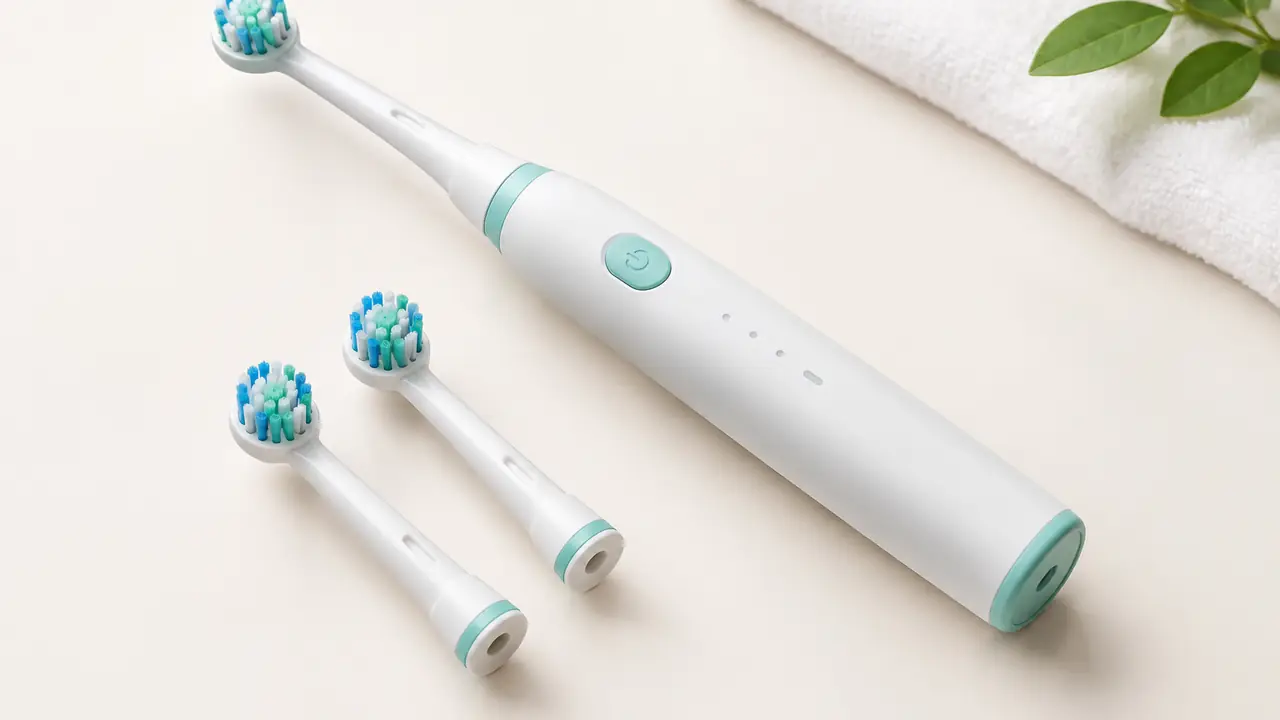
What a rotating toothbrush is
A rotating toothbrush cleans with a small round head that spins. The handle holds a motor and a gear train; the shaft turns the brush cup at a typical 7,000-8,800 rotations per minute, and the user works tooth by tooth or quadrant by quadrant instead of sweeping along the arch. A two-minute timer with a thirty-second pacer is standard across the category, and pressure sensing is optional on mid and premium builds. The format has decades of retail history behind it and a distinct feel: a smaller working head, a slower turning speed and a more localised action than a sonic handle delivers.
For a sourcing desk the format is a separate product line, not a sonic brush with a different head. The drive train, the shaft, the collar and the head economy all differ, and buyers who try to treat the two as one platform usually discover it at tooling stage.
The drive and the sonic overlay
Two drive layouts dominate quotations. The pure rotation layout runs the cup off a gear train and keeps the cost floor low; this is the layout most value retail ranges specify. The hybrid layout adds a sonic element: the handle also drives strokes at 20,000-40,000 per minute, so the cup rotates while the handle pulses. Buyers choose between the layouts on price band and in-hand feel rather than on a single number, because rotation speed is a typical range and two cups at the same speed can behave differently depending on bristle profile, cup mass and the fit of the head on the shaft.
Configurations plants quote most often
| Configuration | Drive | Power | Typical use |
|---|---|---|---|
| Round-head classic | 7,000-8,800 rotations/min | 3.7 V lithium, dock or USB | Value retail, distributor ranges |
| Sonic-overlay hybrid | Rotation plus 20,000-40,000 strokes/min | 3.7 V lithium, 800-1,400 mAh | Mid retail, brand extensions |
| With pressure sensing | Rotation with load sensor | 3.7 V lithium, dock or USB | Mid and premium builds |
Ranges are category references confirmed per model datasheet; on the hybrid, the stroke figure refers to the sonic overlay, not to the cup speed, and listings should keep the two apart.
Heads: the round cup business
Round heads are the consumable side of the format, and they behave like a business of their own. Collars snap onto a fixed shaft platform, so a brand that locks the platform early sells heads against it for years: soft and medium bristle profiles, small cups for tighter mouths, and polishing-style cups with denser tufting for the premium tier. Bristle quality is measurable - tuft density, tip rounding, retention force on the pull rig - which makes the head the right place to spend sampling time. The head compatibility guide explains platform tooling, the replacement heads line carries the material and tufting options, and the material side is covered in the heads guide.
Rotating or sonic: how buyers decide
The two formats are not substitutes on a shelf; they are different products with different retail grammar. Rotating formats suit ranges built around the round-head habit, where the shopper recognises the cup and the price band sits in the middle. Sonic formats suit slim-handle design language, mode-led listings and a replacement-head story told in colours and bristle types. When a buyer needs both, the heads, docks and packaging are usually kept separate because the platforms share nothing. The mechanics are compared in the sonic versus rotating guide, the shopper-level comparison is in this format face-off, and the rotating deep-dive is in the rotating buyer guide.
Where the handles are built
Rotating handles draw on two supplier bases. The Shenzhen and Dongguan OEM belt in Guangdong supplies the motor, gear and moulding chain that the drive train needs, and assembly plants there build rotating lines alongside sonic ones. Ningbo and Hangzhou in Zhejiang are the sonic strongholds, but their plants also run rotation platforms for export ranges. The desk shortlists plants by drive-train experience - gear quality shows up as noise and wear - rather than by catalogue size. More on the clusters.
Power, testing and shipping
Rechargeable rotating handles run a 3.7 V lithium cell, typically 800-1,400 mAh, with runtime quoted per model datasheet and charged on a dock or a USB stand. The battery carries UN 38.3 transport tests and IEC 62133-2, and the appliance side is certified to IEC/EN 60335-2-52 with CE marking for Europe or UL 859 through UL or ETL for North America. Inspection adds rotation-specific checks to the usual plan: cup speed on a rig against the model report, gear noise at the ear, timer and pacer behaviour, head retention on the pull rig, IPX7 soak with a post-soak button check, drop and carton tests. The plan is written per program before the first batch - see quality control, the reference quantities on MOQ and lead time, or send the brief to the quote form.