
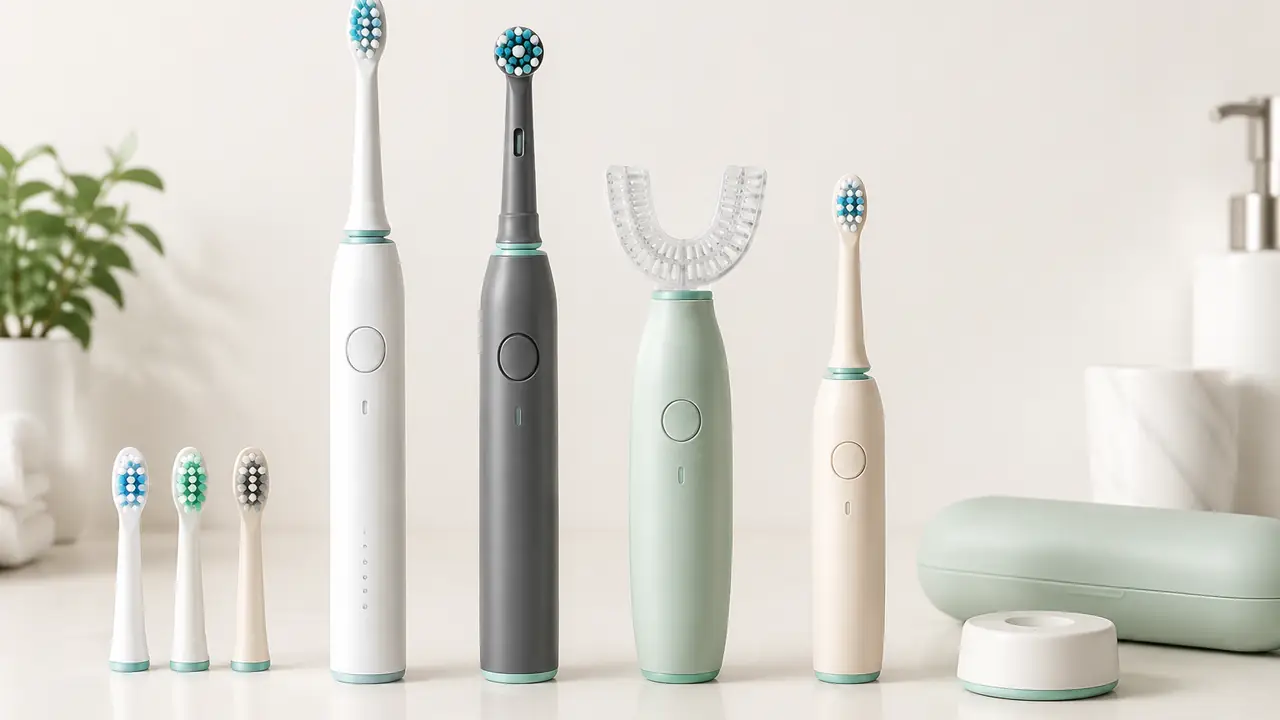
What the format is
A rotary handle hides a gear train where a sonic handle has a swinging shaft. The motor spins, gearing scales the speed and carries rotation up the neck, and a round head turns on a stem seated in a socket at the tip. Bristle tufts are set into the round base at mixed heights and angles, so that as the head turns, each tuft traces a small arc across the tooth surface. The user works tooth by tooth rather than sweeping the whole arch, which is why the format's feel is usually described as a polish rather than a wash. For a buyer, the mechanical summary is this: the drive is geared, the head is the wear interface, and the plants that build the format well are a narrower set than the broad sonic base.
That last point frames the whole guide. Rotary is not a variant a general sonic plant bolts onto a quote; it is a platform with its own tooling, its own tolerances and its own experienced factories. Treating it as its own category from the first plant conversation is what separates a rotary program that runs for years from one that generates socket complaints within a season.
Speeds and drive options
| Parameter | Typical range across the category | Buyer note |
|---|---|---|
| Rotation speed | 7,000-8,800 rotations/min | Not comparable with sonic stroke counts - different geometry |
| Hybrid stroke option | Sonic-range strokes added on some models, 20,000-40,000 strokes/min | Quote as its own category; drive, head and cost all differ |
| Timer | 2-minute timer with quadrant prompts | Standard furniture across families |
| Pressure sensor | Optional, common on mid tiers | Suits a format that concentrates on a few teeth at a time |
| Power | 3.7 V, 800-1,400 mAh lithium, or AAA cells on entry builds | Lithium adds UN 38.3 and IEC 62133-2 paperwork |
| Waterproofing | IPX7 | Category norm; verify the socket and shaft seal specifically |
The rotation number is an order of magnitude below sonic stroke counts, and that is fine: a full rotation covers far more distance than a half-sweep. The numbers were never meant to be compared across families, and a rotary listing that prints its speed beside a sonic competitor's is borrowing a scale it does not share. Within the format, what matters is that speed, gearing and head design are matched - which is a plant engineering question, not a datasheet question, and one more reason to sample before committing.
The round head is the economics
On a sonic program the handle is the product and heads are consumables; on a rotary program the same is true but the head plays a bigger mechanical role, because it is both the brush and the rotating element. Tuft height and angle decide whether the head reaches along the gumline or polishes flat surfaces; bristle stiffness and trim set the feel; and the socket that couples head to stem is the wear point that must hold its fit over years of daily snapping on and off. Head supply therefore deserves the same contracting discipline as the handle itself: collars are built to the plant's platform, spares come only from that platform, and replenishment minimums of 5,000-10,000 pieces per order are the usual reference band. The replacement brush heads page and the replacement heads note cover bristle and collar detail, and the desk confirms head availability in writing for the product's whole life before any tooling is cut.
A smaller, specialised plant base
Fewer factories build rotary handles competently than build sonic handles, and the gap shows in specific places. Gear quality appears directly in the noise profile - a good drive produces a low, busy sound, while a poor one whines or develops backlash over time - so listen to several units per plant, not one showroom piece. The head socket should be cycle-tested with repeated fit-and-remove runs and rechecked for looseness. Motor life is evidenced by continuous run-hours against the factory's own standard, then a teardown to inspect gear teeth and lubrication. These checks are exactly what the desk's factory audit looks at when shortlisting a rotary source, and they are why the audit matters more for this format than for sonic, where the average plant quality is higher and the platform maturity does more of the work.
Where rotary earns a slot
For most importers the format is the value tier or the second SKU, not the flagship. Its head economics support sharp entry pricing on the handle, its feel gives a catalogue breadth that a second sonic handle cannot, and its simpler modes keep the bill of materials lean - one or two programs rather than four or five. Distributors and wholesalers filling entry price bands are the natural first buyers, which is why the format features prominently in the distributor and wholesaler program. Retail chains use it as the own-brand entry handle beneath a sonic flagship. The full mechanical comparison - where each family's strengths actually lie - is in the sonic vs rotating guide and the deeper sonic vs rotating note.
Certification and quality control
The appliance route matches any other electric toothbrush: IEC/EN 60335-2-52 with IEC 60335-1 for most export markets, CE marking on LVD, EMC and RoHS plus REACH documentation, and UL 859 through UL or ETL for North America. Rechargeable builds add UN 38.3 transport tests and IEC 62133-2 for the cell; AAA-battery builds avoid the lithium paperwork entirely. US market entry rides on the plant's FDA establishment registration - a facility matter, never described as product approval. QC concentrates where the format wears: socket cycling, gear run-hours, shaft seal integrity under the IPX7 immersion routine, plus the standard battery, timer and button-life checks. None of it is exotic, but it is specialized, and it is the difference between a rotary source and a sonic plant improvising one. Documents are verified per project; the certifications guide lists the full matrix.
What to ask before ordering
- How many rotary platforms run on your own lines, and can two references from each be sampled - because gear and socket quality only show across units.
- What run-hour and socket-cycle evidence exists for the drive, and what failed units from those tests looked like.
- Whether the model is hybrid (rotation plus sonic strokes) or pure rotary, since the two quote differently.
- Head supply terms for the platform: collar design, bristle options, replenishment minimums and lead time.
- Power build and market: lithium with UN 38.3 and IEC 62133-2, or AAA without - and the certification file that matches.
Typical minimums follow the usual bands - catalog-mold handles from 500-1,000 pieces per model, private-mold programs from 1,000-3,000 plus tooling, samples in 7-15 working days for public molds - all confirmed in writing per program through the desk. Reference schedules sit on MOQ and lead time, and a rotary brief starts at the quote form. However the drive spins, the claims rule does not change: listings describe motion and feel, a brush helps remove surface stains and paces a routine, and nothing in a rotary datasheet justifies therapeutic language.