
Price-band ladders, not one-off buys
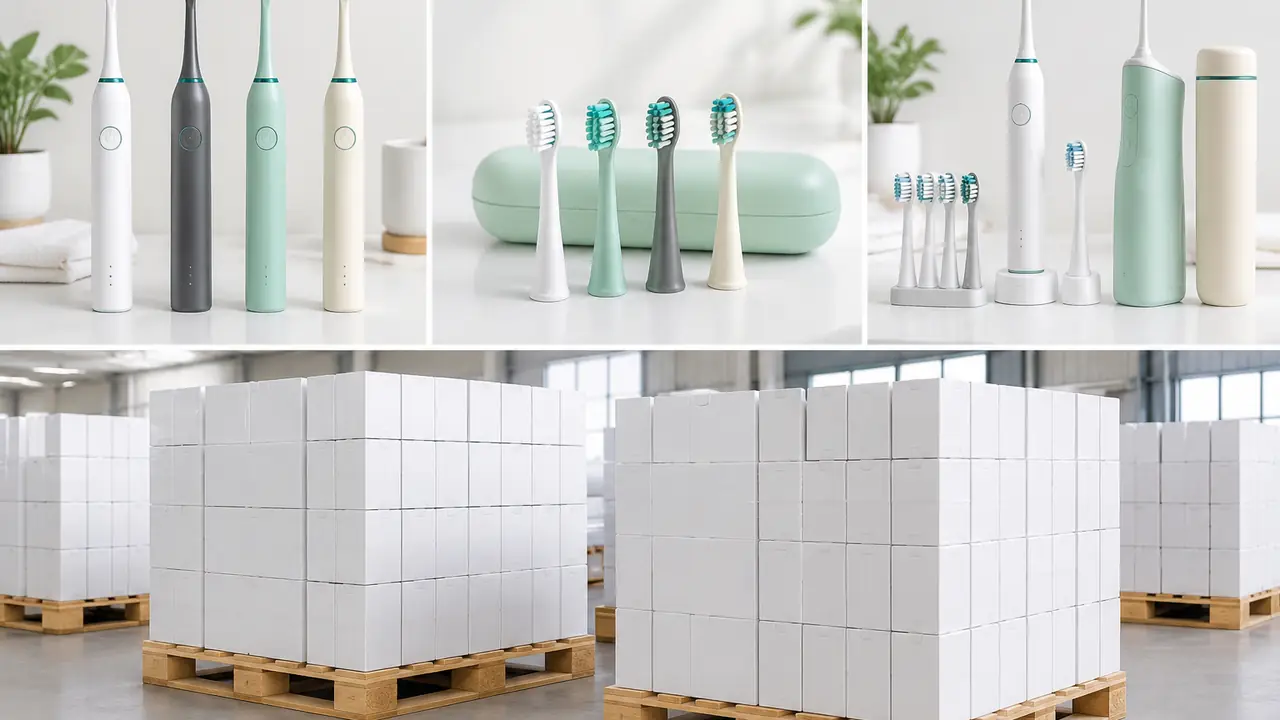
A wholesale range earns its shelf space by covering the customer who walks in with a small budget and the one who wants the better handle, without the two offers reading as the same product at two prices. The usual ladder runs from a battery brush at 7,000-12,000 strokes per minute, through an entry sonic handle at 20,000-31,000, to a 31,000-40,000 flagship, with a water flosser as the companion that lifts the basket size. Each band gets its own carton language and model naming so the tiers read clearly on a shelf and in a catalogue. The desk assembles the ladder from catalog molds across partner plants, which keeps tooling cost out of the program and lets a distributor enter at the two or three bands it can actually sell, then extend later without changing suppliers. Where a market needs its own brand on the range, the same bodies take private label cartons at the 1,000-3,000 unit band while the ladder logic stays unchanged.
Stable supply across seasons
Oral care has a season: the run-up to gifting periods concentrates orders into a narrow window, and a distributor that starts planning in that window queues behind everyone else. Repeat programs work differently. Quantities are forecast on the ranges of the MOQ and lead time page, batches are booked 30-45 days ahead of need, and the desk holds one golden sample per appearance so the lot that arrives in November matches the one the market already knows. Capacity is reserved per plant per appearance; a program is not moved to whichever factory has space that month, because a second plant means a second motor vendor and a lot that feels different. Stock levels across the ladder are reviewed together, since a head refill that runs dry unsells the handle it belongs to. Stability here is a scheduling habit, not a promise, and it is written into the program schedule that both sides sign.
Spare parts and after-sales
Wholesale after-sales runs on parts the distributor can hand over the counter. Heads are the obvious one - planned from the first order at 5,000-10,000 units and re-ordered on the same cadence as the brushes. Docks, cases and cables are the second: a warranty counter that can replace a dock keeps a customer without replacing a handle. A small spare-motor and cell stock can be agreed for markets where the distributor runs its own repair. The note on warranty and spare parts planning sets out how the quantities are sized. The desk keeps the parts list tied to each appearance so a head ordered two years later still fits the handle on the shelf, and any specification change on a refill is proposed in writing before production, never discovered in a carton.
Mixed-container programs
Few wholesale orders are one model in one carton. The normal load mixes bands: battery brushes in master cartons, sonic handles in retail boxes, a flosser line, and head packs in display cartons, all consolidated at the plant into one FCL or smaller lots into one LCL. The desk plans the load with the forwarder - carton counts, pallet pattern, which models share a pallet so unloading at the distribution centre is one move per band. Display-ready builds are planned the same way: where the buyer's channels shelve straight from the carton, the master box is designed as the display, and the pallet plan follows the store layout rather than the warehouse. Sea transit typically runs 15-25 days to the US West Coast and 30-45 days to Europe; AAA models move without lithium formalities while rechargeable lots carry UN 38.3 papers. One packing list covers the container, and the document pack rides with it.
A ladder that fits one container
An illustrative, anonymized ladder for a regional distributor. Quantities are typical reference ranges, confirmed in writing per program.
| Band | Line | Typical MOQ | Role in the range |
|---|---|---|---|
| Entry | Battery brush, 7,000-12,000 strokes/min | 500-1,000 units | Volume driver, AAA simplicity |
| Mid | Entry sonic, 20,000-31,000 strokes/min | 500-1,000 units | Margin step-up, rechargeable |
| Upper | Sonic flagship, 31,000-40,000 strokes/min | 1,000-3,000 units private label | Anchor for the range |
| Companion | Water flosser, 140-220 mL tank | 300-500 units | Basket builder beside the brush |
| Refill | Replacement heads, 2-4 profiles | 5,000-10,000 units | Repeat revenue every quarter |
Documents for repeated crossings
Repeat wholesale means the same papers, correct every time: CE under LVD, EMC and RoHS for European lots, UL 859 or ETL for North American ones, UN 38.3 and IEC 62133-2 wherever a lithium lot moves, and the HS reference of 8509.80 confirmed with the broker for each destination, since head and part classifications need the same check. The desk assembles one document pack per shipment so customs clearance does not depend on which clerk opens the file. When a new band joins the ladder, the certification route is scoped through the quote form at the same time as the samples, not after the order is placed.