
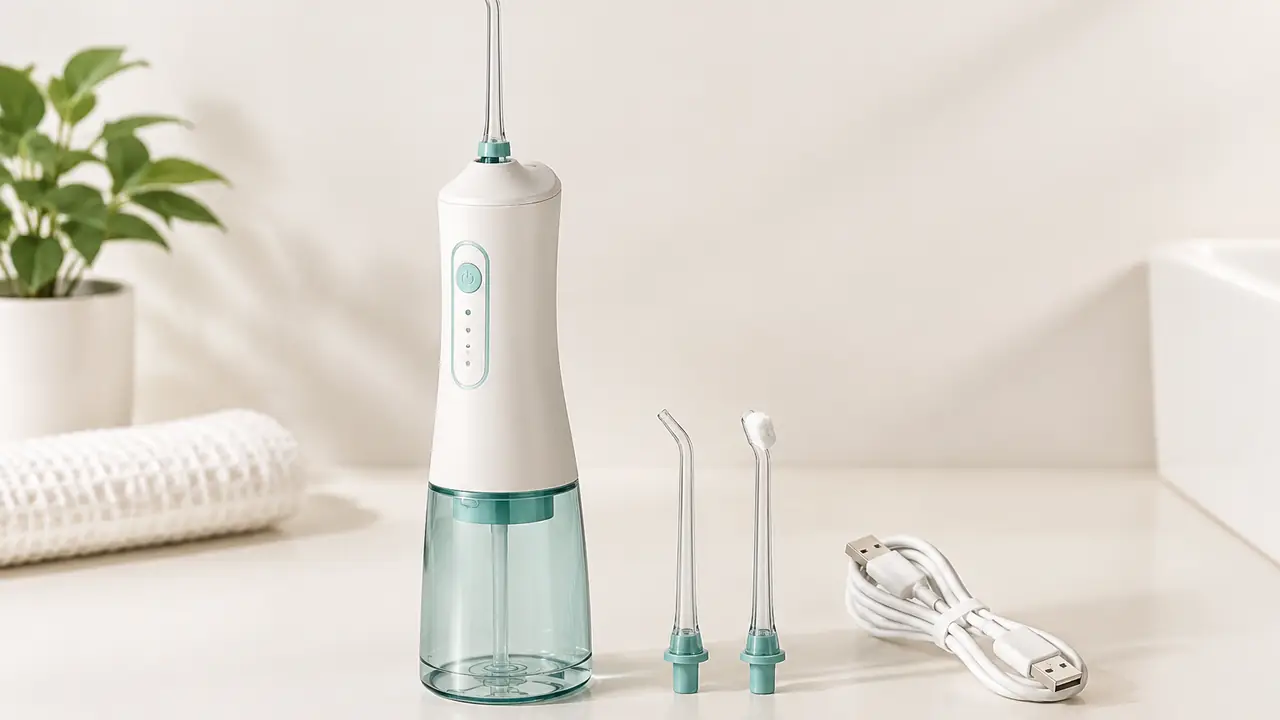
What a water flosser is
A water flosser is a mechanical irrigator. A micro pump in the handheld body pushes pulses of water through a jet tip at 20-140 PSI, cycling at roughly 1,400-1,800 pulses per minute, and the tank in the body holds 140-220 mL, enough for a full session without a refill. In listings the wording stays mechanical: the device helps rinse away debris and loose residue where string floss misses. It is a rinse tool, not a treatment, and copy carries no health claims of any kind. The water flosser versus string floss piece explains how the two tools sit side by side rather than in competition.
Buyers add the line for three practical reasons: it shares a shelf and an aesthetic with the brush program, many oral-care plants build flossers on lines adjacent to toothbrushes so quality systems and sourcing carry over, and the repeat business runs on tips rather than heads.
The six parts on the card
The waveform sketch traces the pulse rhythm, but the parts are listed in the order a plant quotes them. The pump is the heart of the quote: its pressure ceiling and pulse consistency decide most of the cost.
| Part | What decides performance | Typical options |
|---|---|---|
| 1 Handle and reservoir | Tank size, seal design, grip | 140-220 mL handheld tank, flip-fill valve |
| 2 Pump and drive unit | Pressure ceiling, pulse consistency, life | 20-140 PSI, 1,400-1,800 pulses/min |
| 3 Battery | Capacity, protection board, charge route | Li-ion 3.7 V, protection board, USB or Type-C |
| 4 Jet tips | Tip set, snap-in fit, washability | Standard, orthodontic and soft profiles |
| 5 PCB and modes | Mode set, auto-stop timer | 2-3 pressure modes, 2 min auto-stop |
| 6 Charging and accessories | Cable, spares, travel kit | USB or Type-C cable, spare tips, pouch |
Pressure, pulse rate and tank figures are typical ranges across the category and are confirmed from each model's own test report, not from this page.
Pressure, pulses and tank size
Entry settings start near 20 PSI so first-time users can work up gently; the top modes on a given model reach toward 140 PSI. Pulse rate sits around 1,400-1,800 per minute, which breaks the stream into bursts rather than a steady jet. Handheld tanks of 140-220 mL cover a two-minute session, and a two-minute auto-stop timer keeps sessions bounded. Every figure prints from the model datasheet; the desk does not quote a number a plant has not tested. What the numbers mean for buyers is covered in how to read specs and the water flosser buyer guide.
Pairing with a toothbrush line
Flossers and brushes are usually quoted together once a brand has a handle program running. The same clusters build both: the Shenzhen and Dongguan belt in Guangdong and the Ningbo and Hangzhou area in Zhejiang run oral-care appliance lines side by side, so colour, finish and charging style carry across the set. Retail plans treat the pair as one story - brush plus rinse - and bundles sell through the full oral-care line guide. The desk coordinates the two programs with one inspection window where the plant allows it; see how production runs.
Tips, modes and configurations worth specifying
- Tip set. Standard jet for daily use, an orthodontic profile for brackets, and a soft tip for sensitive users; tip retention is checked at inspection.
- Mode set. Two to three pressure modes is the common spread; more modes rarely earn their place on a handheld.
- Tank and valve. 140-220 mL with a flip-fill valve that seals after filling; leak tests run at inspection.
- Finish. Matte white and soft-touch colourways shared with the brush line for shelf consistency.
- Packaging. Colour box with pulp insert for retail, plain carton for marketplaces; see packaging.
Compliance and shipment
A rechargeable flosser certifies like a toothbrush: IEC/EN 60335-2-52 with CE (LVD, EMC, RoHS) for Europe, UL 859 via UL or ETL for North America, and UN 38.3 with IEC 62133-2 for the lithium battery. The body seals to IPX7 - one metre for thirty minutes is the common yardstick, confirmed per model - because the whole device gets wet in normal use. The route by market is in the certifications guide, and the IPX guide explains the seal ratings.
Inspection before shipment
- Pressure at each mode on a gauge rig against the model's own test report.
- Pulse rate and auto-stop timer behaviour on sampled units.
- Tank fill, valve seal and leak check with the unit held at working angle.
- IPX7 soak on sampled units; pump start and button check after the soak.
- Tip retention and snap-in fit on sampled tips.
- Carton drop test and label, manual and pack contents against the approved sheet.
The plan is written per program and confirmed before the first batch; see quality control. Reference quantities and timing sit on the MOQ and lead time page, and the quote form starts the conversation.