
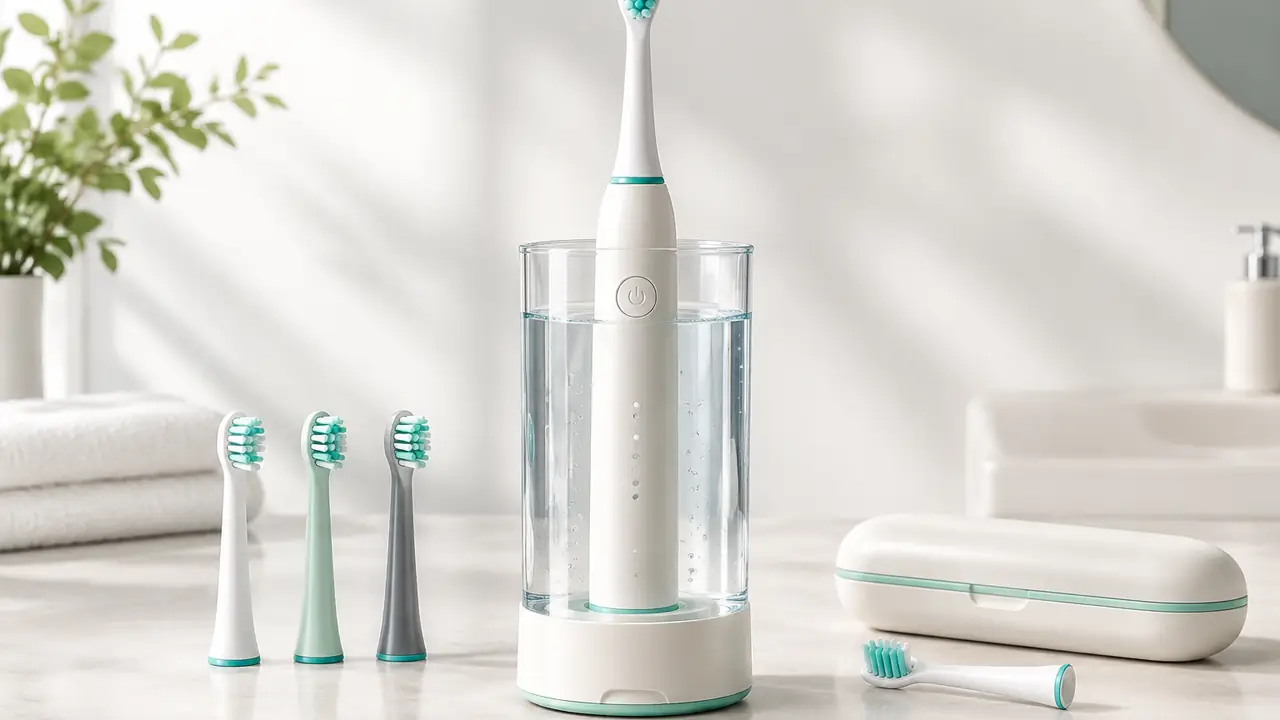
What the IP code actually says
The IP code rates how well an enclosure keeps the outside out. It carries two characters after the letters: the first digit describes protection against solids such as dust, the second against liquids, and an X in either position means that dimension is simply not rated. A toothbrush handle quoted IPX7 therefore says nothing about dust and everything about water: the 7 is the immersion grade, and it is the grade the oral-care category has settled on as its norm. Lower liquid grades exist for splashes and sprays, and higher ones for stronger and longer exposure, but a buyer specifying electric toothbrushes will almost always be comparing IPX7 against IPX7 - which makes the interesting question not the number but the construction behind it, and the evidence behind the construction.
The IPX7 test, step by step
The immersion grade is defined by a concrete condition, and the condition is what a listing should quote:
- The handle is placed in fresh water at a depth of one metre, measured from the lowest point of the enclosure.
- It stays there for thirty minutes under those conditions.
- It is removed, dried on the outside and opened for examination.
- Water must not have entered in quantities that interfere with correct operation or compromise safety.
- Function is checked after the soak: modes switch, the timer runs, the cell charges.
Two limits follow from the definition. The rating covers a stationary soak, not high-pressure jets, and it covers a bounded thirty minutes, not indefinite submersion such as swimming. It also describes a new unit; it says nothing about a seal that has been stressed by drops or by years of head cycling. Copy on a box should mirror the tested condition - immersion rated IPX7, one metre, thirty minutes - rather than a loose promise of invulnerability.
How a handle keeps water out
A handle has five places where water wants in, and each is closed by its own construction.
| Zone | Typical construction | What inspection checks |
|---|---|---|
| Drive shaft opening | Lip seal or O-ring around the moving shaft | No wicking after soak; head still seats and snaps |
| Mode button | Sealed dome under the key or overmoulded button | Button actuates correctly after the soak |
| Charge port | Plugged cap on USB or Type-C, or a contactless coupling | Port dry after soak; charging works afterwards |
| Battery compartment | Ultrasonically welded shell joint, gasket under the cover | No ingress at the seam on opening |
| Shell halves | Ultrasonic weld, adhesive bead or gasket line | Seam examination after the soak |
The shaft seal carries the hardest duty because it moves with every stroke, which is why seal life and head-insertion cycling appear alongside the soak in most test plans. Construction choices - welds versus gaskets, cap versus coupling - are among the points the desk compares when shortlisting plants, since seal process discipline varies more between plants than the ratings they claim.
Sealing the charging path
The charge path is the one opening a handle does not strictly need, and the two ways of closing it define a visible split in the range. A cable-charged handle has a USB or Type-C port behind a plugged cap: cheap to build, familiar to users, and dependent on the user actually seating the cap, which is why a wet-port complaint is a known failure mode. A dock-charged handle couples wirelessly through the sealed shell - energy crosses, no water can follow - and trades a slower charge, typically twelve to sixteen hours against four to six over a cable, for the absence of any opening at all. Mid and premium programs increasingly put the port inside a travel case or drop the port entirely. The hardware sits on the charging dock and case line, and the trade-offs are set out in charging types.
What listings may and may not say
The rating language travels safely: a listing may state that a handle is IPX7 rated and tested to the immersion condition of one metre for thirty minutes, and should quote exactly that condition. It may not stretch the number - the code does not cover jets, pools or a pressure washer, and it does not renew itself after a drop on tiles. Nor should ingress wording drift into hygiene claims: a sealed handle keeps water out of the electronics, and that is all the claim needs to be. Anything stronger on a box invites a return rate the product cannot defend, so the desk checks that the manual, the box and the model's report all quote the same condition in the same words.
Test evidence to collect per model
Because IPX7 is claimed per model, the evidence is per model too. The base document is the model's own soak report from the test lab the plant uses, obtained as part of the certification file; partner documents are verified per project, since a sourcing desk holds no certificates of its own. Around that report, the pre-shipment plan repeats a short version on sampled units - soak, dry, function, seam check - so the claim holds for the carton being shipped rather than only for the laboratory sample. Both layers are written into the inspection plan on testing and inspection and followed through on quality control. For the surrounding paperwork by market, see the certifications guide, and for reference quantities the MOQ and lead time page. Programs usually start at the catalog-model range of 500-1,000 units, confirmed in writing per order.