
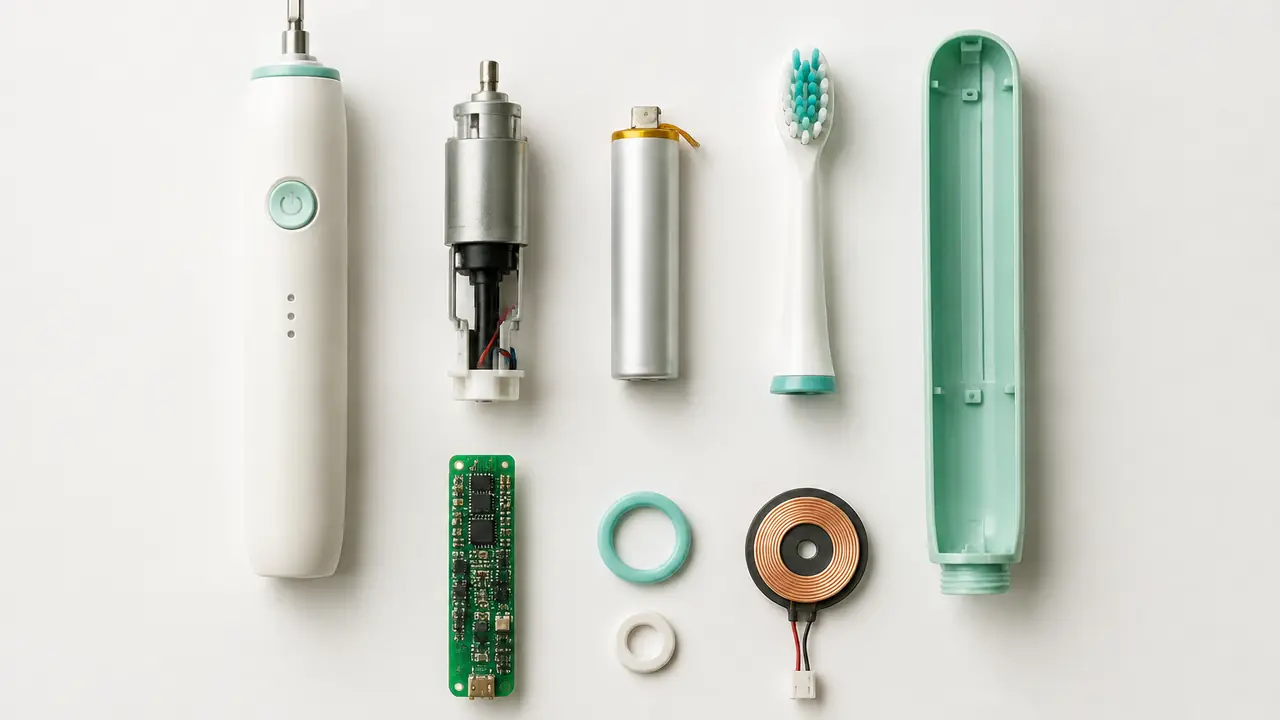
What IPX7 actually tests
IPX7 says a handle survives immersion under one metre of water for thirty minutes. That is the industry norm across the category, confirmed per model, and it is a good description of real life: rinsing under a tap, a drop into a sink, a wet bathroom shelf. It is equally a bounded promise. The test is still water at modest depth and temperature, for a defined time, on a sample in defined condition - it says nothing about pressurized spray, about hours of humidity, or about a unit that has been dropped twice and aged for a year. Buyers who understand the boundary write better briefs: the rating goes on the datasheet with its test method, marketing copy stays inside what the method covers, and nothing in the listing has to be walked back later. The full reading of the rating is in IPX7 waterproof ratings explained.
Where water gets in
A toothbrush shell is a machine full of holes by design. The shell halves meet along a parting line that runs the whole handle. The drive shaft passes through the nose, moving thousands of times a minute. The mode button pierces the grip. The charging path - a port, or the dock interface - opens the base. Every one of those is an ingress path, and waterproofing is the discipline of closing each one with a seal matched to how it moves. Handles do not leak because a plant forgot waterproofing; they leak when one specific path is under-sealed for how that model is used, which is why the desk reviews the paths one by one rather than accepting a single IPX7 line on a quotation. The review takes minutes and costs nothing; the returns it prevents cost a season of ratings.
How plants seal each path
The shell joint is closed by joining, not by gasket alone: ultrasonic welding or a bonded seam fuses the halves into one piece, so the parting line stops being a gap. The shaft neck gets the hardest-working seal in the handle - a close-tolerance rotating seal that must hold water out while letting the shaft sweep freely, forever balancing retention against friction. Buttons are solved by removing the opening: a diaphragm or capacitive design senses the press through a continuous surface, so no seam crosses the shell. And the charging path is either a sealed port with a plugged, gasketed opening or, increasingly across the category, no opening at all - wireless charging couples through the shell, and the charging dock and case line shows how the dock side of that coupling is built. The dock interface itself is a last path: a handle standing wet on a base needs the base-to-shell contact designed so water cannot wick inside, which is docking-geometry work as much as seal work.
Two materials surround all of it. Silicone rings and overmoulds carry the flexible seals, specified with the same grade discipline as any mouth-contact silicone. And the shell resin itself is chosen for stable dimensions in humidity, because a shell that swells opens clearances that were sealed at molding.
The sealing map
| Ingress path | Typical seal | How it is verified |
|---|---|---|
| Shell parting line | Ultrasonic weld or bonded seam | Immersion test, seam inspection |
| Drive shaft neck | Close-tolerance rotating seal | Immersion plus function after run hours |
| Mode button | Diaphragm or capacitive, no seam | Button life cycle, then immersion |
| Charging port | Sealed, gasketed opening | Immersion with port closed per instructions |
| Wireless coupling | No opening; energy through shell | Immersion, then charge test |
| Dock interface | Draining, standoff geometry | Wet-dock cycling check |
How the rating is verified
Verification runs the immersion routine on development samples and then on production lots at a sampling rate agreed in the test list. The sequence matters as much as the soak: units are tested as shipped, immersed for the full thirty minutes, dried, and only then powered and function-checked - charge state, modes, timer, sensor response. A handle that works before the bath and fails after has failed the test, whatever the datasheet says. The desk writes the sequence into the pre-shipment list for every program, because waterproofing is the failure mode that shows up in customer returns rather than on the production line; the inspection routine around it is on the testing and inspection page.
Why field leaks still happen
Sealed handles leak in the field for reasons the test cannot see coming. A drop can open a weld line a fraction of a millimetre. Button diaphragms wear with years of pressing. Shaft seals age with every session, and a collar that has rattled for months transmits vibration in ways the seal was never tuned for. Heat and humidity age all of it faster. None of this is a quality scandal - it is wear - but it explains why the returns conversation and the waterproofing conversation are the same conversation. The failure symptoms, and what users typically report, are described in water inside the handle, and the charging failures that follow a leak in toothbrush not charging causes. The desk treats early-returns data as seal data: a leak pattern in the first months points back to a specific path on the sealing map, and the fix is a design conversation, not a slogan. Spare-part planning follows the same reading - seals are not serviceable items, so the program's response to a leak pattern is a running change on the next production batch, agreed in writing with the plant.
Writing waterproofing into the spec
Four lines cover the buyer side. Name the rating and the method - IPX7, one metre, thirty minutes, per model datasheet. Choose the charging architecture with sealing in mind, since wireless coupling removes the port and every seal that port needed; the trade is dock cost, set out in USB vs wireless charging. Put the immersion sequence and the button-life count on the agreed test list with a sampling rate. And ask how the model is meant to be dried and stored, because user handling is part of the real-world margin the rating leaves out. Reference schedules for programs with sealing changes follow the usual development windows on MOQ and lead time, and a sealing question - new model, or a leak pattern on an existing line - can be raised through the quote form.