
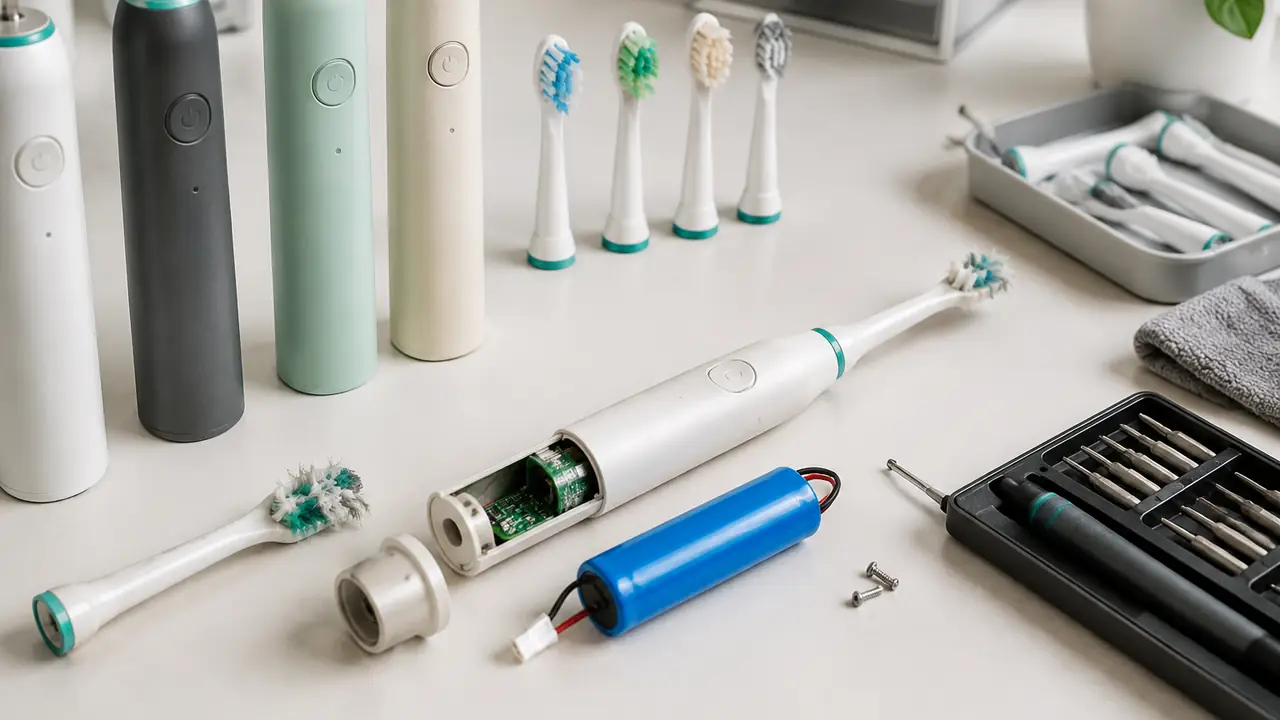
How water travels: the paths into a handle
A sealed handle has a short list of doors, and water uses one of them. The neck, where the shaft enters the shell, relies on a seal under the collar. The shell itself is a joint - glued or welded - with a line that must hold along its whole length. The button is a moving part through the wall, sealed by a membrane. USB-charged models add a port with a cover. And any of these can be compromised by a crack after a knock. Corrosion follows contact, not the other way round, so the inspection question is never why the board failed - it is which door let the water in, and the doors are finite.
The commercial sting of ingress is timing. A handle that leaks at the factory fails on the line and costs cents. A handle that leaks slowly - a few drops past a tired neck seal - fails in month eight, inside a warranty the brand set, with a frustrated customer writing the review. That is why the leakage conversation belongs in the specification and the inspection plan, where each door can be closed and then checked, rather than in the returns queue where it can only be paid for.
The causes, in order of likelihood
| Order | Cause | Typical story | Where the program acts |
|---|---|---|---|
| 1 | Drop damage | A knock opens a hairline shell crack or displaces a seal; the leak appears weeks later | Drop test, then post-drop water re-check on samples |
| 2 | Neck seal wear or assembly variance | Seal seated imperfectly at assembly, or aged after months of head swaps | Seal design; assembly jig control; retention and drain checks |
| 3 | Port cover open or degraded | Charging with the cover open, or a tired cover on a USB model | Cover design; wireless charging removes the port |
| 4 | Glue-line voids | Production variance along a glued shell joint | Welded joints; immersion sampling agreed per order |
| 5 | Marginal seal design | Passes the lab rig, fails real bathroom service | Sealing architecture specified, not just the rating |
The top row deserves emphasis, because it reorders how brands read leakage claims. Most handles that arrive corroded were dropped at some point on their journey, and the drop - not the bathroom - opened the door. That makes the drop test and the water check that follows it the two most valuable line items in this whole problem group.
What IPX7 promises, and what it does not
IPX7 is the industry norm across the category: the handle survives immersion under one metre of water for thirty minutes, per the model datasheet. Read as a promise, that covers rinsing under a tap, a dropped-in-the-sink moment, and a wet bathroom shelf. It does not cover high-pressure jets, a dishwasher cycle, deliberate long soaks, or an open charge port on a USB model - and a manual that says so plainly prevents a family of disputes where the rating technically held and the customer reasonably disagrees. The wider context for buyers is on the waterproof IPX guide, and the sealing construction behind the rating is taken apart in the seals note.
Build choices that keep water out
Four build decisions carry the sealing program. Joint technology comes first: welded shell joints hold along the whole line where glue lines depend on bead coverage, which is why welding is the default on better handles and a question worth putting to any plant quoting a glued shell. Neck sealing comes second: a gasket or O-ring arrangement under the collar, specified with the retention force so the head stays on and the water stays out at the same time - the two requirements are designed together, not sequentially. Button sealing is third, a membrane detail that belongs to the same conversation as the neck. And charging architecture is fourth: a wireless dock removes the port and its cover entirely, trading an ingress path for a slower charge, a trade-off set out on the charging dock and case line. Plants describe their combined approach as an integrated sealing process; a buyer's job is to ask how each door is closed, not to accept the rating as an answer.
Two quieter choices support the four main ones. An overmould grip does double duty - it damps the vibration users feel and covers shell seams in the zone hands wet most. And shell material matters at the joints: a resin that welds cleanly and resists the cleaning products a bathroom throws at it keeps its seams tight for years, where a marginal compound can chalk and micro-crack under the same service. Neither choice appears on a spec table as waterproofing, and both belong in the material review before tooling - the stage where changes are free and after which they are recalls.
How inspection catches leaking handles
Immersion is a listed test item, and a sensible plan sequences it. Units are tested against the datasheet routine, then function-checked after immersion - a handle that survives the water but not the switching has still failed. Drop-tested samples go through the water check afterwards, in that order, because the knock is what opens the door. Where the design uses glue or a port cover, sampling concentrates there. The sampling depth and the acceptance criteria are agreed per order and written down, so the result is a record rather than an opinion - and when a leakage claim arrives in month eight, the batch records answer whether the door was closed at shipment. How the items are organised sits on the testing and inspection page, with the sampling logic on quality control.
Back to specification and inspection
A leak-free handle is a short specification: joint technology, neck seal geometry with its retention band, button membrane, port and cover policy or wireless-only, and the IPX7 rating with the manual wording that scopes it. Each line is cheap at the drawing stage and expensive in the returns queue. Put the immersion, post-drop and post-immersion function checks in the inspection plan, confirm both documents in writing per program, and the leakage category shrinks to the drops no design survives - which is the honest floor. Reference quantities and schedules sit on MOQ and lead time, and a program brief starts on the quote form.