
Why a line, not a SKU
A single toothbrush competes on its spec sheet against dozens of near-identical handles, and every season resets the comparison. A line competes on coverage: the customer who trusts the flagship finds the kids model, the travel kit, the refills and the flosser under the same name, and each additional shelf slot makes the next one cheaper to win. The economics compound through the head pipeline as well - every handle sold joins the installed base that refills serve, so a line does not just add products, it thickens the recurring layer beneath all of them. None of this argues for launching wide: the strongest lines in the category were built in sequence, each SKU earning the next. It argues for designing the sequence from the start, which is what the architecture below is for.
The reference architecture
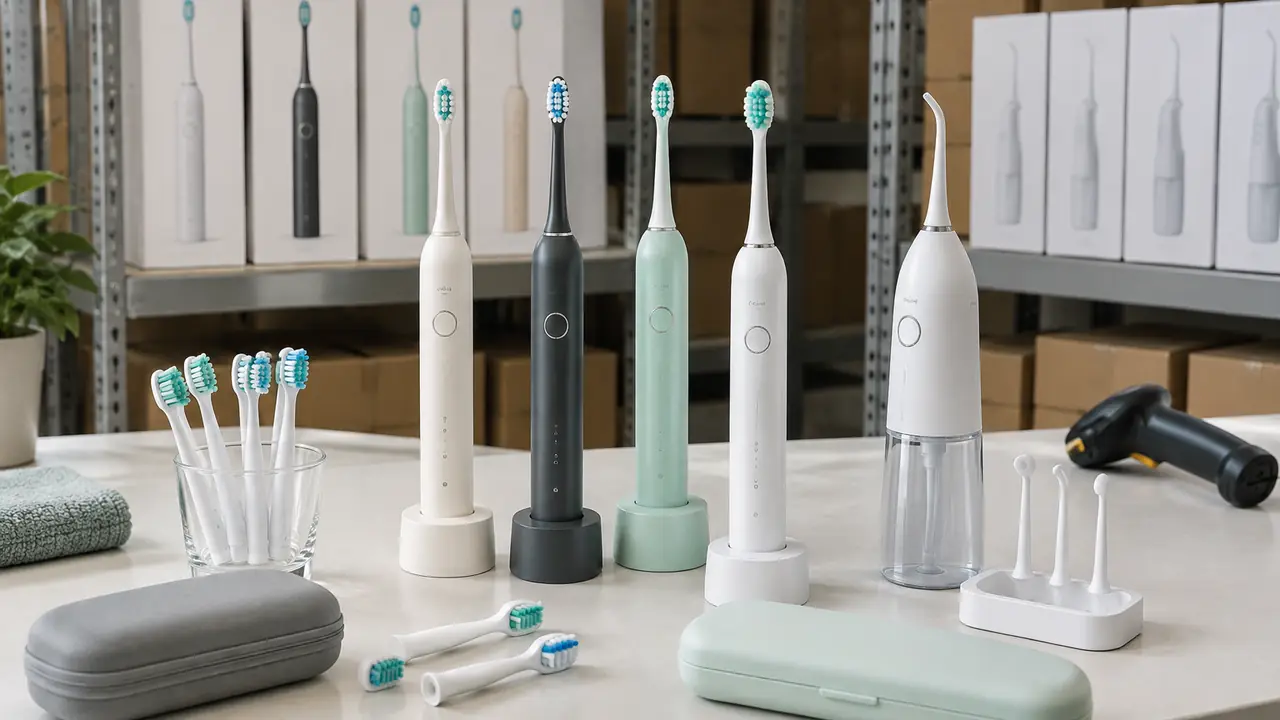
Most mature oral-care assortments, whatever the brand, fill the same eight slots. A new program does not need all eight - it needs to know which three it is building first and which five the platform must be able to absorb later.
| Slot | Line | Role in the line | Reference minimums |
|---|---|---|---|
| Flagship | Sonic toothbrush | Brand anchor, premium spec, 31,000-40,000 strokes/min tier | 500-1,000 pieces catalog; 1,000-3,000 private label |
| Value tier | Battery or entry sonic handle | Entry price band, wide reach | 500-1,000 pieces per model |
| Kids format | Kids electric toothbrush | Household coverage, gifting | Around 1,000 pieces |
| Travel format | Travel handle with case | Seasonal and gifting tier | 500-1,000 pieces per model |
| Consumables | Replacement heads | Recurring revenue for every handle sold | 5,000-10,000 pieces per specification |
| Companion device | Water flosser | Premium cross-sell on a shared platform | Commonly 300-500 units |
| Accessories | Docks, cables, cases | After-sales and upsell layer | Per program, in writing |
Sequencing the build-out
The order that keeps risk proportionate is consistent across channels. Start with one flagship on a catalog mold or a light private label: minimums of 500-1,000 pieces per model are the lightest tuition the category offers, and the first season reads real sell-through. Add heads immediately - not after the flagship proves, but with it, because the refill stream is the line's financial spine and its minimums of 5,000-10,000 pieces per specification are sized for exactly this moment. The third slot follows the channel: retail programs reach for the value tier to complete a price ladder, DTC programs reach for the subscription depth of the head line, and household brands reach for the kids format. Travel kits slot into gifting windows naturally once the flagship exists, and the flosser is deliberately last: it is a premium cross-sell that makes sense only when there is a customer base to cross-sell into. At each step the previous SKU's data - sell-through, return causes, head attach rate - sizes the next order, which is the discipline that separates a line from a wish list. The minimums and schedules behind every step are collected on MOQ and lead time, each confirmed in writing per program.
Platform decisions that keep a line coherent
A line holds together or falls apart on decisions made at SKU one. The head platform is the largest: if every handle in the line shares one collar geometry, refills consolidate, inventory simplifies and the compatibility story a customer learns once serves the whole range - whereas each new collar fragments the consumable stream and the shelf. Charging is second: one dock family, or at least one cable standard, keeps accessories and spares manageable. Design language is third: a shared silhouette and finish system lets a kids model and a flagship read as relatives, which is what turns products into a brand on a shelf. Firmware behaviour completes it - the same timer style, the same mode logic, the same prompt feel - because users who add a second handle from the line should find it familiar on day one. None of these decisions costs more when made early; all of them cost heavily to retrofit, which is why the desk raises them in the first platform conversation rather than the fourth. The component-level levers behind them are itemised under toothbrush components.
Certification at line scale
A line does not multiply paperwork linearly, but it does multiply it, and the pattern is worth budgeting. Each new model re-runs the appliance safety route - IEC/EN 60335-2-52 or UL 859 depending on market - though platform sharing means later models inherit tested internals and move faster than the first. Lithium variants carry UN 38.3 and IEC 62133-2 per cell design, a Bluetooth model adds FCC or CE RED, and a flosser is its own appliance file even when it shares a factory. The practical planning rule: certification weeks belong on the same calendar as production slots for every new slot in the line, because a launch date that ignores them is not a date. Sequenced well, the certification load of a third SKU is a fraction of the first, since the plant's test history and the buyer's document templates carry over - one of the quieter economies of building a line rather than a one-off.
Channel fit for the first year
Lines grow differently by channel, and the first-year plan should match. Brand owners building a differentiated range start flagship-first and protect the head platform from day one - the audience page for brand owners maps that route. DTC programs grow depth-first: one handle, deepening refill plans, then a second handle format once the first runs steadily. Retail chains grow breadth-first: flagship, value tier and kids format to fill a planogram, with own-brand kits assembling the range into shelf-ready units - the chain view sits on the retail chains page. Distributors grow price-band-first, pairing an entry handle with head multipacks for volume. Whatever the channel, the first year should end with the same asset: one coherent platform, one proven refill stream, and the sales evidence that prices the next slot.
Structuring the program
A line build is a program of programs, and it benefits from the same written spine as any single order: the platform decisions recorded before SKU one; minimums, schedules and certification weeks confirmed in writing per step; the head commitment negotiated for the product life; and a review gate after each launch that feeds the next sizing decision. The desk's role across the sequence is coordination - shortlisting plants per slot, verifying documents per project, and keeping the platform coherent as pieces are added. A line brief - target channels, first three slots, markets and timing - can be started through the quote form, and the desk returns a sequenced plan with matched plants rather than a quote for a single box.