
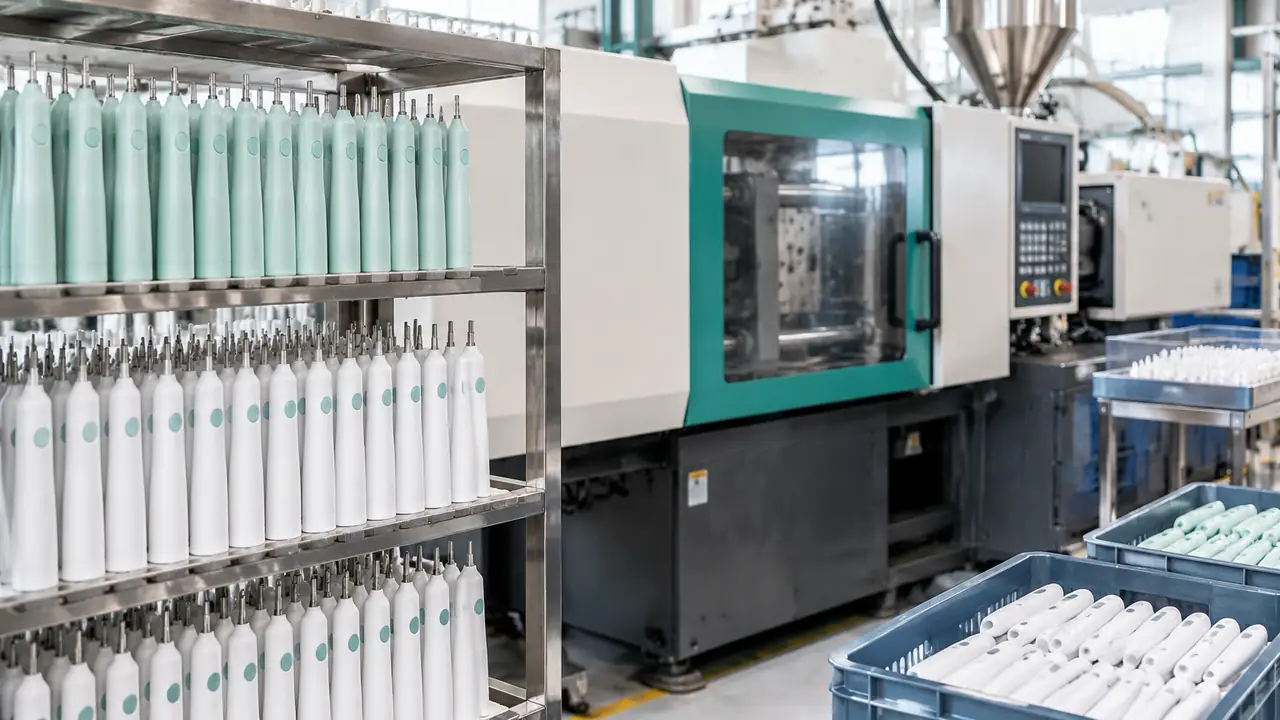
Why the order of the line matters to a buyer
Understanding the production process is not academic: it tells a buyer why a colour change costs two weeks, why firmware is frozen before pilot build, and why a seal problem discovered at final inspection is a tooling conversation rather than a rework one. The sequence below is the typical route through a partner plant in the Chinese clusters; details differ by plant and line, and the desk confirms the exact flow per program during the plant audit.
Before the line: tooling and pilots
Catalog-model programs start at moulding because the tools already exist. Private-mold programs start earlier: parts are drawn, moulds are cut in steel, and the first shots are measured against the CAD before anyone assembles a handle. A pilot build follows - a small run that assembles real parts with production methods, exposing fit problems between collar and shell, motor seat clearances and seal compression while they are still cheap to fix. Firmware and mode sets are frozen before the pilot, because changing mode logic after SMT means re-flashing and re-testing boards that are already built. For ODM tooling timelines and ownership basics, the OEM and private label page carries the reference ranges.
Change control keeps the pilot honest. Once a pilot is approved, colour swaps, material substitutions and mould modifications all go through a written change note, because each one touches downstream stages in ways that are easy to underestimate: a new TPE supplier changes overmould adhesion, a shell tint affects the cosmetic standard, and a collar radius change alters head retention. The desk routes every change through a revised sample and, where the change touches seals or the battery, through re-test - cheap at the pilot stage, expensive as a field return.
The nine stages from resin to carton
- Moulding. Handles, collars and internals are injection-moulded from ABS or PCR-ABS; material lots are logged, and first-article shots are measured before the press runs for the batch.
- Overmoulding. Soft-touch grips are overmoulded onto rigid shells; adhesion between the two materials is checked on pulled samples, not assumed.
- Motor sourcing and incoming test. Sonic or rotating motors arrive from the plant's own line or an audited supplier; incoming checks sample stroke rate, noise and shaft runout against the platform specification.
- PCB SMT and firmware flashing. Control boards are placed and reflowed in-house or at an audited SMT partner, then each board is flashed with the program's firmware version, which is recorded per lot.
- Cell sourcing and pack assembly. Lithium cells (3.7 V, typically 800-1,400 mAh) arrive with UN 38.3 and IEC 62133-2 reports; protection boards are welded, packs are formed and aged, and AAA-battery models skip this stage entirely.
- Handle assembly. Motor, board, pack and switch are fitted; screws are torqued to spec, and the assembly fixture - not the operator's judgement - decides seating.
- Sealing. Ultrasonic welding or a seal press closes the shell to its IPX7 rating; press parameters are logged so a drifting weld can be traced to a time window.
- Routine safety tests and screening. Every unit passes the end-of-line safety routine test (charge, power-on, basic function); sampled units then sit a run-in cycle and a noise screen on the rig.
- Packing. Heads, manuals, cables and cases are kitted, boxes are coded with the batch, and cartons are sealed for the drop test that comes with final inspection.
Checkpoints by stage
| Stage | Typical checkpoint | Record kept |
|---|---|---|
| Moulding | First-article dimensions per cavity | Mould log, material lot list |
| Overmoulding | Pull-sample adhesion between shell and grip | Shift sample sheet |
| Motors | Incoming stroke rate, noise, shaft runout | Supplier lot certificate |
| SMT and firmware | Board function test, firmware version match | Lot firmware record |
| Cell packs | Weld strength, open-voltage check, ageing result | Pack batch log |
| Assembly | Torque, seating, switch feel | Line check sheet |
| Sealing | Press parameters; sampled IPX7 soak | Parameter log per shift |
| Routine tests | Every unit: charge, power-on, function; sample: run-in and noise | Routine-test log |
| Packing | Kit contents, batch code, carton condition | Packing list per carton |
What the desk adds on top
A plant's own line controls are necessary but not sufficient for an export program, so the desk layers three things. First, an inspection plan agreed before production, so the final check measures what the buyer's listing claims - the quality control page lists the measured items. Second, verification that test and lab reports match the platforms actually being built, which closes the gap an audit found most often: a report for a motor no longer fitted. Third, a sealed-sample workflow: the approved sample is sealed and referenced at final inspection so the batch is compared against what the buyer approved, not against memory. Laboratory methods behind the tests sit on the testing and inspection page.
Timing and the carton
Reference ranges, confirmed in writing per order: catalog-model samples in about 7-15 working days and branded samples in 15-25 days; production batches at roughly 30-45 days for catalog models and 35-50 days for private label, with first ODM orders longer because tooling and certification sit inside them. Packing looks like an afterthought and is not: the carton spec, insert choice and batch coding are part of the process, and carton drop tests happen before the lot leaves the floor. Retail formats and export labelling sit on the packaging page. To have a flow mapped for your program, send the brief through the quote form; a plain-language walk-through of the parts is in inside an electric toothbrush.