
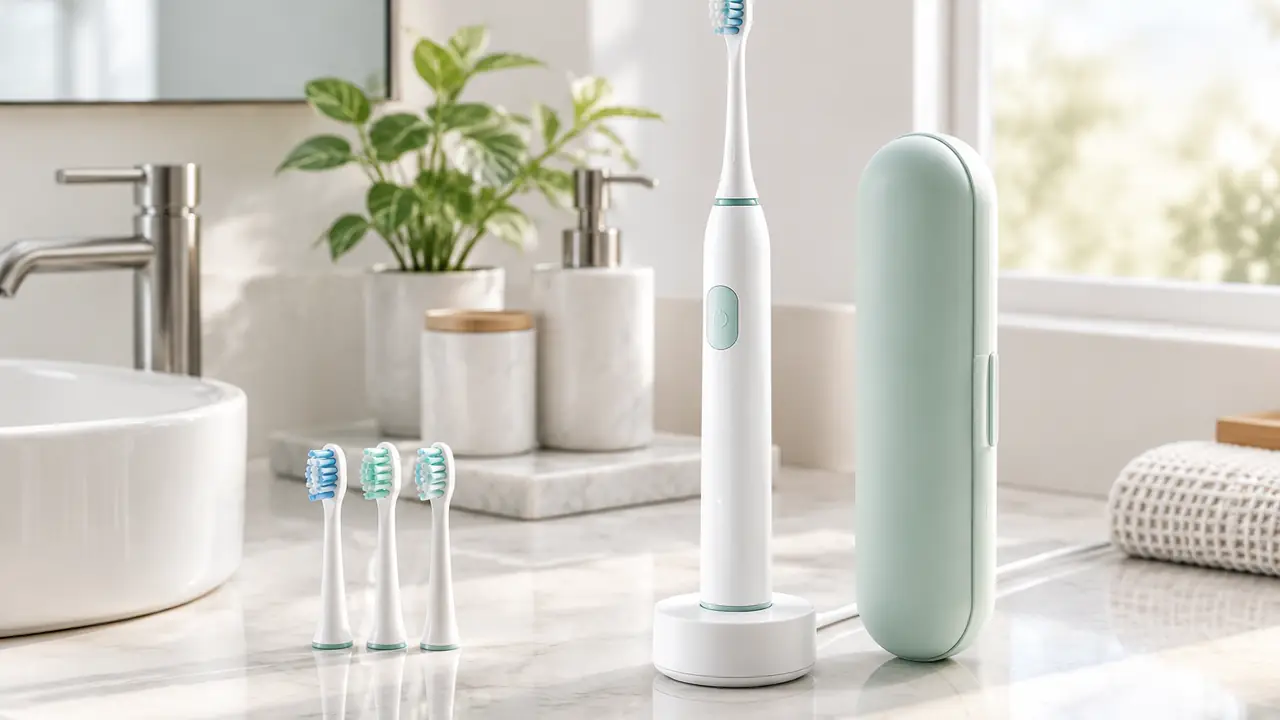
What the handle must compensate for
The physical changes that come with age translate directly into tool requirements, and none of them are exotic. Reduced grip strength asks for a wider handle with a soft overmould that does not need squeezing. Reduced dexterity asks for fewer controls, larger and more distinct, that work without precise finger placement. Reduced stamina asks for a lighter body that stays comfortable through a full two minutes. Tremor or stiffness asks for a drive that does the work without requiring small corrective movements, and for gentle modes that never punish an unsteady hand. Memory asks for a product that behaves identically every time it is picked up - same button, same mode, same prompts.
Read as a brief, this is less a new product than a selection discipline on existing platforms. Every element above exists as a catalog option in the category: overmould grips, single-button firmware, two-mode handles, docks, battery models. What the desk adds is the insistence that the options be chosen as a set and confirmed in writing, because an ease-of-use SKU assembled from defaults - thin handle, five modes, cable charging - is not an ease-of-use SKU at all, however the box describes it.
Grip: diameter, overmould and the button
Grip is the first specification and the easiest to get wrong, because handle fashion in the category runs slim. For this audience the diameter should step up, the surface should be soft overmould rather than glossy plastic, and the taper should be gentle enough that the handle rests in a relaxed grip instead of demanding a closed fist. The power button belongs where a thumb lands naturally, sized generously, with a clear press feel; secondary controls, if any, must be visually and tactilely distinct so a user never mode-cycles by accident. Plants hold overmould and shell options on their platforms, so the grip upgrade is a tooling-light request on most sonic lines - but it must be called out per model, sampled in hand and confirmed on the datasheet before the order.
Weight and balance
Weight is the quiet spec. The drive, the cell and the shell decide it, and across the category the difference between a light and heavy handle is felt within seconds by a user with tired hands. The balancing act is against runtime: the lithium cells that power the category, typically 800-1,400 mAh at 3.7 V, are the heavy element, so an ease-of-use SKU often chooses the smaller end of the cell range, accepting a runtime around the low end of the usual 14-30 days in exchange for a handle that stays comfortable through the session. That trade is worth making explicitly with the plant rather than discovering it in samples, and the desk asks for the assembled weight of each candidate model, head fitted, as a line item in the datasheet review.
Operation: one button, one mode, clear prompts
Firmware is where ease is won or lost. The spec the desk writes for this audience: power on with one press, straight into the gentle mode, no mode cycling required for the everyday session; two programs on the handle at most; the two-minute timer standard, with thirty-second quadrant prompts delivered as a distinct pulse the user can feel even with reduced hearing; a long end signal so the finish is unambiguous. Default-mode firmware is the single highest-value line in the brief - it removes the only decision the product otherwise asks for twice a day - and it is a small firmware change plants accept readily when specified before the order. Where a pressure sensor is in the platform, it earns its place here too, since pressing harder is also the habit of a hand compensating for stiffness. None of this is therapeutic framing; every line describes what the tool does, and the box should read exactly the same way.
Charging and power: docks over cables, batteries as the alternative
Charging is where the format decision lands, and the two routes suit different placements.
| Format | Ease advantage | Trade-off |
|---|---|---|
| Rechargeable with dock | Handle stands in the dock; nothing to plug in, 12-16 h wireless charge | Dock needs a shelf spot by the sink; runtime 14-30 days typical |
| Rechargeable, USB cable | Lighter and cheaper | Small connector and 4-6 h charge; harder for stiff hands |
| AAA battery handle | No charging at all; 7,000-12,000 strokes/min; simple two-cell door | Battery changes need dexterity or a helper; lower drive rate |
For most programs the dock-charged sonic is the anchor: the dock is the single feature that removes cable handling entirely, and the charging dock and case line carries the options. The AAA battery model is the low-maintenance alternative - no charging routine, a familiar object for users who distrust rechargeables - and it runs roughly 90 days per battery set at twice-daily use as a typical figure. The two formats compared in full are in the battery vs rechargeable note, and runtime behaviour is explained in the battery life note.
Channels and program shape
This audience reaches the category through gift retail, pharmacy chains, mail order and family purchase - channels where the distributor and wholesaler tier does most of the placing, and where simple, honestly specified products with strong packaging communication outperform feature-dense flagships. The program writes itself from the sections above: one dock-charged sonic SKU specified for grip, weight and single-button operation; optionally the battery model beside it for the no-charging preference.
Packaging and manuals carry more weight here than in most segments. The box should state the three things a buyer needs on the front - charge type, session behaviour, button count - in type large enough to read without effort, and the quick-start card should be one diagram per step rather than a folded leaflet of dense text. Plants hold packaging options across the standard formats, so the ease-of-use reading of the box is a layout and artwork request, agreed at the same review that fixes the claims wording - and the wording stays inside the same honest mechanical limits as every other SKU in the category.
Quantities follow the standard references - 500-1,000 pieces per model on catalog molds, more with private-mold tooling - with samples in 7-15 working days, documents per project under IEC/EN 60335-2-52 or UL 859 plus the lithium paperwork where a cell is fitted, and every figure confirmed in writing. Schedules sit on the desk's MOQ and lead time page, and the brief goes through the quote form with grip, weight and button count named as first-class specification lines.