
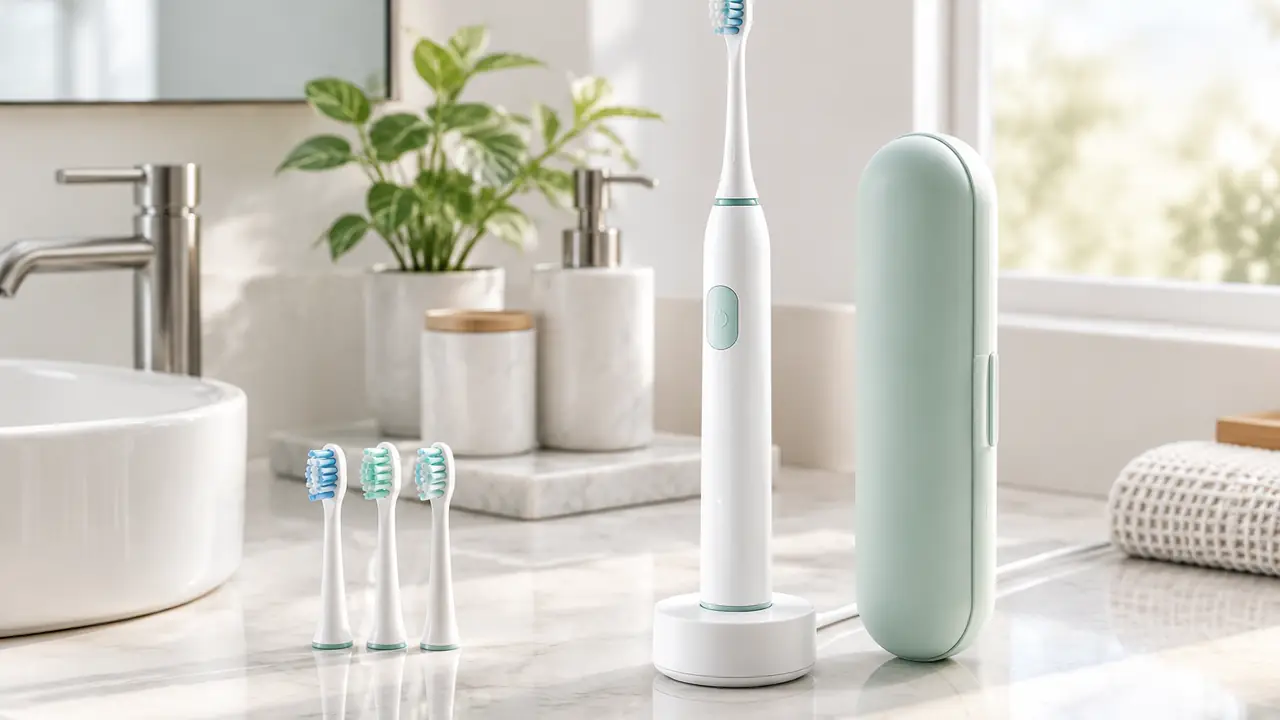
What a brush can honestly do about stains
Teeth pick up two kinds of discolouration, and the distinction decides everything a buyer needs to know. Surface stains sit on the enamel - films and deposits left by coffee, tea, wine or tobacco - and they respond to mechanical action, because bristles moving across the surface at thousands of strokes per minute wear the film away the way any polishing action does. Intrinsic colour, by contrast, sits in the tooth structure itself, and no amount of bristle motion reaches it; changing that is a chemical process that belongs to other products and other regulatory categories entirely. A toothbrush therefore has one honest stain story: through mechanical polishing it helps remove surface stains. That sentence is the whole claims envelope, and everything in this note stays inside it.
For a buyer, this is good news rather than a limitation. The mechanical story is fully verifiable - frequency, amplitude, bristle layout and mode behaviour are all measurable - so a stain-interest SKU can be specified, sampled and approved on facts alone. The products that get into trouble are the ones whose boxes promise a colour change, and the discipline of keeping to the mechanical story is what separates listings that survive strict retail review from listings that do not.
Where the staining story sits in the assortment
Both drive families can carry a stain-interest SKU, with different mechanics behind the same honest claim.
| Type | Polishing mechanics | Typical figures |
|---|---|---|
| Sonic flagship | High-frequency sweep with amplitude doing the work across a wide area | 31,000-40,000 strokes/min; amplitude about 1.5-3 mm |
| Entry sonic | Same motion at a lower rate; polish mode lifts it for the polishing pass | 20,000-31,000 strokes/min |
| Rotary | Round head works one or two teeth at a time with a concentrated, polish-like feel | 7,000-8,800 rotations/min; some models add 20,000-40,000 strokes/min |
| AAA battery handle | Lower mechanical energy; a polishing story is weak here and usually avoided | 7,000-12,000 strokes/min |
Sonic handles dominate the stain-interest shelf because the motion covers area quickly and the platform supports a dedicated polish mode without new tooling. Rotary handles earn their place through feel: users describe the small round head as a polish in the literal sense, and some assortments carry one of each so the shelf answers both preferences. The full mechanical comparison is in the sonic vs rotating guide.
The mechanical elements that do the polishing
Three specifications decide how much polishing action a handle actually delivers, and all three are verifiable. The first is the drive itself: within the sonic family, the flagship band of 31,000-40,000 strokes per minute with amplitude in the 1.5-3 mm range moves more paste-and-water across the surface per second than an entry drive, which is the honest mechanical reason premium handles anchor this segment. The second is the head: nylon bristle layout does the contact work, with trim height and tuft angling deciding how bristles sweep the curved surfaces, and the bristle materials note covers the filament options plants stock. The third is the mode firmware: most plants offer a polish or brighten-named program that raises the rate or amplitude for short bursts, and the brushing modes note explains what these programs typically change. A buyer specifying a stain SKU should ask for all three in writing: the drive band, the head filament spec and the firmware sheet that says what the polish mode does.
One detail separates serious programs from brochure ones: whether the polish mode is time-limited. Many platforms run the high-energy program for a short window or pulse it inside the two-minute timer, because a full two minutes at maximum amplitude is punishing for most users and drains the 800-1,400 mAh cell faster. Ask how the mode behaves in the session structure, and test it on samples with the shipping head fitted.
What cannot be promised
The limits deserve their own section because this is the segment where listings fail. A toothbrush listing may say that mechanical polishing helps remove surface stains. It may not promise a colour change, may not use before-and-after implication in artwork, may not borrow the vocabulary of chemical whitening products, and may not attach timeframes such as shades in weeks. None of that language describes what a bristle can do, so it fails the desk's basic test: every claim must trace to a measurable feature. Retail channels in strict markets enforce this inconsistently but unpredictably, and a box printed with an overreach is a reprint, not an edit. The practical rule the desk applies at artwork stage: describe the mechanism, describe the sensation, state the honest surface-stain ceiling, and stop. The same discipline applies across the category's other red lines - no treatment claims, no medical framing - and it is checked before any packaging goes to print.
Specifying a stain-interest SKU
For a line planner, the stain SKU is usually a variant of the sonic hero rather than a separate platform: the same handle with a polish mode moved up the mode list, a head choice biased toward polishing bristle layouts, and artwork that carries the mechanical story. On a three-tier line it typically sits second - above the gentle or gum-care tier in energy, below the flagship in sensor features - which keeps the factory configuration shared and the artwork doing the segmenting. Where a rotary companion is wanted for feel-based shoppers, the rotating line accepts the same treatment: polishing head layout, a stated rotation band and the same honest wording. Refill heads keep the story alive; a polish-positioned line should plan its replacement heads with the same filament spec as the launch head so the experience holds across the ownership cycle.
Program notes
Commercially nothing is exotic: catalog-mold handles from 500-1,000 pieces per model, private-label programs from 1,000-3,000 pieces plus tooling, heads from 5,000-10,000 pieces per style, public-mold samples in 7-15 working days. Documents follow the platform - IEC/EN 60335-2-52 or UL 859 for the appliance, UN 38.3 and IEC 62133-2 for the lithium cell - verified per project. Reference schedules sit on the desk's MOQ and lead time page, and a stain-interest brief can be sent through the quote form with the drive band, head spec and mode list called out explicitly, which is all a plant needs to quote it accurately.