
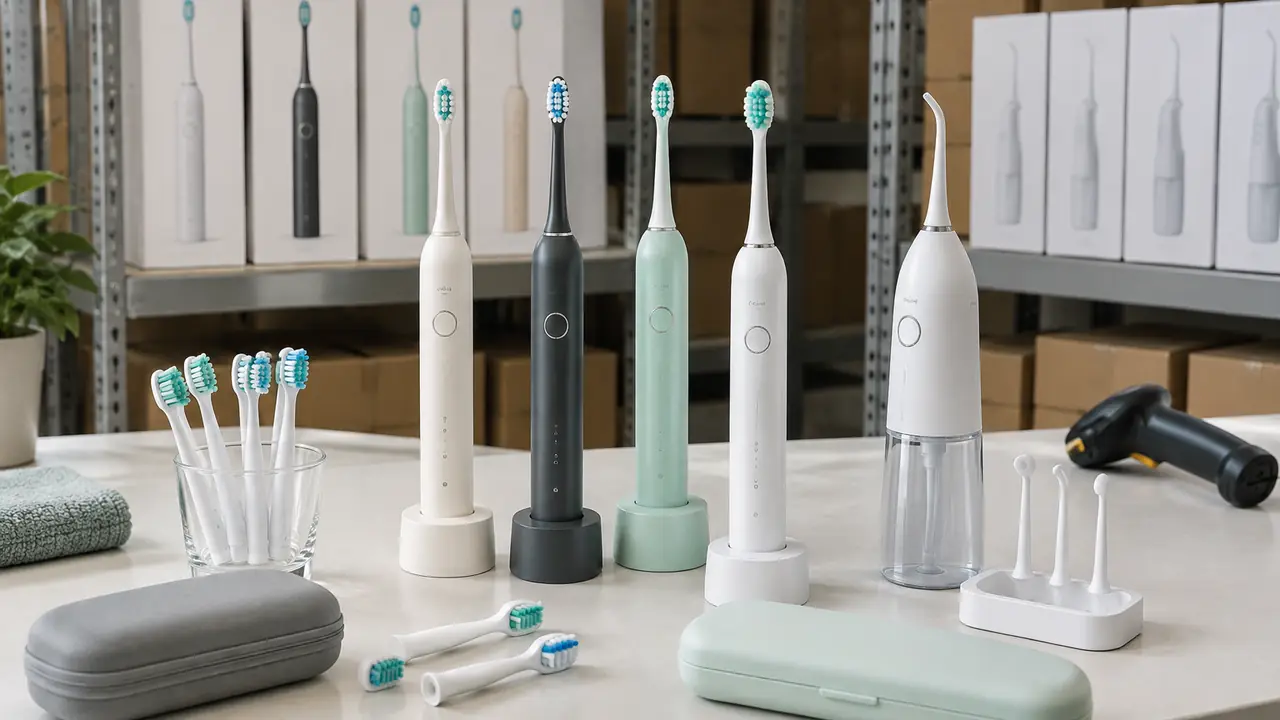
The numbers that carry a listing
A powered toothbrush is specified, not styled, and a listing that leads with its mechanical facts converts better and complains less. Four numbers do most of the work. Frequency: flagship sonic handles run 31,000-40,000 strokes per minute, with entry models at 20,000-31,000 - always quoted as the model datasheet states, because the binding figure is per model, not per category. Modes: two to five named programs, each doing something a user can feel, from a full-power clean to a gentle setting. Runtime: 14-30 days is typical across the category at two two-minute sessions per day, following the 3.7 V cell of roughly 800-1,400 mAh - and the usage pattern belongs in the sentence, because a runtime figure without one is not comparable. Sealing: IPX7, the industry norm meaning the handle survives one metre of water for thirty minutes. Around these sit the supporting facts - the two-minute timer with thirty-second prompts, charging hours of 4-6 by USB or 12-16 on a wireless dock, head availability - each answering a question a shopper genuinely has. The mechanics behind each number are explained in the note on reading toothbrush specs, and the flagship tier is specified on the sonic toothbrush page.
A content map for the page
A listing reads well when each block answers one question and stops. The map below is the structure the desk sees working across markets; it also happens to be the structure reviewers and platform auditors find easiest to verify.
| Section | What to state | Wording guard |
|---|---|---|
| Headline block | Drive family, frequency, mode count, sealing rating | Figures per the model datasheet; no cross-model boasts |
| Comfort and control | Timer, quadrant prompts, pressure sensor, gentle modes | Sensory or mechanical words - soft bristles, gentle modes |
| Power and charging | Cell type, runtime with usage pattern, charging hours | State the pattern behind every runtime claim |
| Consumables | Head compatibility and replacement cadence | Compatibility stated per platform, plainly |
| Compliance | Standards by name: IEC/EN 60335-2-52 or UL 859, cell tests | Never approval language; registration is not endorsement |
| What the brush does | Mechanical benefits only | Helps remove surface stains - and nothing beyond that |
Claims discipline: where listings are won or lost
Oral care carries claim lines that general appliances do not, and the discipline is strict enough to state as rules. A powered brush helps remove surface stains through mechanical action; that is the whitening-adjacent sentence a listing may make, and it ends there - promising whiter teeth, or showing results imagery that implies it, steps past what the product can honestly deliver. Wording that implies treatment, remedy or an effect on bacteria is out in every market, however common it looks on competing boxes. Endorsement and proof language of any kind - professional recommendation, efficacy-sounding validation, association acceptance - is not available to this category at all. And the compliance block should be written as it is: toothbrush plants for the US market hold an FDA establishment registration, which is a registration layer, not a product approval, and listings must never shade it into one. The safest test before publishing is mechanical: every benefit sentence should still be true if the words describe a machine - frequency, pacing, sealing, bristle contact. The moment a sentence promises an outcome in the mouth rather than an action of the tool, it should be rewritten back to the machine. Market-by-market documentation rules sit in the certifications guide.
Specs that answer questions before they become returns
Some listing content is less about persuasion than about expectation-setting, and it earns its place by preventing complaints. Charging hours belong in plain text - a user told that a wireless dock takes 12-16 hours does not read slow first charging as a defect. The runtime sentence carries its usage pattern, as above. Head compatibility deserves a compatibility table or a plain statement of which platform the heads fit, because a refill that does not seat is read as a defective product. Mode names should describe what they do - gentle, clean, sensitive - because a mode list of marketing names leaves the user guessing. And the pressure sensor, where fitted, is worth a sentence: its pulse or light is a feature a first-time user may otherwise mistake for a fault. Each of these facts is cheap to state and expensive to omit, which is the whole economics of a well-built listing page.
Consistency across box, card and page
A listing does not stand alone: the retail box, the insert card and the digital page are read together by reviewers, by retail buyers and by platform audit tools, and a figure that differs between them reads as a defect even when it is only a typo. Frequency, runtime, mode count, sealing and compatibility statements should be drawn from one approved fact sheet that feeds all three surfaces, and every claim on the printed box should be able to show its evidence document. Retail programs formalise this: chains review packaging and listing claims side by side, and a mismatch stalls a listing at onboarding. The print side - box copy, insert cards, claim review before plates are made - is handled with the packaging team described on the packaging and retail boxes page, and the chain-facing view of the same discipline is on the retail chains page. Mode wording specifically is developed in the note on brushing modes.
A pre-publish checklist
- Every number on the page traces to the model datasheet, and one fact sheet feeds box, card and listing alike.
- Benefit wording is mechanical throughout: helps remove surface stains, paces the session, sealed to IPX7 - nothing beyond.
- No treatment, microbial-action or endorsement language anywhere, including image captions and A/B variants.
- Runtime states its usage pattern; charging states its hours; compatibility states its platform.
- Compliance block names standards and registrations accurately, with evidence on file for each.
Programs that intend to scale usually fix the fact sheet before the first print run - reference minimums and schedules for the underlying program are on MOQ and lead time, and a brief can be started through the quote form with the listing fact sheet as part of the deliverables.