
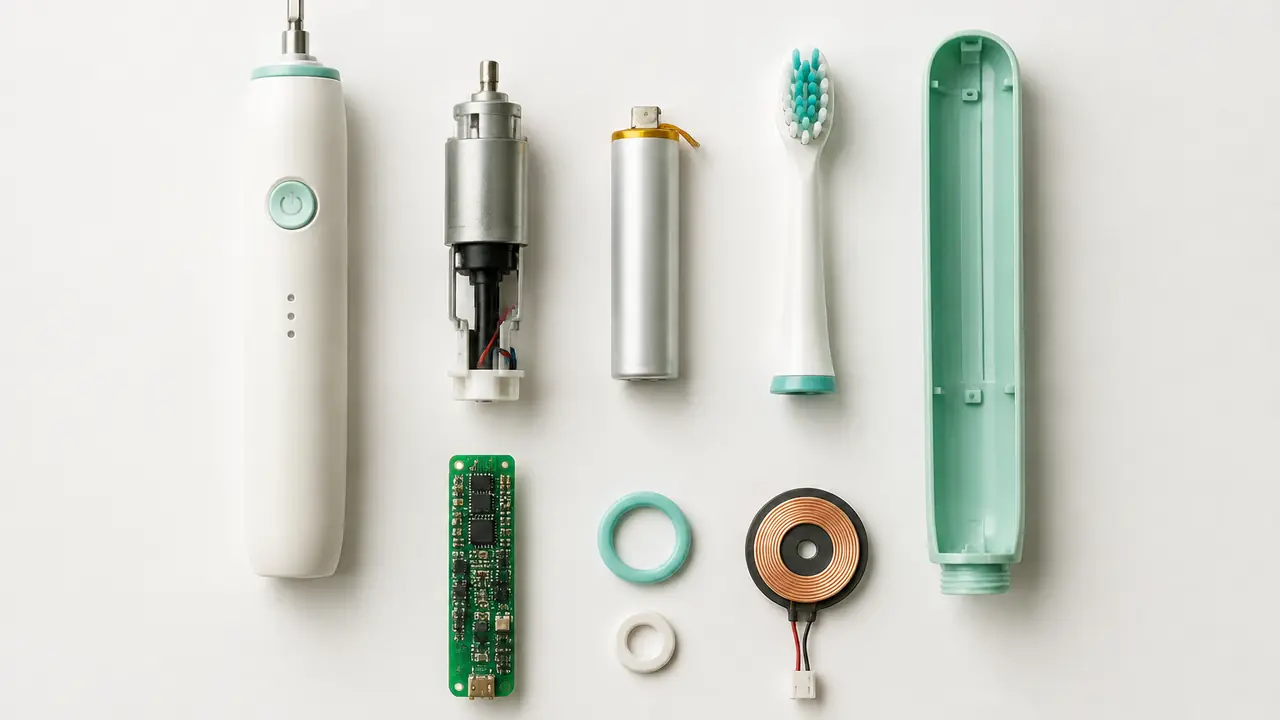
What a retail pack contains
Open a toothbrush box on a shelf and the parts inventory begins before the product does. There is the outer package - box, blister card or sleeve - carrying the brand and the legal marks. There is an inner tray or insert holding the handle without play. There is the handle itself, usually cased or sleeved, and one or more heads in sealed wraps. Beside them sit the accessories: a charging dock or cable, sometimes a case, and almost always a manual plus a card - warranty, quick-start, or a head-replenishment note pointing at the brand's own store. Each item is a sourced component with its own supplier, minimum and lead time, and a program that treats packaging as one lump item loses control of exactly the costs and delays that show up late - usually in the last two weeks before shipment, when there is no room left to move. The desk bills packaging line by line for that reason, and the finished-goods checklist that closes production inspects the pack with the same weight as the handle, per the appearance-and-packaging item on every agreed test list.
Blister, window box or gift box
| Format | Strengths | Trade-offs | Typical channel |
|---|---|---|---|
| Blister card | Lowest cost, tamper-evident, hangs on pegs | Weak brand stage, hard to open | Entry lines, marketplace and value retail |
| Window box | Balances cost and shelf presence | More material, more print | Mid tiers, retail chains |
| Magnetic gift box | Full unboxing stage, kit presentation | Highest cost and volume in the carton | DTC flagships, gifting sets |
The choice is a channel decision before it is an aesthetic one. Peg-hook retail wants blisters; a shelf-lined aisle rewards window boxes; a direct-to-door program earns its unboxing with a gift box - the pattern behind most DTC brand programs, while shelf-pack rules dominate for retail chain private label. One box can also serve several channels with a sleeve swap, which is a common trick for programs that straddle two.
Trays, wraps and the fit problem
The inner tray does the silent work: it stops the handle rattling through transit and presents it on open. Pulp, vacuum-formed plastic or molded fiber are the usual routes, chosen against cost and the brand's material story. Heads ship in sealed wraps that keep them protected and give the replenishment story a place to live. Fit is the checkpoint: a tray that lets the handle travel ten millimetres will print wear onto the finish by arrival, so first articles are shaken, not admired, and the tray material is quoted with its own lead time like any other component. For kits - brush plus head multi-packs, brush plus flosser - the tray becomes the architecture that makes the bundle feel like one product rather than a bag of parts, which is why kit packaging is quoted per kit rather than inherited from the single line, and why kit minimums deserve their own confirmation in writing.
Manuals, cards and language
The manual is a compliance document wearing a marketing outfit. It carries the safety instructions the destination market expects, the charging and care guidance, and the certification marks the program claims - all in the market's language. Translation is a per-language cost line and a per-language risk: a mistranslated care instruction creates support tickets, and a wrong compliance phrase creates worse. The desk keeps a master manual structure per platform and translates variants per market, confirming each language version in writing before print. Cards carry the lighter load - quick-start steps, warranty terms matched to the market, and, on replenishment-led programs, the note that points users toward head refills. One discipline holds across every printed piece: claims stay mechanical. A brush helps remove surface stains and paces a routine; treatment, germ and endorsement language stays out of every language version, because a claim that survives one market's rules rarely survives the next's. How listing copy and box copy reinforce each other is in toothbrush listing content.
Marks, labels and lithium warnings
Beside the brand marks sit the legal ones. Material and recycling symbols per market, the certification marks the program actually holds, barcodes at the size the channel scans, and country-of-origin wording. Programs with lithium cells add the transport-side marks the forwarder requires on cartons, tied to the cell paperwork already on file - the packaging and the shipping file are one system, not two. None of these items is optional at the margin where it matters, and all of them are cheaper to fix in artwork than on a stopped container, which is why the desk reviews the full mark set against the destination checklist before any print run; the certifications behind the marks are mapped in the certifications guide.
The export layer around the retail pack
Around the shelf pack sits the export pack: inner cartons, master cartons, and the drop and compression behavior that gets a full container through transit with sellable contents. Drop testing is a named item on the agreed list, run on packed product rather than bare handles, because the pack is what absorbs the knock. Carton spec follows the lane - sea freight dominates this category, around 15-25 days to US West Coast ports and 30-45 to Europe, with air reserved for launches and top-ups; the lane choices and their paperwork sit on logistics and shipping. Flat-packing is the quiet cost lever here: boxes shipped folded and assembled at the plant save container space, and buyers moving their own assembly should price the labor question honestly before choosing it.
Ordering print: artwork control and lead times
Packaging runs on artwork discipline. The desk keeps the master artwork per program - dielines, mark set, language versions - and releases controlled versions per order, so the tenth production run matches the first and a market-specific change never silently leaks into another market's cartons. Print minimums and lead windows are set per program and confirmed in writing, riding alongside the product schedule rather than after it, since a finished handle without its approved box is not a shippable SKU; the reference timing lives on MOQ and lead time. A packaging brief - new box, language set, kit tray or the export layer - can be attached to any program through the quote form, and the export-specific packaging rules are expanded in toothbrush packaging for export.