
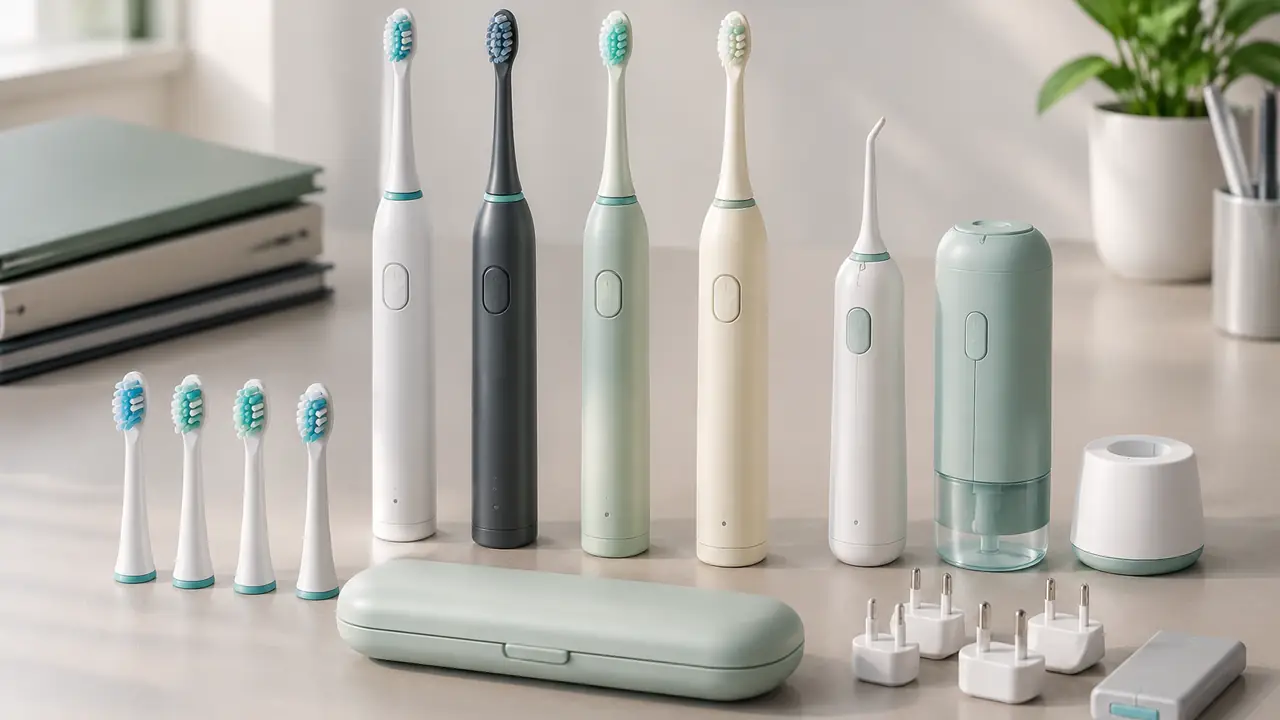
Why the checklist splits by market
A toothbrush leaves the plant as one product and arrives as several compliance files, and which files it needs is decided by the destination market rather than by the product itself. Appliance safety, lithium cell transport, radio approvals, chemical restrictions and facility registration each follow their own route, and a program shipping to two continents runs the routes twice. The routes overlap heavily - the same plant documents, re-cut per market, cover most of the list - but skipping one layer stops a shipment as surely as skipping them all, so buyers should treat the checklist as a set rather than a menu.
Three principles run beneath every row that follows. First, standards appear here as routes a plant follows for a model: Sonicelle holds no certificates, and partner plant documents are verified per project. Second, every timing figure in this note is a reference range observed across the desk's programs and confirmed in writing for each order. Third, the layers interact: a rechargeable Bluetooth model sold into the EU and the US needs almost every line of the table, while a AAA-battery handle without a radio needs a fraction of it - which is why power type and feature set should be fixed before certification planning starts, not after.
The master checklist
| Layer | What it covers | EU route | North America route |
|---|---|---|---|
| Appliance safety | Electrical and mechanical safety of the finished handle | EN 60335-2-52 with EN 60335-1, inside CE (LVD, EMC) | UL 859 via UL or ETL |
| Battery transport | Cell behaviour under transport conditions | UN 38.3 test series | UN 38.3 test series |
| Battery safety | Cell and pack design for portable use | IEC 62133-2 | IEC 62133-2 |
| Radio, Bluetooth models | The wireless function | CE RED | FCC Part 15 |
| Materials | Restricted substances in parts and packaging | RoHS and REACH | The desk requests the same declarations as evidence |
| Facility registration | The plant as an FDA-regulated establishment | Not applicable | FDA establishment registration held by the plant; not a product approval |
| United Kingdom | Marking for the GB market | UKCA alongside the EN route | Not applicable |
Read the table as a matrix rather than a sequence. The appliance layer differs most between markets, because Europe and North America run genuinely different safety regimes. The battery and radio layers are close to universal, and the materials layer is a documentation exercise anywhere. A buyer can therefore plan one document pack with two safety files on top, rather than two parallel projects - the approach the desk uses on every dual-market program.
The appliance safety layer
IEC 60335-2-52:2021 is the particular standard for electric oral hygiene appliances, applied together with the general part IEC 60335-1, and covering appliances rated up to 250 V. For EU programs the harmonised EN text sits inside the CE marking file under the Low Voltage and EMC directives, with third-party test reports behind a self-declaration; reference timing in the desk's programs is about 2-4 weeks. For North America the route is UL 859, the standard for household electric personal grooming appliances, evaluated by UL or by ETL, with a reference window of about 4-8 weeks. The two files ask similar technical questions in different paperwork, so the work overlaps but never collapses into a single report - a model sold on both continents carries both. The routes are taken apart in the IEC 60335-2-52 note and the UL 859 note.
The lithium battery layer
Every rechargeable handle ships with a lithium cell - typically 3.7 V and 800-1,400 mAh across the category - and the cell brings its own papers regardless of destination. UN 38.3 is the transport test series, the conditions a cell must satisfy before it moves by air or sea, and IEC 62133-2 is the safety standard for lithium cells and packs in portable applications. Both attach to the cell model itself: change the cell and the papers must follow the new cell, which is why the desk re-checks cell numbers on every quotation revision. AAA-battery models skip the layer entirely, one of that format's quiet advantages for marketplace sellers. Reference timing for UN 38.3 testing is about 2-3 weeks, and the freight consequences are laid out on the logistics and shipping page, with the fine detail in the UN 38.3 and IEC 62133 note.
The radio and registration layers
Bluetooth models add a radio file on top of everything else: FCC Part 15 for the United States and CE RED for the EU, each clearing the wireless function rather than the brushing mechanics. The US then adds one more layer that buyers frequently misread. Electric toothbrushes are overseen there as electric products, and the manufacturing establishment holds an FDA establishment registration - a facility-level record held by the plant, not a judgment on any model. An establishment registration is not a product approval, and no listing should present a toothbrush as approved by the FDA. What a buyer actually checks at that layer is set out in the FDA registration note.
How documents are verified
Collecting certificates is the easy half; trusting them is where programs stumble. The desk's routine pulls the document pack per project and checks that names, models and versions line up: the photographs inside a safety report against the sample units on the bench, the standard's edition against the destination market's current requirement, the applicant named on a report against the plant that will ship the goods, and the cell model on a UN 38.3 summary against the cell written into the bill of materials. Mismatches are common and usually innocent - a report issued to an earlier shell colour, a cell swapped for availability - but each is resolved in writing before a purchase order moves. The routine sits on the compliance and certifications page, and the same document discipline continues at testing and inspection on every batch.
What to ask for first
- The market list and the feature set, because they decide which rows apply - a Bluetooth rechargeable model for the EU and US is the heaviest case on the list.
- The document pack per model: the appliance safety report, the cell papers, the radio file where applicable, and materials declarations.
- Names and versions: report holder, testing body, standard editions and cell model numbers, so the desk can verify them at source.
- Timing as reference ranges for this program, so the launch calendar leaves room for the North American file.
- Written confirmation of every agreed certificate and figure before tooling and orders move.
A brief that arrives with those five answers attached is the program the desk can run fastest. It starts at the quote form, and the reference quantities and schedules behind the plan sit on MOQ and lead time. The market-by-market detail also lives in the long-form certifications guide, which pairs with this checklist for buyer teams building internal templates of their own.