
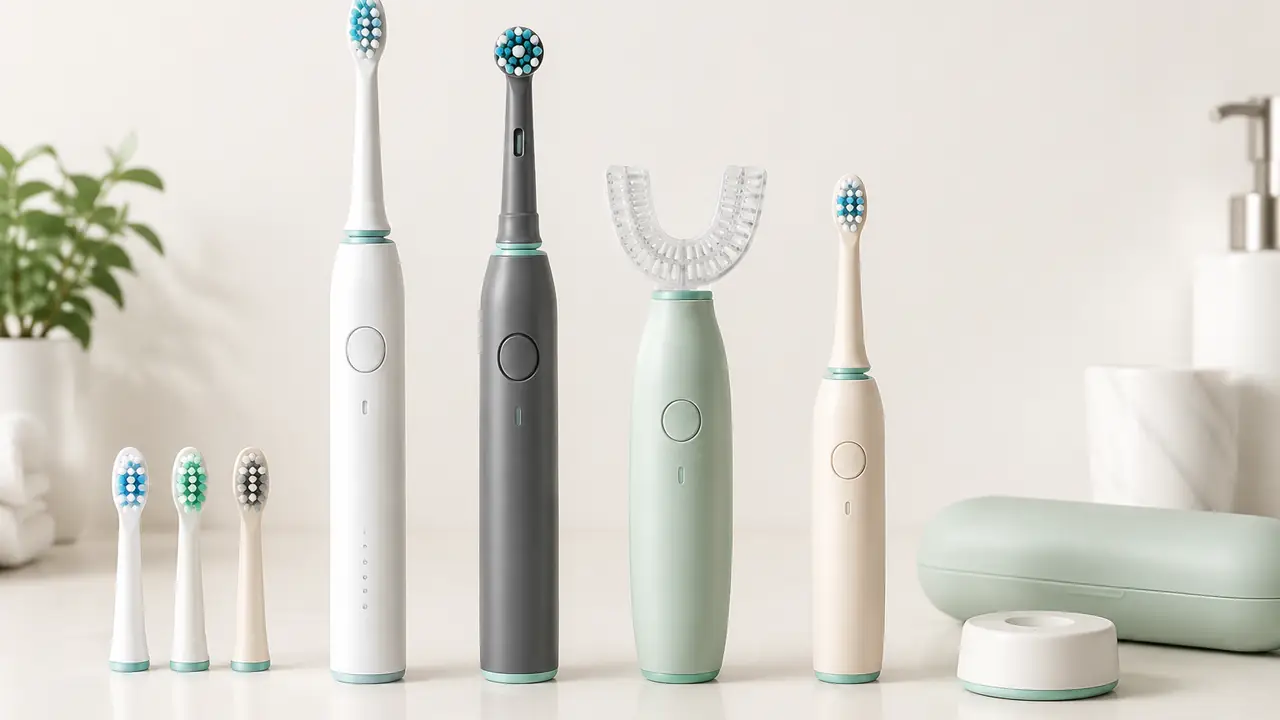
Why brand lines start with sonic
Ask which format a first oral-care line should carry and the practical answer is usually a sonic handle. The plant base is the widest in the trade - coastal clusters in Zhejiang and Guangdong build the format on mature platforms - so quotes arrive quickly and comparison is meaningful. The architecture also scales: one drive family covers an entry model at 20,000-31,000 strokes per minute and a flagship at 31,000-40,000, which lets a catalogue grow by adding modes, sensors and finishes rather than by changing platform. And the head story is clean: elongated snap-on heads are produced at scale, support replenishment revenue and can be merchandised as a consumable from day one.
None of that makes sonic the right answer everywhere. A distributor filling an entry price band may be better served by a AAA-battery handle; a children's aisle may want a U-shaped tray. But for a brand owner whose brief is a credible mainline handle, sonic is where the sourcing conversation usually starts, and it is the format this guide follows from spec sheet to purchase order.
The reference ranges to quote
| Parameter | Typical range across the category | Where it is confirmed |
|---|---|---|
| Frequency | 31,000-40,000 strokes/min flagship; 20,000-31,000 entry | Model datasheet |
| Amplitude | About 1.5-3 mm bristle tip travel | Per head type, per datasheet |
| Modes | 2-5 named programs | Firmware sheet |
| Timer | 2-minute timer with 30-second quadrant prompts | Sample test |
| Battery | 3.7 V, 800-1,400 mAh lithium | Cell specification |
| Runtime | 14-30 days at two 2-minute sessions a day | Runtime report |
| Charging | Wireless dock 12-16 h, or USB 4-6 h | Accessory datasheet |
| Waterproofing | IPX7 (1 m, 30 min) | Test report per model |
These are category reference ranges, not commitments about any specific model. Treat every figure as indicative until the plant's own datasheet is on file, and have the desk verify test reports per project - frequency and runtime are the two numbers most often inflated in listings. The spec-reading note explains how to compare datasheets across plants without being misled by differing measurement conditions.
Which parts decide how the handle feels
Four components carry most of the difference between two handles with identical headline numbers. The motor comes first: eccentric-motor drives dominate on cost while linear magnetic drives appear where a brief wants a different stroke character, and motor grade shows up directly in noise - a well-built sonic bay runs at or below about 55-60 dB. The head collar comes second: it is the coupling between motor and mouth, and a loose fit turns stroke into rattle, which is why retention force is pull-gauge tested during development. The cell comes third: runtime claims follow the 800-1,400 mAh pack, and cell sourcing decides both the runtime report and the shipping paperwork. The seals come fourth: IPX7 is the category norm, and it is achieved by overmoulding and gasket design that cheaper builds imitate on the surface only. The sonic motor and replacement brush heads pages break the drive chain into sourceable parts.
The certification route by market
The appliance itself is tested to IEC/EN 60335-2-52 together with the general rules of IEC 60335-1 for Europe and most export markets, with CE marking built on LVD, EMC and RoHS declarations plus REACH documentation. North America is the UL 859 route through UL or ETL. Any model with a lithium pack adds UN 38.3 transport tests and IEC 62133-2 for the cell, and a Bluetooth smart variant adds FCC Part 15 or CE RED for the radio. For the United States, toothbrush plants hold an FDA establishment registration - a production-facility matter, not a product approval, and listings must never say otherwise. Sonicelle holds no certificates; partner documents are verified per project, and the certifications guide lists the full matrix by market. As planning numbers, CE documentation typically takes 2-4 weeks, UL or ETL 4-8 weeks, and UN 38.3 about 2-3 weeks - reference figures, confirmed per project.
Typical MOQ, samples and lead time
A first sonic program on a catalog mold - the plant's existing body with a buyer's colors, logo and packaging - typically starts at 500-1,000 pieces per model. A private-mold body generally runs 1,000-3,000 pieces plus tooling. Catalog samples usually take 7-15 working days; private-label samples 15-25 days; a from-scratch body 45-90 days before tooling is even cut. Mass production lands at roughly 30-45 days for catalog builds and 35-50 days for private-label programs. Every figure here is an industry reference range, and the desk confirms quantities and dates in writing for each program - the standing ranges live on MOQ and lead time. What the ranges imply is worth stating plainly: a catalog-mold sonic line can move from brief to shipment inside a quarter, which is why it is the standard first program for a new brand.
What to ask a plant
- Which sonic platforms run on your own lines today, and which are brokered in - because a plant quoting a borrowed platform is a different risk.
- The datasheet for the exact model: frequency, amplitude, modes, cell size, runtime and charging times, with the test reports behind each figure.
- Which parts are catalog and which are customized, since tooling scope is what moves the minimum and the calendar.
- Head supply terms for the product's whole life - collar design, replenishment minimums of 5,000-10,000 pieces and the lead time behind them.
- The certificate file for the target market, verified per project rather than summarized in an email.
A brief structured this way quotes cleanly: the desk can shortlist partner plants against it and return comparable offers, usually with samples inside two to three weeks. Start through the quote form.
Head economics finish the business case
The handle sells once; the heads sell for years. A sonic program is therefore judged on head supply as much as on the handle itself: collar compatibility, bristle options, pack formats and the replenishment minimums that keep the SKU alive on a subscription or a retail shelf. Buyers who plan the head stream at the same time as the handle avoid the classic failure mode - a handle in the market whose heads are unavailable or mismolded a season later. The replacement heads note and the OEM and MOQ explainer cover both halves in depth, and the desk can price the handle-plus-heads program as one package. One rule of thumb closes the guide: listings describe mechanics - strokes, modes, timers, sealing - and never promise results. A sonic brush helps remove surface stains and paces a routine, and the wording should be written that way from the first carton.