
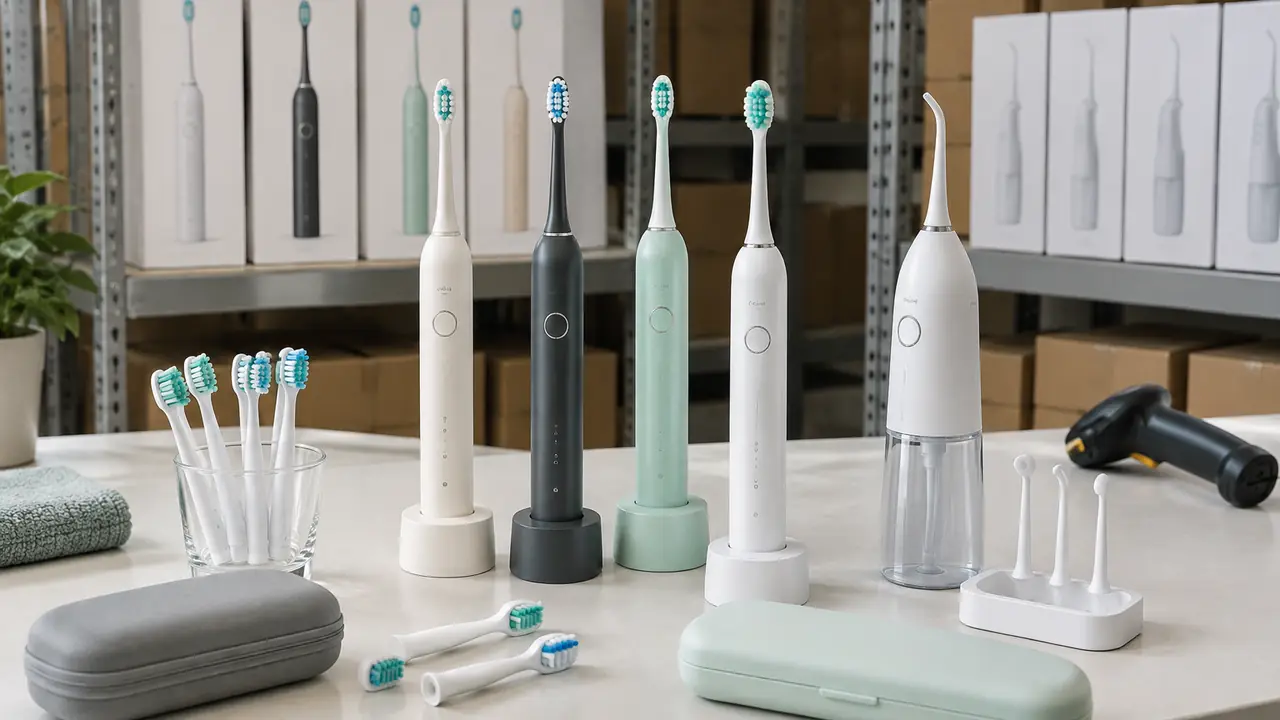
Why bundles work in this category
Electric toothbrushes bundle unusually well, for reasons rooted in the product itself. The category already thinks in systems - a handle plus heads plus a charger - so a kit does not invent a story, it completes one. Consumption is built in: a second handle for a partner or child is a predictable second purchase, and heads are consumed on a schedule regardless. The products are small and light, so a kit adds little freight and little shelf footprint while lifting the value of the slot it occupies. And gifting windows reward ready-made answers: a boxed kit removes the wrapping problem for the buyer and the pricing problem for the retailer. The result is a format that works in every channel this site serves - chains building own-brand kits, DTC brands assembling starter sets, distributors filling pallet economics, hospitality programs ordering room kits at project scale.
The formats that recur
Most bundles on shelves and in catalogues trace back to a handful of archetypes. Each has a different job, a different component list and a different planning note on the sourcing side.
| Bundle | Typical contents | Usual role | Planning note |
|---|---|---|---|
| Starter kit | Handle, charging path, one head | Flagship presentation of a line | The box carries the claims review for the whole program |
| Refill multipack | Heads in a retail-count pack | Recurring revenue at entry price | Head minimums of roughly 5,000-10,000 pieces per specification |
| Couples or family pack | Two handles, shared dock, heads for each | Gifting and household value | One SKU, two of several components - assembly cost is real |
| Travel kit | Compact handle, case, cable | Seasonal and gifting tier | Case options live on the dock-and-case line |
| Flosser pairing | Toothbrush plus water flosser | Premium cross-sell | Flosser minimums commonly around 300-500 units, confirmed per program |
| Hospitality set | Travel or battery handles, heads, room-box packaging | Project and hotel channel | Order dates follow the project schedule, not retail seasons |
Two of these deserve their own deep dives on the buyer side: the couples and family logic is set out in the note on sets and family packs as retail SKUs, and the room-kit version in the guide to hotel amenity programs.
Sourcing a bundle: multi-line coordination
A kit is a small supply chain wearing one box. The handle comes from one line, heads from another, docks and cases from a third, and a flosser pairing adds a fourth - usually the same plant family, since most brush plants build flossers on shared platforms, which simplifies coordination without removing it. Three practical consequences follow. First, minimums stack per component, not per kit: a couples pack needs two handle runs and two head runs behind it, so the arithmetic of the kit inherits the arithmetic of its parts - the reference ranges sit on MOQ and lead time. Second, lead times follow the slowest component: a kit waits for its longest part, and packaging proofs gate the whole assembly. Third, quality accountability needs one owner: the kit ships as one product with one returns process, so the desk assigns inspection responsibility across the components rather than leaving each line to its own default. Bundles assembled at a consolidation point - heads packed with handles into the retail carton at the plant or a nearby facility - arrive shelf-ready and avoid a second handling step at destination, which is usually worth the coordination effort on its own.
Packaging and merchandising
Bundles live or die on the box. A kit box must show contents at a glance, state the component list plainly - what is included, what fits what - and survive distribution without an extra outer carton where the channel allows. Insert cards carry the setup steps and the compatibility statements for every component in the kit, because a bundle multiplies the documentation surface: a couple with two handles needs the charging sentence once, but the head-compatibility sentence for each. Claims review applies to the kit as a whole, and the whitening-adjacent wording stays inside the mechanical boundary across every panel. The print and structural side - box formats, inserts, proof cycles, shelf-ready formats for chains - is handled with the team described on the packaging and retail boxes page, and the merchandising expectations of the channel are set out for retail chains.
Matching the bundle to the channel
The same archetype sells differently by channel, and the fit is worth stating. Retail chains favour own-brand kits in shelf-ready cartons, with the refill multipack as the workhorse and seasonal gift kits at the front of the store in the late-year window. DTC brands use the starter kit as the acquisition product and the refill plan as the retention product, so the kit box is designed for the doorstep as much as the shelf. Distributors and wholesalers buy bundles for pallet economics - kits that consolidate well move more value per cube. Hospitality and project buyers order room kits against property schedules, where the packaging is the brand and the contents skew to travel and battery formats. A flosser pairing sits naturally with the premium tier in any channel, and the product itself is described on the water flosser line page, while the accessories that complete most kits - cases, docks, cables - are itemised on the charging dock and case page.
Launching a bundle program
A bundle launches cleanly when it is specified like a product, not improvised like a promotion: a component list with part numbers per line; minimums and lead times confirmed per component and per kit; a packaging proof cycle that gates the assembly date; an inspection plan that covers the kit as shipped; and a written agreement on who assembles, where, and at whose cost. With those fixed, the kit becomes a normal SKU with better economics than its parts. A bundle brief - components, quantities, target channel and in-warehouse date - can be started through the quote form, and the desk returns a written schedule across the component lines rather than a quote for the box alone.