
Weak is a symptom with several sources
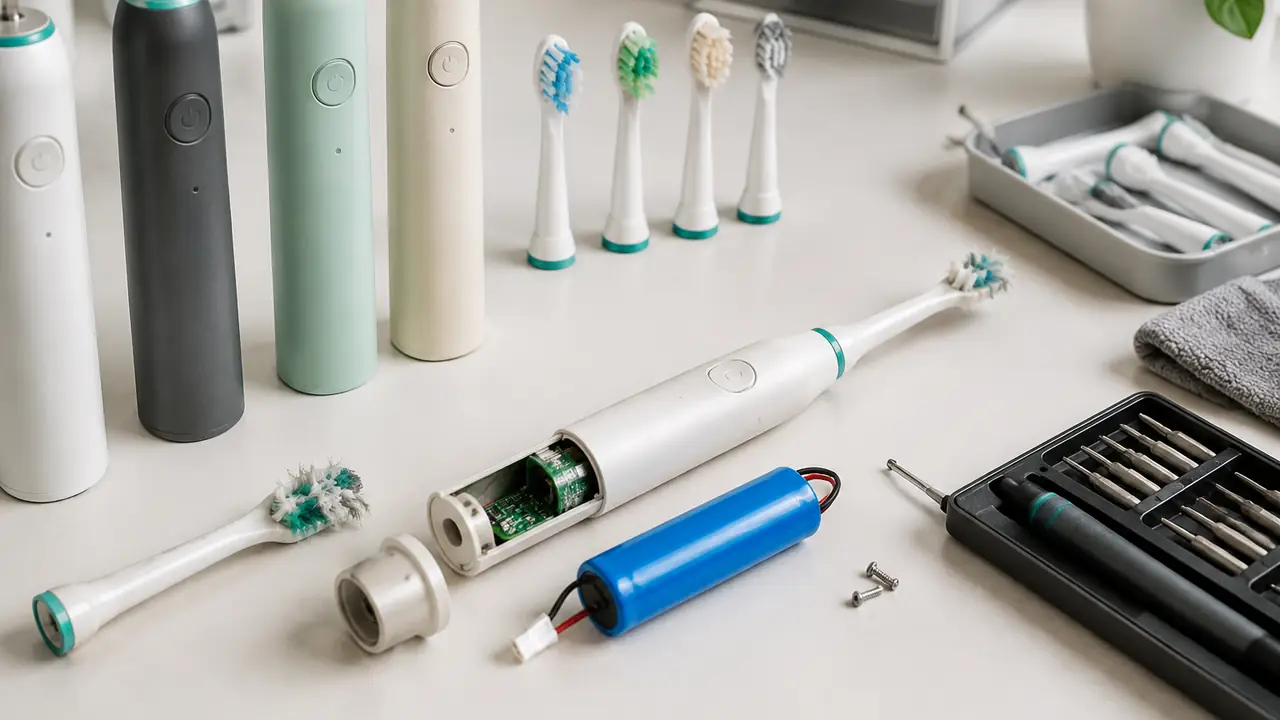
The chain that delivers vibration is short but leaky: a cell feeds a drive board, the board runs a motor, the motor shakes a shaft, the shaft couples to a head through a snap collar, and the collar translates the shake into bristle travel. Energy - and the sensation of power - can leak out at any link. A sagging cell lowers the drive voltage. A soft mode lowers the output on purpose. A collar that does not seat fully turns stroke into rattle and noise. A tired motor turns amplitude into heat. Because the user only feels the end of the chain, every one of these presents the same way: the brush feels weaker than it used to, or weaker than the box promised.
That shared symptom is why returns teams and support scripts misdiagnose weak-vibration complaints so often. The fix is to stop treating the symptom and start walking the chain in order of likelihood, which is shorter work than it sounds - the first three links settle most cases.
The causes, in order of likelihood
| Order | Cause | What the user notices | Brand-side lever |
|---|---|---|---|
| 1 | Low charge: output tapers as the cell sags | Weak after days of use, strong after charging | Low-battery behavior written into the spec |
| 2 | Gentle mode selected | Weak since new; LED shows the soft mode | Mode map and LED legend in the manual |
| 3 | Head fit: wrong head, worn collar, debris | Rattle, noise, paste packed in the socket | Retention force spec; head pairing rules |
| 4 | Motor wear after long use | Slow fade over months, more noise | Life run-hours per the factory standard |
| 5 | Drive output fault on the board | Sudden change, one mode affected | Amplitude and mode checks at inspection |
The first two rows cost nothing to resolve and everything to ignore: they are communication items, decided by what the manual says and what the LEDs mean. The middle row is a parts and pairing question. Only the last two are engineering, and both are addressed long before shipment - which is the shape of most problem groups in this category.
Head fit: where strokes get lost
The collar is the only part of the drive chain a user touches, and it is where the most amplitude is quietly wasted. A head from a different platform, a collar worn loose after many swaps, or a socket packed with dried paste all decouple the head from the shaft, and the stroke the motor still delivers arrives at the bristles as noise and buzz. The user experience is unmistakable: the handle vibrates harder in the grip while the head does less work.
Specification answers are concrete. Retention force - the pull needed to remove a head - is a listed test item, measured with a gauge, and it has a band: tight enough to stay on through a full brush and a pull against the teeth, loose enough for a thumb to snap off. Head pairing is the second half: heads are molded to a platform, and the replacement brush heads a brand sells must be made to the same collar drawing as the shaft they meet. Where a second head supplier enters the program, first-article checks against the drawing are the guard rail, as the compatibility note explains.
Motor wear and what life testing is for
A sonic drive is a wear system by nature: an eccentric weight or a linear oscillator cycling tens of millions of times over its life. Wear shows up gradually - a little less amplitude, a little more noise - which is why the complaint arrives as weak rather than dead. Plants qualify motors with continuous run-hours against their own life standard, and a buyer's question at sourcing is simply which standard applies to the motor platform being quoted and what the unit-to-unit spread looks like at end of test. Motor architecture itself - eccentric versus linear - changes the feel and the noise profile as much as the wear curve, and the sonic motor line and the motor types note compare the options. Noise is the honest companion reading here: a motor bay kept at or below 55-60 dB typical tells a buyer the drive is healthy, and a sample that runs louder than its datasheet is a conversation to have before the purchase order, not after the reviews.
Specifying vibration so it stays honest
Because weakness is a comparison the customer makes against a promise, the promise is where the prevention starts. Write both numbers - frequency and amplitude - into the model specification, with the measurement method, and hold listings to them. The reference ranges across the category look like this:
| Parameter | Typical range across the category | Where it is confirmed |
|---|---|---|
| Frequency | 31,000-40,000 strokes/min; entry models 20,000-31,000 | Model datasheet and tachometer jig |
| Amplitude | About 1.5-3 mm bristle-tip travel | Per head type, per model datasheet |
| Modes | 2-5 named programs, lower output on gentle settings | Firmware sheet and mode map |
| Noise | Motor bay typically kept at or below 55-60 dB | Measured on an assembled unit |
| Runtime | 14-30 days at 2 x 2 min per day | Runtime report per model |
Two behavioral lines complete the specification. State what the handle does as the cell empties - a taper, a pulse, an LED - so a weakening session reads as a charge reminder instead of a defect. And state the mode map, so a customer in the soft program knows the handle is doing what it was designed to do.
Back to specification and inspection
On the line, weak-vibration prevention is a short measurement list: frequency on a jig against the datasheet, amplitude spot-checks per head type, retention force by gauge, noise on assembled samples, and runtime cycling to confirm the box figure. Items are agreed per order and the results recorded, so a warranty claim months later can be compared against the batch it shipped from - that is the whole point of measuring at inspection rather than arguing after it. Reference quantities and schedules sit on MOQ and lead time, a vibration-led brief starts on the quote form, and the inspection items themselves are organised on the testing and inspection page.