
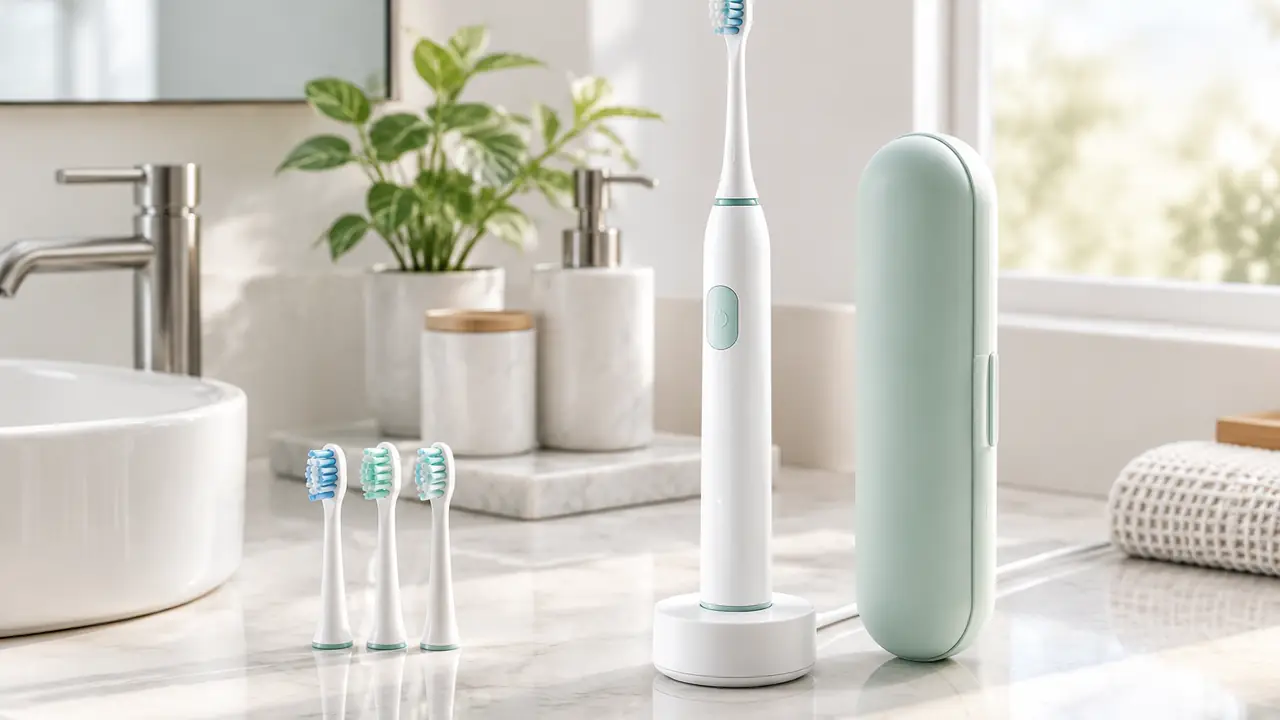
Why braces change the brush brief
An orthodont wearer brushes around obstacles. Brackets and archwires stand several millimetres proud of each tooth, they trap paste and food where they meet the enamel, and they interrupt the long contact paths that a bare arch allows. Three consequences follow for the tool. The head must be small enough to reach tooth by tooth around the hardware, because a full-size head bridges from bracket to bracket and cleans neither. The bristles must be soft, because the surfaces being worked sit right against bonded hardware and the tissue around it is already challenged by the appliance. And the power must be moderate with an accessible gentle mode, because the instinctive response to feeling that nothing is getting clean is to press harder - exactly the wrong move around brackets.
For a brand or retailer, the orthodont shelf is one of the clearer specification exercises in the category, because the needs translate directly into catalog options. No new platform is required: a compact head, soft filament, gentle mode and pressure sensor are all standard selections on existing lines. The work is choosing the combination and keeping it consistent from handle box to refill pack, which is where most orthodont SKUs actually fail - not in the design, but in the refill heads that quietly revert to the standard catalog head a year later.
Which types fit the orthodont brief
| Type | Role on the orthodont shelf | Specification to lock |
|---|---|---|
| Sonic, compact head | The everyday format; tooth-by-tooth reach around hardware | Compact head, soft tapered filament, gentle mode, 2-min timer |
| Sonic with pressure sensor | The premium tier; corrects the press-harder habit in the moment | Sensor with pulse or light response, stated on the box |
| U-shaped tray | Specialty format; seats around brackets without steering | 8,000-20,000 vibrations/min, 45-60 s cycle, adult tray size |
| Water flosser | Companion product; flushing where bristles cannot reach | 140-220 mL tank, 20-140 PSI, 1,400-1,800 pulses/min |
The pairing logic matters for assortment planning. A sonic handle is the anchor; the water flosser is its natural companion because flushing dislodges what sits between bracket and enamel, and most brush plants build flossers on shared electronics so the pair can be sourced as one program. The U-shaped tray serves the convenience niche within the segment. Battery handles at 7,000-12,000 strokes per minute appear on the value edge of the shelf, though the low energy makes them a harder fit for the around-hardware job.
Heads: size and softness first
The head is the specification that carries this segment, and both parameters point the same direction. Size: a compact head - noticeably shorter than a standard oval - lets the user place bristles on the tooth surface below and above each bracket rather than bridging across them. Softness: soft nylon filament, ideally with tapered tips that thin to a fine point, reaches the margins where bracket meets enamel with lower contact pressure per tip than flat-cut bristle. Tuft layout matters too; mixed-height trimming lets longer filaments sweep the tooth surface while shorter ones work near the hardware. All of these are catalog options on the replacement brush heads line, and the desk asks plants to confirm the filament spec and trim drawing in writing for orthodont SKUs, because the details are invisible on a shelf and decisive in the mouth. The refill program should carry the identical head spec; an orthodont line whose refill packs revert to standard heads loses the very users it was built for.
Power, modes and sensing
Within the sonic family, the orthodont brief sits at the moderate end of the drive range. A flagship band of 31,000-40,000 strokes per minute is fine at the gentle setting, but the mode list should include a genuinely soft program, and the desk asks for the firmware sheet to confirm what that mode actually changes - rate, amplitude within the 1.5-3 mm range, or both. The two-minute timer with thirty-second prompts holds its usual value here, since quadrant pacing keeps the session structured even when progress around hardware feels slow. Pressure sensing earns its premium-tier place more strongly in this segment than in almost any other: the appliance invites heavy pressing, the sensor answers it in the moment with a pulse or light, and the feature is a standard option on mid and premium tiers. Sealing and battery follow the platform constants - IPX7 as the industry norm, a 3.7 V cell of roughly 800-1,400 mAh giving 14-30 days of typical runtime - confirmed per model datasheet.
U-shaped trays on the orthodont shelf
The U-shaped format earns its orthodont reputation mechanically: a silicone tray seats over the arch and vibrates at 8,000-20,000 vibrations per minute for a 45-60 second cycle, so the user bites rather than steers a head around hardware. For buyers it is a specialty line rather than a flagship - the adult tray size and the silicone grade are the decisions that matter, and the format is positioned as a convenience tool for the segment, not a replacement for the everyday handle. Assortments typically carry it as a second SKU beside the sonic anchor. The market-side view of this segment - how the orthodont audience sizes up, which formats and specialty heads the shelf wants, and how the line should expand - is covered in the orthodont market note.
Program shape for an orthodont line
A practical orthodont program is three SKUs: the sonic anchor with compact soft head and gentle mode, the same platform with pressure sensing as the premium tier, and the flosser as companion, with the U-shaped tray as an optional fourth where the channel supports specialty shelving. Quantities follow the standard references: 500-1,000 pieces per model on catalog molds, 1,000-3,000 plus tooling for private-mold programs, heads from 5,000-10,000 pieces per style, flossers from roughly 300-500 units. Samples take 7-15 working days on public molds. Documents follow the platform - IEC/EN 60335-2-52 or UL 859 for the appliances, UN 38.3 and IEC 62133-2 for lithium cells - verified per project. Schedules are on the desk's MOQ and lead time page, and an orthodont brief can be sent through the quote form with the head spec called out first, since it is the decision everything else follows.