
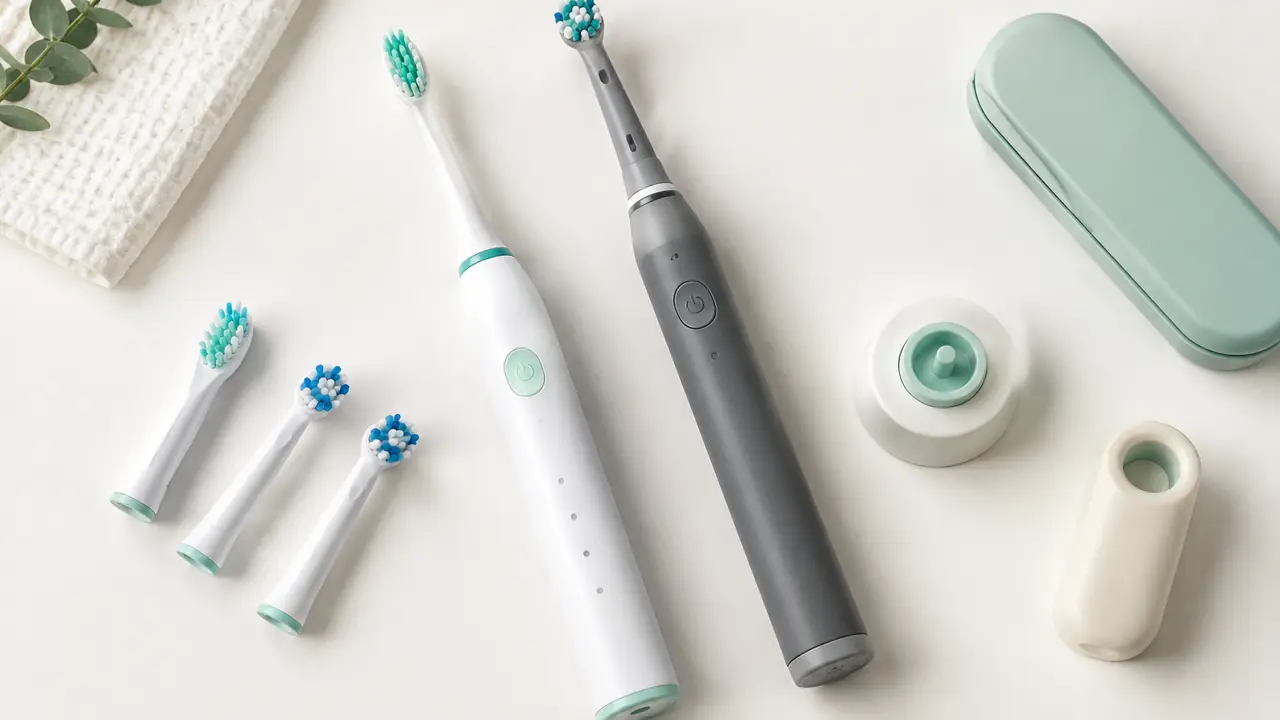
Two answers to one question
A sonic toothbrush is a sealed handle that swings an elongated bristle head at 31,000-40,000 strokes per minute on flagship models, or 20,000-31,000 on entry tiers, with the user steering a small head around the mouth for two timed minutes. A U-shaped toothbrush inverts the idea: the user bites into a silicone tray molded to the arch, the tray vibrates at 8,000-20,000 vibrations per minute, and an automatic cycle of 45-60 seconds per arch replaces the two-minute routine. One format asks the user to brush; the other asks the user to bite. That difference drives everything a buyer cares about - who the customer is, what wears out, what tooling is needed and which shelf the SKU belongs on.
The formats also share more than they look to. Most U-shaped programs run on the same electronics layer as sonic handles - a 3.7 V lithium cell of 800-1,400 mAh, a mode board, IPX7 sealing - so plants treat the tray as a sibling product on shared platforms. What separates a strong U-shaped offer from a weak one is almost entirely in the silicone: the grade, the durometer, the groove geometry and the snap joint to the shaft. That is why the sourcing conversations differ sharply even though the factory visits look alike, and why the desk prices the two formats from different bills of material rather than comparing them as near variants.
Side by side
| Dimension | U-shaped tray | Sonic handle |
|---|---|---|
| Form factor | Mouthguard-style silicone tray on a short handle | Slim handle with an elongated bristle head |
| Motion | Whole tray vibrates, 8,000-20,000 vibrations/min | Head sweeps side to side, 31,000-40,000 strokes/min (entry 20,000-31,000) |
| Session pattern | Automatic 45-60 s per arch, bite and hold | 2-minute timer with 30-second quadrant prompts |
| Core users | Young children; some orthodont wearers | Everyday adults; the default flagship format |
| Wear part | The silicone tray itself, on a slower cycle | Nylon bristle head, replaced regularly |
| Cost drivers | Tray mold and sizes, silicone grade, coupling joint | Motor grade, amplitude delivery, modes, collar fit |
| Certification route | IEC/EN 60335-2-52 or UL 859; food-contact papers for silicone; UN 38.3 and IEC 62133-2 if lithium | IEC/EN 60335-2-52 or UL 859; UN 38.3 and IEC 62133-2 if lithium |
| MOQ reference | About 1,000 pieces per model, tray tooling involved | Catalog 500-1,000; private label 1,000-3,000 plus tooling |
| Strongest fit | Kids aisle, orthodont shelf, accessory SKU | Flagship tier, DTC subscription base, retail own brand |
Where the sonic handle wins
The sonic format wins every brief that starts with an adult everyday user. It carries the premium silhouette, the mode ladder of 2-5 programs, pressure sensing from mid tiers and the widest plant base in the industry, so catalog-mold samples typically arrive in 7-15 working days against minimums of 500-1,000 pieces. Its head economics are proven: nylon heads wear visibly, replenish regularly and anchor subscription revenue. For brand owners, retail chains and DTC lines, the sonic handle is the revenue core, and the honest question is never whether to carry one but which specification - the ranges are on the sonic line page and the selection logic on the electric toothbrush overview.
Where the U-shaped tray wins
The tray wins two specific audiences. Young children cannot yet run a two-minute steering routine; a bite-and-hold cycle of 45-60 seconds fits their patience, and the geometry positions itself. Some orthodont wearers find a tray easier to seat around brackets than threading string or angling a small head, which is why orthodont assortments often carry one - the head and power choices for that market are in the braces note. As a business, the format is an accessory SKU that reaches customers a handle does not: it adds a shelf presence in the children's aisle and the orthodont section without asking the flagship to change. Adults without either need tend to return to a conventional handle once the novelty fades, so the desk advises positioning it as the easy-entry format for two named audiences rather than a replacement for anything. Priced and worded that way, the tray earns steady reorders from the shelves it was built for instead of competing with the core SKU for the same buyer.
What to specify on each
On a U-shaped brief, the silicone is the project. Specify platinum-cured, mouth-contact grade silicone with food-contact documentation for the target market, verified per project; state the durometer band and the inner fin profile; and confirm tray sizes - child and adult usually mean two molds. Add the vibration band (8,000-20,000/min), the automatic 45-60 second cycle, IPX7 sealing, the 3.7 V cell at 800-1,400 mAh with its UN 38.3 and IEC 62133-2 tests, and the snap joint's retention and feel. Expect minimums around 1,000 pieces because the tray mold is program-specific, and sample schedules slower than a catalog sonic. The bristle and tray material trade-offs run deeper in nylon vs silicone bristles.
On a sonic brief, fix the frequency band, ask how the roughly 1.5-3 mm amplitude is measured, specify the mode set, the noise target at or below the 55-60 dB band typical for sonic motors, runtime of 14-30 days at two two-minute sessions a day, and the charging path - USB in 4-6 hours or a wireless dock in 12-16 hours. Both formats share the appliance safety route under IEC/EN 60335-2-52 with IEC 60335-1, or UL 859 for North America, so the certification work overlaps even though the products do not. The age-by-age fit for the kids side is mapped in toothbrushes by kids' age.
Positioning the two in one line
The pairing that works is core and accessory: a sonic handle as the everyday core SKU with a U-shaped tray beside it for the children's and orthodont shelves, sharing plant, certification file structure and often packaging language. Carry both replacement streams from day one - heads for the handle, trays for the kids model - so neither product strands its buyer. Copy discipline matters across the pair: the handle is described by its sweep, timer and sealing; the tray by its cycle time, sizes and silicone grade; and neither listing drifts into promises about results, because both formats are mechanical tools and the wording should stay exactly there. Reference minimums and schedules for both formats are on MOQ and lead time, each confirmed in writing per program, and a combined brief goes through the quote form so the desk can price the pair as one program instead of two quarrelling ones.