
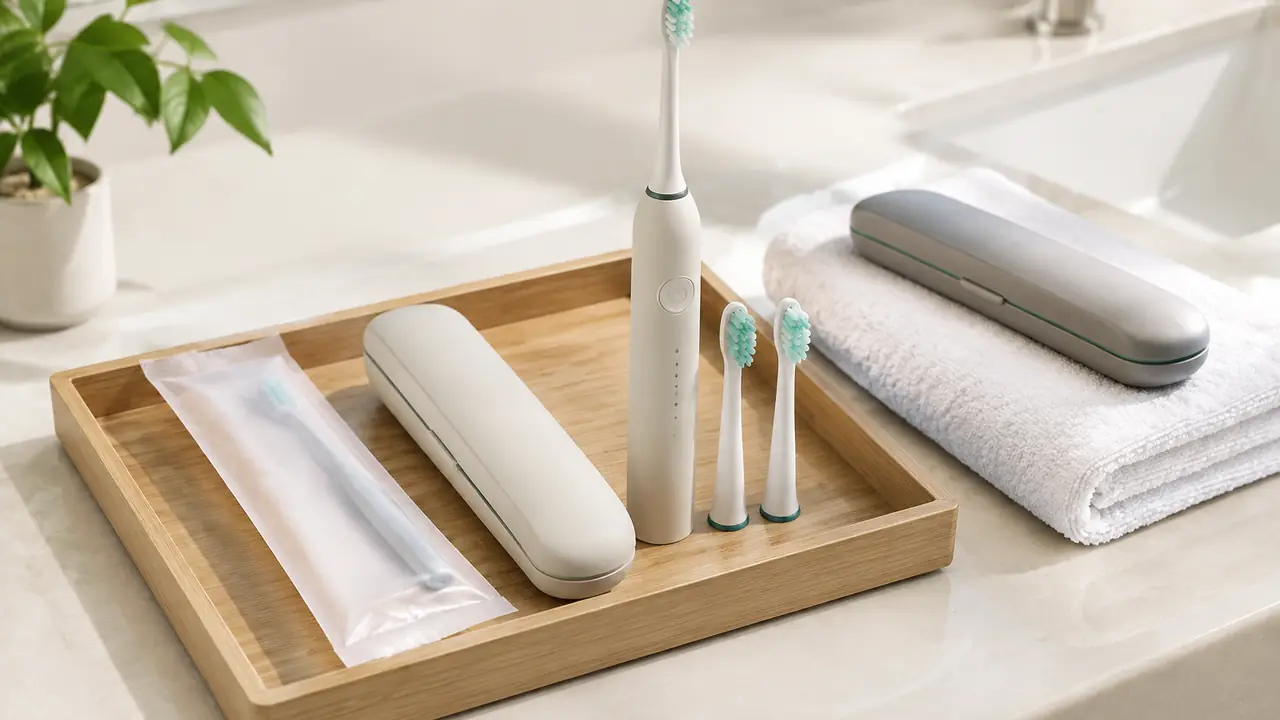
Two product logics in one program
Hospitality runs two different products under one contract. The first is consumable: a compact brush sealed until use, taken or binned with the room turnover, ordered in the thousands against occupancy. The second is durable: a keepable travel brush that a guest packs and takes home, placed in suites or sold at the desk, ordered in hundreds to low thousands and remembered for its feel rather than its price. Many groups run both - sealed kits in standard rooms, keepable sets where the rate justifies them - and the two share suppliers, artwork standards and a re-order calendar even though their economics differ. The desk prices and schedules them as one program so housekeeping stock and suite stock never drift out of step.
Sealed single-use kits
The standard build is a compact battery brush - two AAA cells, 7,000-12,000 strokes per minute, a small soft head - in a sealed sachet or pouch, optionally with a travel cap and a mini toothpaste. The seal does the work a guest cares about: the item is untouched until the guest opens it, which is a packaging fact rather than a claim, and it is stated that way. Kits are packed to case counts that fit the housekeeping trolley, printed with the property artwork, and ordered from about 1,000 pieces per run with re-orders following consumption. Head softness matters more here than stroke count, because the guest using it did not choose it; the soft profile is the default and the specification says so. Because the cells are AAA, the kits move as ordinary goods with no lithium paperwork, which keeps replenishment simple and air freight open when a property runs short.
Keepable travel brushes
The keepable build is a folding or split travel handle in a zip case, either on AAA cells or with a small lithium cell - 500-1,000 mAh, 20-60 days of typical low-frequency use on the datasheet. AAA keeps the program free of lithium formalities; lithium buys runtime and a charge indicator, and brings UN 38.3 papers and IATA packing when it flies. Guests take these home, which is the point: the property artwork travels in a suitcase instead of a bin. Quantities follow the 500-1,000 unit band of the travel line, confirmed in writing per project, and suite sets add a dock or stand in a gift box with the logo debossed. The travel line page lists the case and charging options.
Quantities and the re-order rhythm
Project quantities are estimated from the property list, not from a forecast deck: rooms by category, expected turnover per kit, and the housekeeping par level that decides when a re-order fires. A sealed kit is consumed; a keepable brush is replaced on loss and damage, so its stock turns far slower and is often ordered once or twice a year. The desk schedules both against the same calendar, books sea freight for the main runs - typically 15-25 days to the US West Coast and 30-45 days to Europe - and keeps express open for top-ups. The table shows the usual starting builds; every figure is confirmed in writing per project.
| Format | Build | Typical start | Packaging |
|---|---|---|---|
| Sealed kit, standard room | Compact AAA brush, soft head, sealed pouch | About 1,000 pieces | Property artwork, trolley-friendly case packs |
| Sealed kit, premium | Brush plus travel cap and mini toothpaste | About 1,000 pieces | Two-piece sachet set, printed sleeve |
| Keepable brush | Folding or split travel handle with case | 500-1,000 units | Zip case, printed or embossed logo |
| Suite set | Keepable brush plus dock or stand | Per project | Gift box, debossed logo |
Artwork, branding and restraint
Property artwork is applied by print, deboss or sleeve, and the base design stays deliberately neutral so a group can rebrand the same build across properties without new tooling. Manuals and packaging text stay in the discipline of the category: instructions, battery markings and recycling marks per market, no therapeutic wording, and nothing that reads as a medical claim, because amenity programs sit in the most public room in the building. Where a group wants its own sustainability story, the honest options are material choices - recycled plastics, paper-based packaging - documented so the claim survives contact with a procurement questionnaire. The packaging and retail boxes page covers the material and print options.
Starting a project order
A project brief is short and factual: the property count, rooms by category, the format mix, the artwork standard and the first delivery date. The desk returns the kit builds, quantities per property, the packaging mock-ups and the schedule, with samples in 7-15 working days for catalog builds and 15-25 once printed kits are involved. Group procurement usually starts through the quote form, with the ranges on the MOQ and lead time page as the shared baseline, and the first delivery timed to land before the par stock of the pilot property runs low.